

Quick answer
A commercial electrical case study should show scope, site constraints, coordination, commissioning and handover evidence, and only documented outcomes. Describe who did what, how changes were handled and what documents were delivered. Publish only with a real project, a baseline and written client permission, and avoid claims such as fully compliant without records.
- State where your responsibility began and ended, and say if you worked to someone else’s design.
- Describe commissioning and handover, such as test records, schedules and as-built information, using sanitised samples only with permission.
- Interview the project manager, check answers against project records and send the draft to the client for approval.
Procurement teams read case studies to judge how you work, not to be impressed. A good one shows scope, constraints, coordination and handover. A bad one makes claims it cannot support. This guide covers what to collect and how to write it. Do not publish a case study unless the project, a baseline and written client permission exist. Web Design Davao does not supply case studies or results.
1. Explain scope and site constraints
Start with the client’s need and the site. Describe the type of facility, the work required and the constraints that shaped the job: an operating building, limited shutdown windows, a fixed opening date or work alongside other trades.
Constraints are the heart of the story because they show judgement. Describe them factually, in general terms, without naming the client or location unless approved.
2. Describe coordination and work boundaries
Explain who did what: your scope, the main contractor’s scope, the consultant’s and the client’s. Show how work was coordinated, how information was exchanged and how changes were handled. Buyers reading this are asking, “Will this contractor manage themselves and work with others?”
State where your responsibility began and ended. If you worked to someone else’s design, say so. If a variation occurred, describe it briefly and how it was resolved.
3. Show approved commissioning and handover evidence
Describe what was commissioned and what documents were handed over, such as test records, schedules and as-built information. Use sanitised samples only with permission. Avoid describing technical results in a way that implies guarantees. A neutral, factual summary of what was tested and recorded is stronger and safer.
4. Report only documented outcomes
Report outcomes you can document, such as completion within the agreed programme if the records show it, or documents delivered at handover. Avoid phrases such as “fully compliant”, “no incidents” or “energy savings” unless backed by records and cleared by the client. If there is no outcome figure, describe the handover.
5. Run a short project interview
Ask the project manager and, with permission, the client contact:
- What did the client need, and by when?
- What made the site difficult?
- How did you coordinate with others?
- What was commissioned and handed over?
- How did you handle changes or problems?
- Is the client willing to approve this summary?
Check answers against project records and send the draft to the client for approval.
Commercial project case-study worksheet
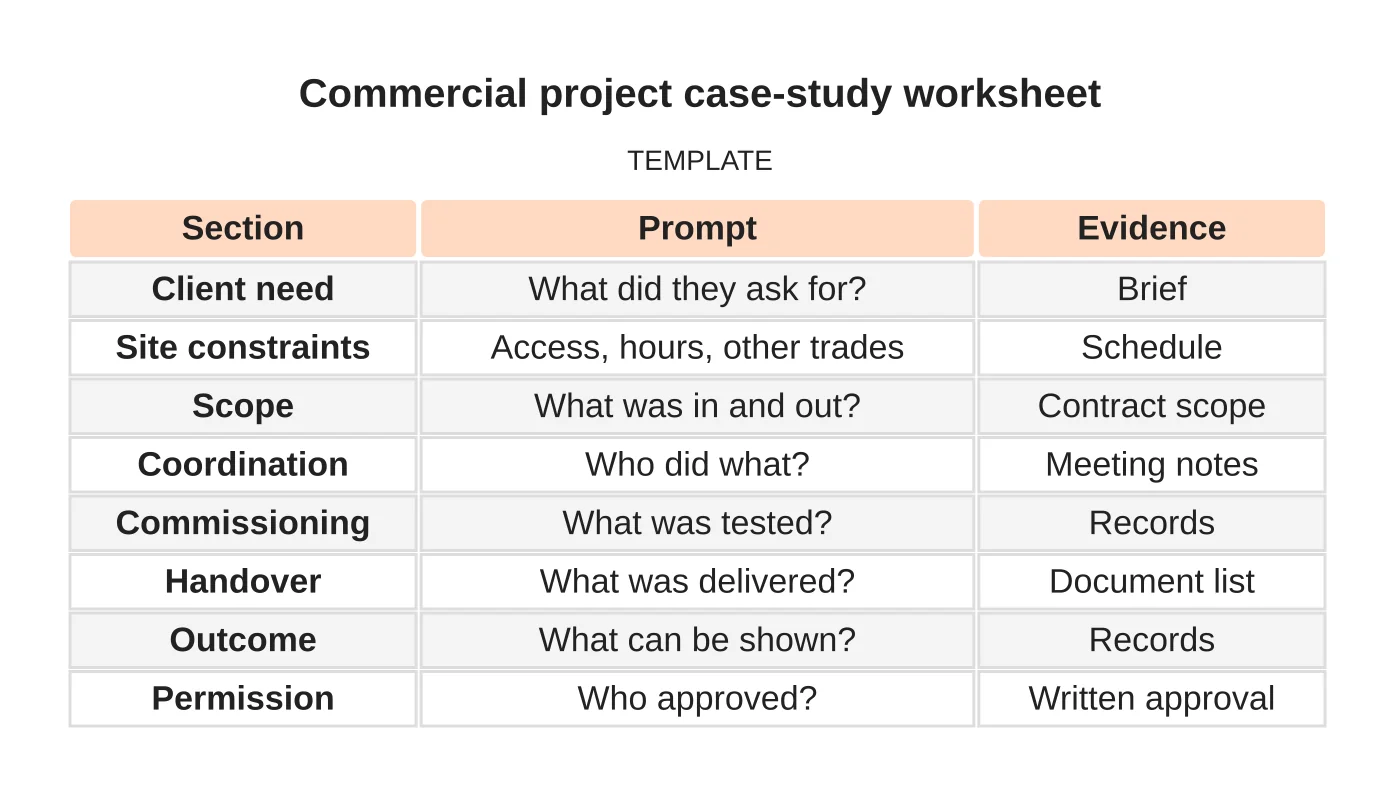
| Section | Prompt | Evidence |
|---|---|---|
| Client need | What did they ask for? | Brief |
| Site constraints | Access, hours, other trades | Schedule |
| Scope | What was in and out? | Contract scope |
| Coordination | Who did what? | Meeting notes |
| Commissioning | What was tested? | Records |
| Handover | What was delivered? | Document list |
| Outcome | What can be shown? | Records |
| Permission | Who approved? | Written approval |
Common mistakes
- Publishing without written permission.
- Showing equipment labels, layouts or site details that raise security concerns.
- Making outcome claims without records.
- Using the same case study text across pages.
- Writing only about the finished result, not the process.
Using the case study
Link it from your main commercial electrical page and from relevant capability pages. Keep the page current, and remove it promptly if the client withdraws permission. See maintaining capability statements for how to keep related documents in step.
Next step
Request a website review or discuss the pages and enquiry workflow your business needs. Read about our web design service or contact us.
Frequently asked questions
What do procurement teams want from a commercial electrical case study?
They want to judge how you work, not to be impressed. Show the scope, the constraints that shaped the job, how you coordinated with others, what was commissioned and what was handed over, in factual terms.
Which outcome claims should I avoid?
Avoid phrases such as fully compliant, no incidents or energy savings unless backed by records and cleared by the client. Report outcomes you can document, such as completion within the agreed programme if records show it.
Can I publish a case study without client permission?
No. Do not publish a case study unless the project, a baseline and written client permission exist. Remove it promptly if the client withdraws permission, and avoid showing equipment labels, layouts or site details that raise security concerns.
Sources and notes
Last updated 21 November 2026. This guide is general information based on Web Design Davao’s web design and digital marketing practice. It cites no statistics and makes no promise about rankings, enquiries or contracts. Web Design Davao is not licensed or certified in this industry, so check technical, safety, legal and regulatory matters with a suitably qualified professional. Examples are templates or illustrations, not client results.


