Quick answer
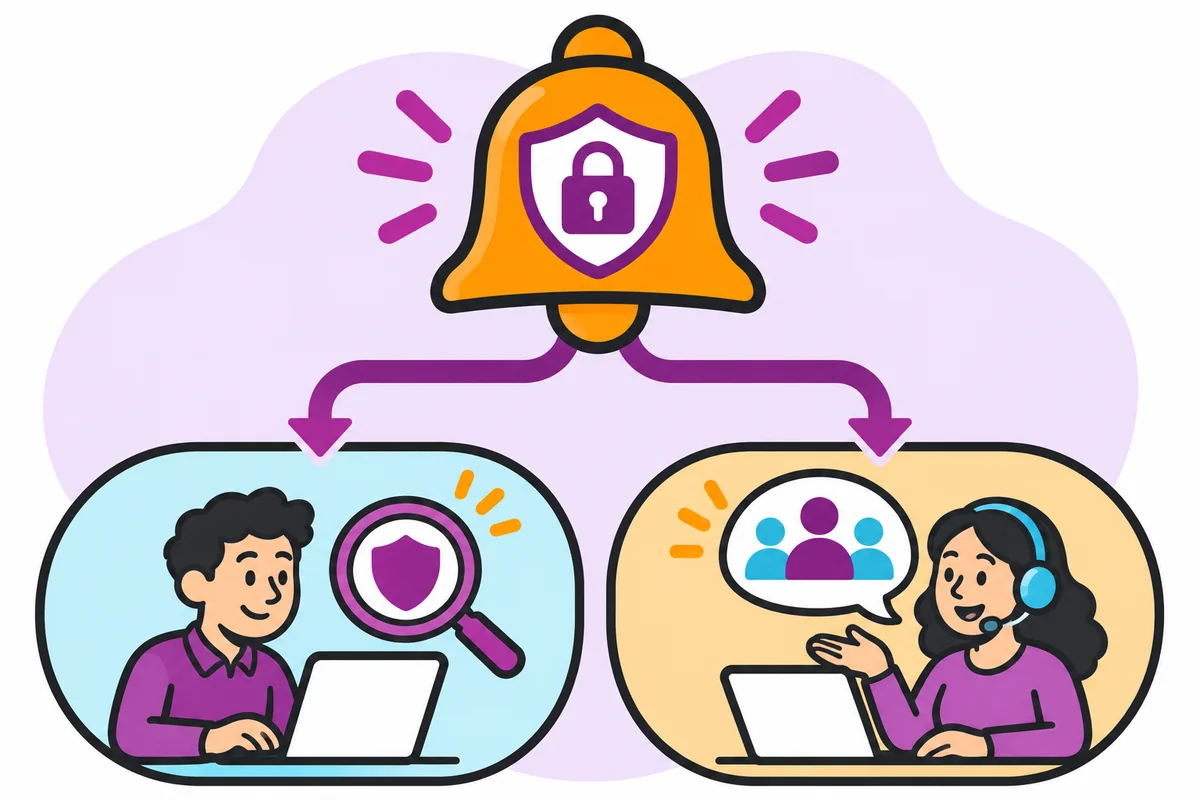
Keep investigation and customer communication separate. Triage the alert and record its source, write down what is verified and what is unknown, and have a named person investigate. Any customer message should draw only on verified facts and be approved first. A holding message can say what is known, what is being checked and when the next update comes.
- Record the alert and its source; your own tool’s alert differs from an email claiming a problem.
- Keep two lists, verified facts and unknowns, and update them as the investigation proceeds.
- Prepare a holding message template in advance, and do not guess at causes in public.
A security alert can arrive before anyone knows whether customers are affected. Keep investigation separate from customer communication: triage the alert, establish verified facts and approve messages. This is general guidance, not incident-response advice. It is written for business owners responsible for website access and ends with the decision, owner and next step to record.
An illustrative scenario
This is a hypothetical example, not a Web Design Davao client case.
Situation. A security alert arrives before anyone has established whether customers are affected.
What happens. At six in the evening an alert says there were many failed logins on the site. The owner does not announce a breach. She records the alert and its source, lists what is verified (the alert exists) and what is unknown (whether any login succeeded), asks the IT provider to investigate and approves a short holding message for customers only if the investigation shows an impact.
Alert triage
Triage the alert first: what it says, where it came from and when. Use the alert field. Record the source, because an alert from your own security tool is different from an email claiming a problem. Do not assume impact before you know it, and do not dismiss it either. Assign an investigator immediately.
Verified impact
Write two lists: what is verified and what is unknown. Use the verified facts and unknowns fields. Keep them updated as the investigation proceeds. A message to customers should draw only on the verified list, and the unknown list tells you what to say you are still checking.
Communication approval
Separate who investigates from who communicates, and approve any message before it goes out. Use the investigation owner, approved message and update time fields. A holding message can say what is known, what is being checked and when the next update will come. Do not guess at causes in public.
Incident communication worksheet
Use this at the point described above. The workflow owner completes it and a named reviewer checks it. A completed row shows that the information, owner and next step are recorded; it does not prove the outcome. Keep it somewhere the team can edit, and keep it free of passwords, tokens and real client records.
Blank copy
| Alert | Verified facts | Unknowns | Investigation owner | Approved message | Update time |
|---|---|---|---|---|---|
Illustrative completed row (hypothetical)
| Alert | Verified facts | Unknowns | Investigation owner | Approved message | Update time |
|---|---|---|---|---|---|
| Login alert | Alert received at a set time | Impact not established | IT provider | Message approved by owner | Next update at a stated time |
Working through the completed row
In the row, a login alert has verified facts (the alert was received at a set time), unknowns (impact not established), the IT provider as investigator, a message approved by the owner and a next update at a stated time.
Common mistakes
- Announcing a breach before verification.
- Letting one person investigate and communicate unchecked.
- Guessing causes publicly.
Questions to settle before you rely on it
- What facts are verified?
- What is still unknown?
- Who approves what customers are told?
How you know it is complete
The worksheet is complete when each alert has facts, unknowns, investigator, approved message and update time. Record who reviewed it and the date.
Where you may not have the answer
Customer data may be involved. Seek professional advice about your obligations before publishing anything. The handoff, not a guess, is the correct next step.
Your next action
Prepare a holding message template in advance.
Ask Web Design Davao to review this workflow and scope the website or marketing support required. Website maintenance & security arrangements are agreed individually; nothing here assumes a particular service, role or timing is already available.
How Web Design Davao works
- Enquiries are generally answered within four hours during support hours (Monday to Friday, business hours), with after-hours help for emergency requests. Scope is agreed individually.
- Preventative website maintenance includes keeping plugins up to date and reviewing website code for known vulnerabilities. This reduces exposure to attack; it does not guarantee a site cannot be compromised. See website updates and uptime monitoring.
Frequently asked questions
Should I tell customers as soon as a security alert arrives?
Not before the facts are verified. Announcing a breach before verification is a common mistake. Record the alert, assign an investigator, and approve a short holding message that draws only on verified facts. This is general guidance, not incident-response advice.
Who should investigate and who should communicate?
Separate the two roles and approve any message before it goes out. The investigation owner, such as an IT provider, establishes the facts. The business owner approves what customers are told, including the wording of the message and when the next update will come.
What if customer data may be involved?
Seek professional advice about your obligations before publishing anything. This is general guidance, not incident-response advice. Keep recording what is verified and what is unknown, and hand the question to the right professional instead of guessing.