
Quick answer
Manage social media approvals across a franchise network by separating central and local content, deciding who owns each account and login, adding a short review step for claims and permissions, and agreeing who answers complaints and when to escalate. Record each decision and approver. Legal wording and permissions should be checked with your adviser.
- Write a short guide with acceptable and unacceptable post examples, and make approved templates and images easy to find.
- Use named logins instead of shared passwords, and remove access promptly when people leave.
- Send serious complaints, legal threats and safety issues straight to a named person at head office.
In a franchise network, social media posts are made by many people in many places, and each one carries the brand. Without clear approvals, local posts can make claims head office would never allow, use images without permission or mishandle a complaint in public. This guide covers boundaries, ownership, review and escalation. It makes no promise about reach or engagement, and platform rules change, so check current guidance.
Web Design Davao does not provide legal advice. Claims, permissions and complaint handling should be reviewed by your adviser.
1. Set brand and local boundaries
Define what is central and what is local. Central content might include brand assets, national offers, service descriptions and legal text. Local content might include team photos, local events and community posts. Write the rules in a short guide with examples of acceptable and unacceptable posts. Make approved templates and image libraries easy to find so franchisees do not have to invent their own.
2. Agree content ownership
Decide who owns each account and who may post. State whether franchisees run their own local pages or contribute to network accounts, who holds the logins and what happens to an account when a franchisee leaves. Record this in your franchise documents with legal advice. Use named logins, not shared passwords, and remove access promptly when people leave.
3. Review claims and permissions
Set a simple review step for anything beyond approved templates. The reviewer checks claims, such as prices, offers and results, against what is approved, and checks permissions for any person, vehicle, property or customer story shown. Keep the turnaround short, such as an agreed response time, so franchisees do not bypass the process. Record the decision and the approver.
4. Escalate complaints and track outcomes
Public complaints need a consistent response. Agree who replies, in what tone and when to move the conversation offline. Serious complaints, legal threats and safety issues go straight to a named person at head office. Track each complaint to its outcome and review patterns monthly, with the network manager, to improve the process rather than only to rank franchisees. See the franchise website and marketing guide and franchise recruitment marketing.
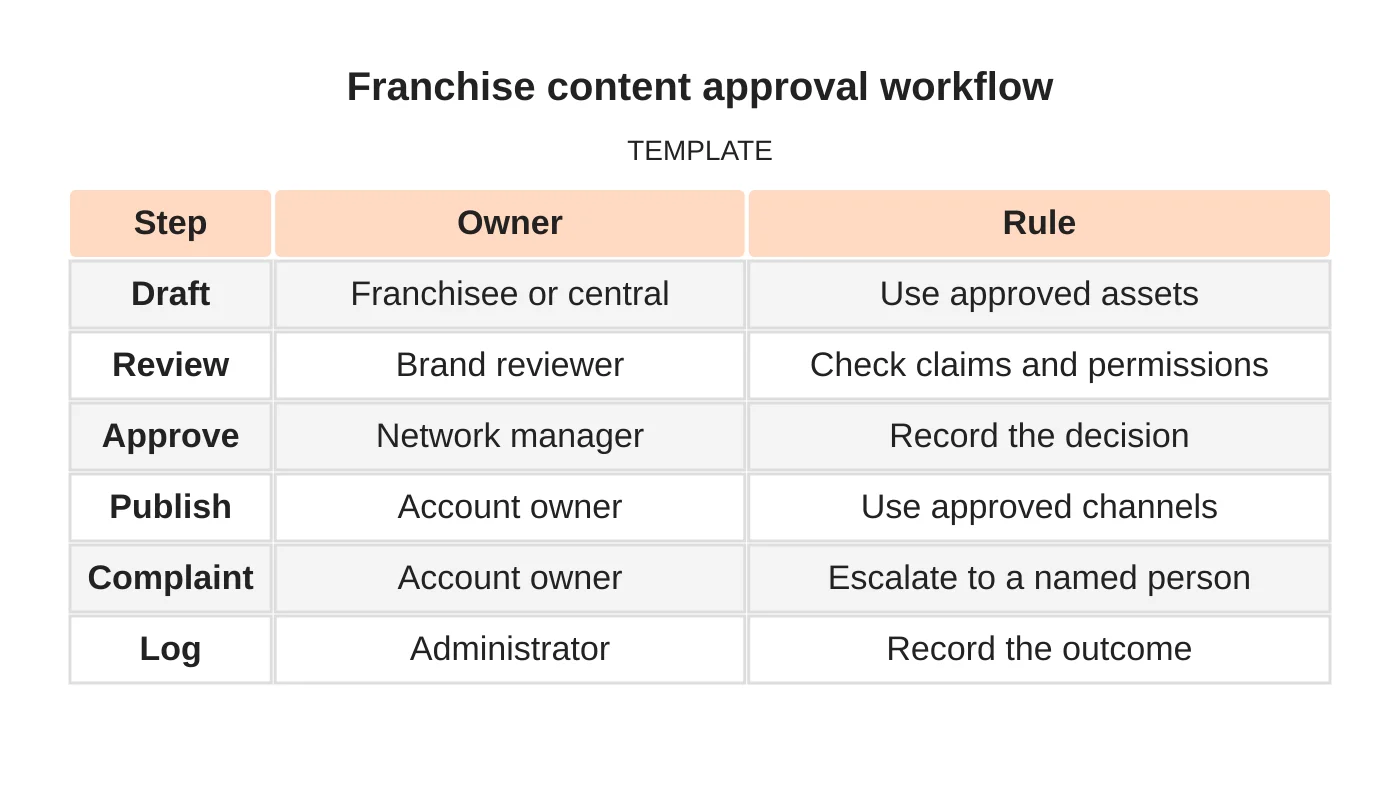
Franchise content approval workflow
| Step | Owner | Rule |
|---|---|---|
| Draft | Franchisee or central | Use approved assets |
| Review | Brand reviewer | Check claims and permissions |
| Approve | Network manager | Record the decision |
| Publish | Account owner | Use approved channels |
| Complaint | Account owner | Escalate to a named person |
| Log | Administrator | Record the outcome |
Related reading: Franchise Opportunity Pages: What Prospective Operators Need Before Enquiring.
Common mistakes
- No written boundary between central and local content.
- Shared logins.
- Slow approvals that franchisees bypass.
- Posting customers or vehicles without permission.
- No named person for serious complaints.
Questions franchisors ask
Should franchisees post freely? Within approved templates, yes. Anything outside them goes through review.
Who should answer public complaints? The account owner for routine ones, with escalation for serious ones.
Next step
Ask Web Design Davao to help plan content, approvals and enquiry handling for your social channels. Read about our social media service or contact us.
Frequently asked questions
Should franchisees post freely on social media?
Within approved templates, yes. Anything outside them goes through review, where a reviewer checks claims such as prices, offers and results against what is approved, and checks permissions for any person, vehicle, property or customer story shown.
Who should answer public complaints?
The account owner for routine ones, using an agreed tone and knowing when to move the conversation offline. Serious complaints, legal threats and safety issues go straight to a named person at head office. Track each complaint to its outcome and review patterns monthly.
Who owns a franchise social account when a franchisee leaves?
Decide this in advance: state who holds the logins and what happens to an account when a franchisee leaves, and record it in your franchise documents with legal advice. Use named logins rather than shared passwords and remove access promptly when people leave.
Sources and notes
Last updated 21 November 2026. This guide is general information based on Web Design Davao’s web design and digital marketing practice. It cites no statistics and makes no promise about rankings, enquiries or contracts. Web Design Davao is not licensed or certified in this industry, so check technical, safety, legal and regulatory matters with a suitably qualified professional. Examples are templates or illustrations, not client results.