

Quick answer
A manufacturing RFQ form should collect the minimum an estimator needs: company and contact, part description, quantity, material and finish if known, required date and delivery region. Offer a secure upload for drawings, explain what happens next, and route technical questions to an engineer instead of one inbox.
- Mark optional fields clearly so buyers without a drawing can still ask a question.
- Do not promise quote or delivery times you cannot meet; say lead time is confirmed at quote.
- Test the form with a drawing from a phone and a computer, and retest after any website change.
A request-for-quote (RFQ) form needs enough information to price a job, but too many fields lose buyers. A good RFQ form collects the minimum an estimator needs, handles drawings securely and sets expectations about review and lead time. This guide sets out the minimum inputs, the handling of uploads and the routing of technical questions.
1. Identify minimum quote inputs
Ask for what an estimator needs to start.
- Company and contact: name, company, role, phone and email.
- Part or product: a description and, if available, a drawing.
- Quantity: the first order and any expected repeats.
- Material and finish: if known, with an “unsure” option.
- Required date: when they need delivery or samples.
- Delivery location: the country or region, to flag shipping needs.
Mark optional fields clearly. Buyers who do not have a drawing yet should still be able to ask a question.
2. Handle drawings and uploads securely
Drawings and specifications may be confidential. Explain how you handle them: who can see them, where they are stored and how long you keep them. Use a secure upload, not ordinary email. Offer a confidentiality route for sensitive projects, such as a non-disclosure agreement discussion with a named person, if that is how your business works.
3. Explain review and lead-time expectations
Tell buyers what happens next: an estimator reviews the request, may ask questions and replies within a stated time. Do not promise quote or delivery times you cannot meet. If lead time depends on material availability and workload, say that it is confirmed at quote.
4. Route technical questions appropriately
Send forms to an estimator with authority to quote. Route technical questions to an engineer. A form can collect information, but design feasibility and tolerances are engineering decisions. Send an automatic acknowledgement and give the buyer a way to reach a person.
5. Test the form
Submit a test RFQ with a drawing from a phone and a computer. Check validation, uploads, routing, acknowledgement and storage. Retest after any website change. See the manufacturing website guide for the wider structure and keeping technical documents current for maintenance.
RFQ form and routing specification
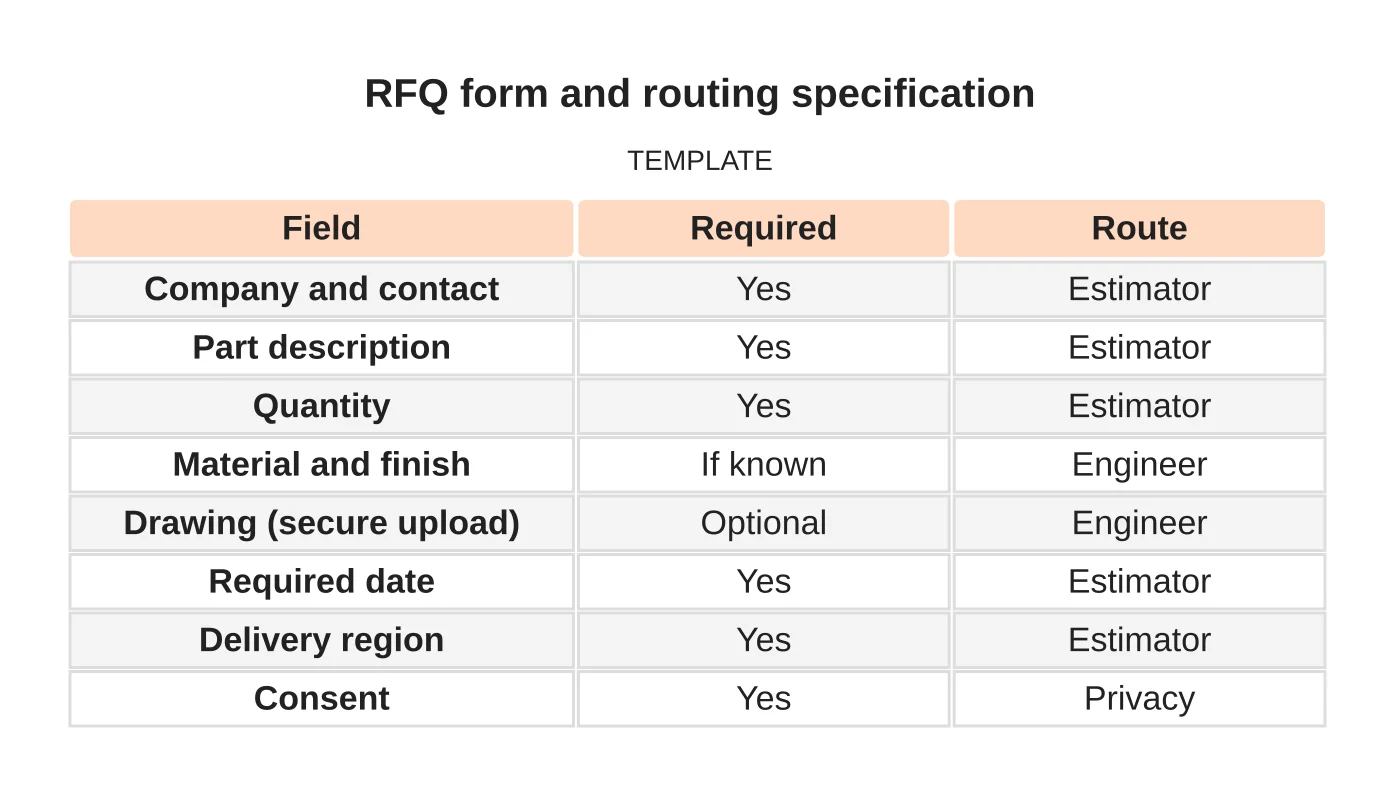
| Field | Required | Route |
|---|---|---|
| Company and contact | Yes | Estimator |
| Part description | Yes | Estimator |
| Quantity | Yes | Estimator |
| Material and finish | If known | Engineer |
| Drawing (secure upload) | Optional | Engineer |
| Required date | Yes | Estimator |
| Delivery region | Yes | Estimator |
| Consent | Yes | Privacy |
Common mistakes
- Asking for too much detail up front.
- Accepting drawings by ordinary email.
- Promising quote times you cannot meet.
- Routing everything to one inbox.
- Not testing uploads.
Questions manufacturers ask
Should the form show prices? Custom manufacturing is quoted, so explain how you quote.
Should I ask for budget? Only if it helps and you explain why. Some buyers find it off-putting.
Next step
Request a website review or discuss the pages and enquiry workflow your business needs. Read about our web design service or contact us.
Frequently asked questions
How should drawings be handled?
Use a secure upload, not ordinary email, and explain who can see drawings, where they are stored and how long you keep them. Offer a confidentiality route for sensitive projects, such as a non-disclosure agreement discussion with a named person.
Should an RFQ form show prices or ask for budget?
Custom manufacturing is quoted, so explain how you quote instead of showing prices. Ask for budget only if it helps and you explain why, since some buyers find the question off-putting.
Who should receive RFQ submissions?
Send forms to an estimator with authority to quote, and route technical questions to an engineer, because design feasibility and tolerances are engineering decisions. Send an automatic acknowledgement and give the buyer a way to reach a person.
Sources and notes
Last updated 21 November 2026. This guide is general information based on Web Design Davao’s web design and digital marketing practice. It cites no statistics and makes no promise about rankings, enquiries or contracts. Web Design Davao is not licensed or certified in this industry, so check technical, safety, legal and regulatory matters with a suitably qualified professional. Examples are templates or illustrations, not client results.