

Quick answer
Quality in offshore accounting support becomes visible when the firm writes a short standard per task, reconciles work to source documents, samples by risk, fixes the causes of errors and keeps preparer and reviewer separate. Missing documents should produce a flagged exception, not a guess. A scorecard tracks trends, not blame.
- Write a short standard per task describing what is correct, what is acceptable and what needs a flag.
- Sample more at the start of an arrangement and reduce it as quality is shown, mixing random and high-risk items.
- For repeated errors, ask why, then change the instruction, checklist or training, and measure how often items return for correction.
Accounting support gets trusted when its quality can be seen. A partner needs more than “it seems fine”. The firm needs a way to check accuracy, see where exceptions arise and reduce rework, without reviewing every line forever.
This guide defines quality per task, shows how to check against source documents, how to sample and how to fix the cause of errors. The scorecard is fictional and shows no real results. It does not describe tax advice or licensed sign-off. See a month-end workflow for where checks sit in the month.
Define quality for each task
“Accurate” means different things for coding, reconciliation and filing. Write a short standard per task: what is correct, what is acceptable and what needs a flag. For example, a coded transaction follows the firm’s coding guide, references the source document and carries a note for unusual items. Standards should be clear enough that two reviewers would agree.
Reconcile to source documents
Check the work against the documents it came from: statements, invoices, payroll reports. Reconciliations should tie to the statement. Sample transactions and trace them to documents. Where a document is missing, the correct outcome is a flagged exception, not a guess. Keep the evidence trail so a reviewer or auditor can follow it.
Read next: Why Australian SMEs Are Hiring Offshore Bookkeeping Assistants Instead of Expanding Payroll.
Sample and review
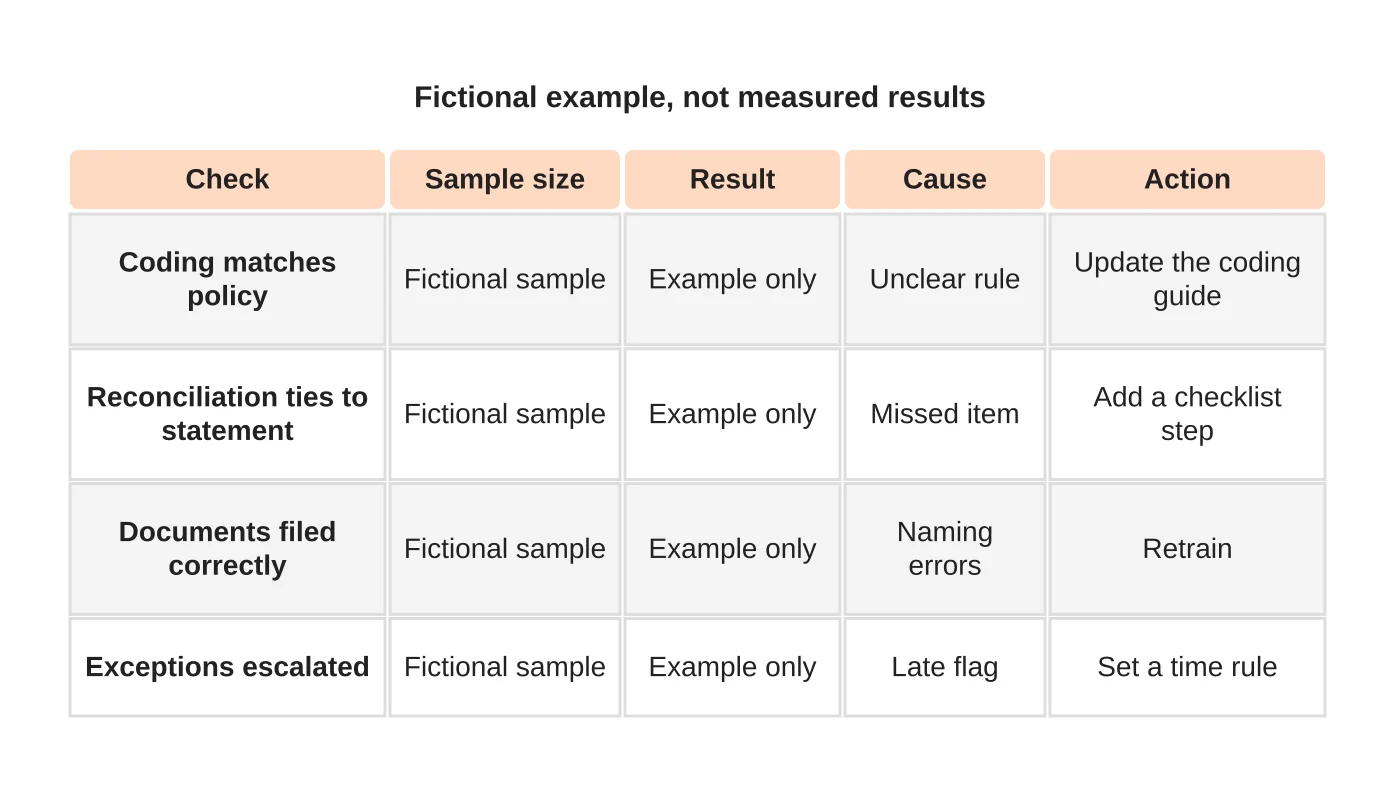
Decide a sampling rate by risk. Early in a new arrangement, review more. As consistent quality is shown, reduce the sample, but do not stop. Use a mix of random items and high-risk ones, such as large amounts and unusual accounts. Record the result, the cause and the action. Use the scorecard to track trends, not to blame individuals.
Fix causes and update instructions
Most errors have a cause: an unclear rule, a missing document, a tool quirk or a lack of training. For each repeated error, ask why, and change the instruction, checklist or training. Rework is costly. Measure it: how often items return for correction and why. Share findings with the assistant in a constructive way.
Keep reviewer and preparer roles separate
Quality checks work best when the reviewer is independent of the preparer and has authority to decide. Make sure the review step is not squeezed when the team is busy. See seasonal support planning for protecting review capacity.
Link quality to the provider relationship
Share the scorecard in regular reviews with any provider. Agree what happens when quality falls. Ask for the same kind of evidence from them. See an offshore staffing provider due-diligence checklist for what to request before engaging.
Frequently asked questions
How do I check the accuracy of outsourced accounting work?
Check it against the source documents it came from, such as statements, invoices and payroll reports. Reconciliations should tie to the statement, and sampled transactions should trace to documents, with the evidence trail kept for a reviewer.
How much work should be reviewed?
Decide a sampling rate by risk. Review more early in a new arrangement and reduce the sample as consistent quality is shown, but do not stop. Mix random items with high-risk ones, such as large amounts and unusual accounts.
What should happen when a document is missing?
The correct outcome is a flagged exception, not a guess. Log it, keep the evidence trail so a reviewer can follow it, and use repeated exceptions to improve the instructions or checklist for the next round.
Sources
Talk through the role
Share the support tasks, systems, working hours and reviewer responsibilities your firm needs covered. Learn about our outsourced staffing service or get in touch.


