

Quick answer
Electrical contractors reach commercial and industrial buyers by writing pages for real capabilities in the words those buyers use, linking them to approved project evidence, keeping business details consistent and measuring enquiry quality. Industrial, commercial and facilities buyers phrase needs differently, so each needs its own page.
- Interview sales or estimating staff about how enquiries are first phrased, and check wording with two or three recent clients.
- Build a page for each capability you deliver and can evidence, covering scope, what you need and a next step.
- Record each enquiry’s buyer type, project type and size, source and whether it led to a meeting, tender or job.
Commercial buyers search differently from homeowners. They look for capabilities, sectors, project types and contractors who can handle a job of a certain size. Search content should reflect that. This guide covers how an electrical contractor can plan pages around real capabilities, connect them to evidence and measure whether the enquiries are the right ones. It makes no promise about rankings or leads, and search platforms change their guidance over time, so check current official guidance before making technical changes.
1. Distinguish industrial and commercial intent
The words buyers use differ by market.
- Industrial buyers think in terms of plant, production lines, motor control, load, maintenance and downtime.
- Commercial buyers think in terms of fit-outs, lighting, building services, tenancy works and compliance with building requirements.
- Facilities teams think in terms of ongoing maintenance and response.
Do not write one page for all of them. Interview your sales or estimating staff about how enquiries are first phrased, and use those words. Check wording with two or three recent clients.
2. Plan actual capability pages
Create a page for each capability you deliver and can evidence. Each should cover:
- what the service is and the buyers it suits,
- scope and typical project types,
- what you need from the buyer to scope the work,
- relevant credentials, stated accurately,
- an approved project example, if you have one,
- a clear next step.
Do not create pages for services you do not offer or can rarely deliver. A site with fewer, stronger pages usually serves buyers better than one with many weak ones.
Related reading: Maintaining Electrical Capability Statements, Credentials and Project Pages Online.
3. Connect sectors and relevant projects
If you have real experience in a sector, such as warehouses, offices, food production or education, you can create a sector page that explains what is distinctive about that environment and links to approved projects. Be careful to describe your own experience and not to imply expertise you do not have.
Do not copy a case study’s text on every page. Summarise and link to it, so the evidence lives in one place and stays accurate. See commercial electrical project case studies for how to build that evidence.
4. Support pages with accurate details
Commercial buyers also check basic business details. Keep company name, address, service area, phone and credentials consistent across your website, Google listing and any directories. If you work in a particular region, state it. If you serve several locations, avoid duplicate location pages and give each only genuine information.
Related reading: Local SEO for Electricians: Useful Service-Area Pages Without Repetition.
5. Measure project-quality enquiries
The aim is not more enquiries but better ones. Record for each enquiry:
- whether it came from a commercial or industrial buyer,
- the project type and rough size,
- the source, as far as you can tell,
- whether it led to a meeting, tender or job.
Review monthly. If many enquiries are for work you do not do, adjust the wording on the relevant pages. If enquiries are few but good, do not chase volume. Validate priorities using your own enquiry records and Search Console data, not assumptions.
Sector-capability content map
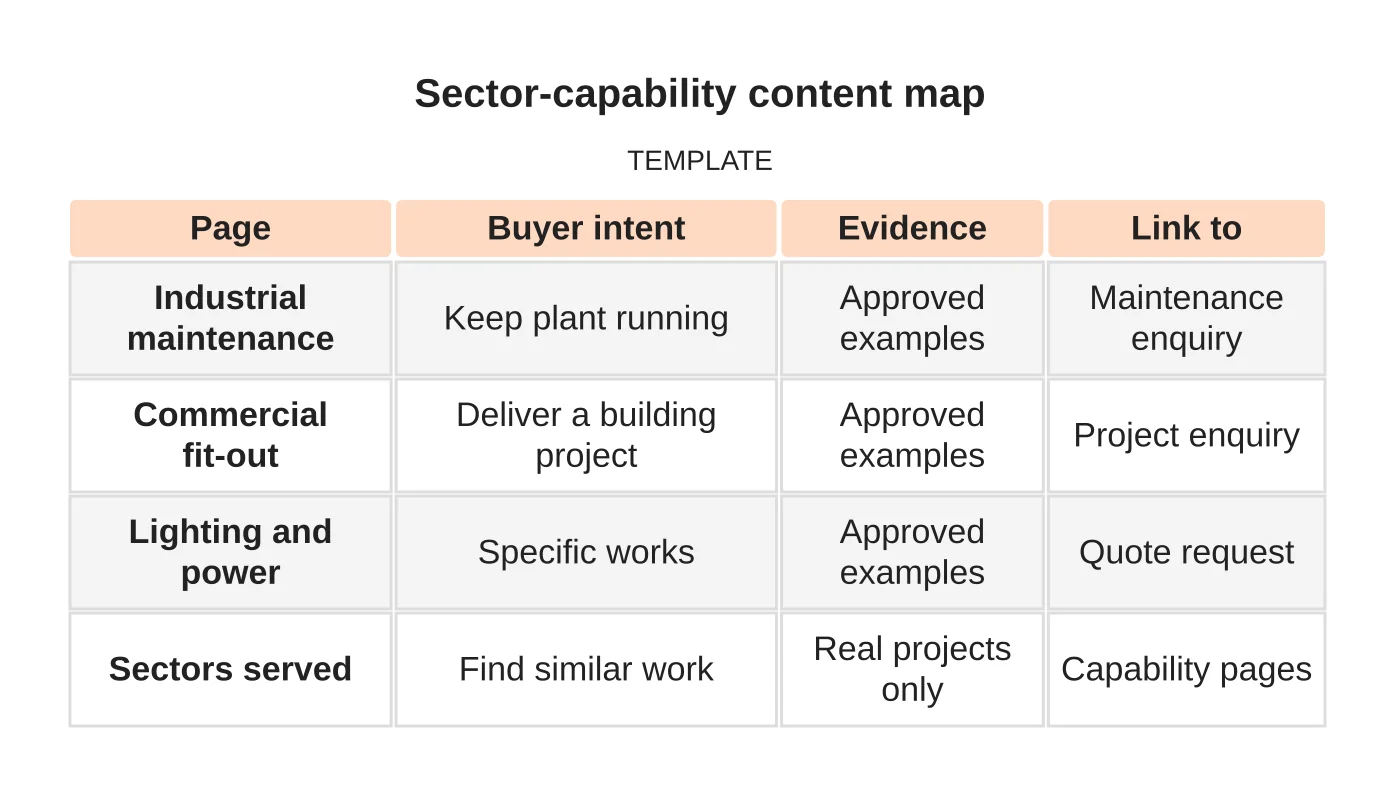
| Page | Buyer intent | Evidence | Link to |
|---|---|---|---|
| Industrial maintenance | Keep plant running | Approved examples | Maintenance enquiry |
| Commercial fit-out | Deliver a building project | Approved examples | Project enquiry |
| Lighting and power | Specific works | Approved examples | Quote request |
| Sectors served | Find similar work | Real projects only | Capability pages |
Common mistakes
- Pages for services you do not offer.
- Copying the same text across sectors.
- Using internal jargon buyers do not search.
- Measuring total enquiries without checking quality.
- Leaving outdated credentials online.
Questions contractors ask
Do I need a blog? Not necessarily. A few useful guides that answer real buyer questions can help, but they should be accurate, reviewed and linked to your capability pages.
How do I know which terms to target? Ask buyers, check your enquiry records and review Search Console data when available. Do not rely on assumed search volumes.
Are directories worth it? Use only relevant, accurate listings, and avoid paid links designed to manipulate rankings.
See the commercial electrical website guide for the overall structure.
Next step
Discuss your target customers, service area and lead-generation priorities with Web Design Davao. Read about our digital marketing service or contact us.
Frequently asked questions
Do I need a blog for commercial electrical SEO?
Not necessarily. A few useful guides that answer real buyer questions can help, but they should be accurate, reviewed and linked to your capability pages, rather than written to fill space or chase volume.
How do I know which terms to target?
Ask buyers, check your enquiry records and review Search Console data when available. Do not rely on assumed search volumes, and use the words your sales and estimating staff hear when enquiries are first phrased.
Are directories worth it for an electrical contractor?
Use only relevant, accurate listings, and avoid paid links designed to manipulate rankings. Keep company name, address, service area, phone and credentials consistent across your website, Google listing and any directories you use.
Sources and notes
Last updated 21 November 2026. This guide is general information based on Web Design Davao’s web design and digital marketing practice. It cites no statistics and makes no promise about rankings, enquiries or contracts. Web Design Davao is not licensed or certified in this industry, so check technical, safety, legal and regulatory matters with a suitably qualified professional. Examples are templates or illustrations, not client results.


