
Quick answer
AEO and GEO are about getting your business named in answers, not only ranking for clicks. AEO shapes content so it can be lifted as a direct answer, and GEO makes your business easy for AI assistants to understand and cite. Both sit on top of sound SEO, with clear pages, consistent details, reviews and credible mentions.
- Open each page and section with a direct one or two sentence answer, then add detail.
- Keep name, address, phone, hours and services identical across your website, Google Business Profile and directory listings.
- Check ten customer questions monthly in Google and AI assistants, recording whether you are named and who is instead.
Search is changing under your feet. More of your potential customers now read an answer on the results page, or from an AI assistant, and never click through to a website. If your traffic has dipped while your business has not, that shift is a likely reason.
This guide explains answer engine optimisation (AEO) and generative engine optimisation (GEO) in plain English, then gives a practical playbook for service businesses in Davao and across the Philippines.
What changed: searches that end without a click
For years, the job of SEO was to rank high enough to earn the click. Now Google’s own AI features, such as AI Overviews and AI Mode, summarise a topic and surface a few links for people who want more. Google describes the aim as helping people get to the gist of a complicated topic quickly, with links as a jumping-off point.
That changes what visibility means. You can rank well and still lose the visit if the answer is given on the results page. You can also win a place inside the answer, where your business is named, even if the person never opens your site.
The useful news is that Google says there are no additional requirements or special optimisations needed to appear in AI Overviews or AI Mode, beyond sound SEO fundamentals. Google’s newer guidance adds that creating content people find unique, compelling and useful will likely matter more than any other tactic. So the work is less about tricks and more about being the clearest, most trustworthy source on your topic and your location.
SEO, AEO and GEO in plain English
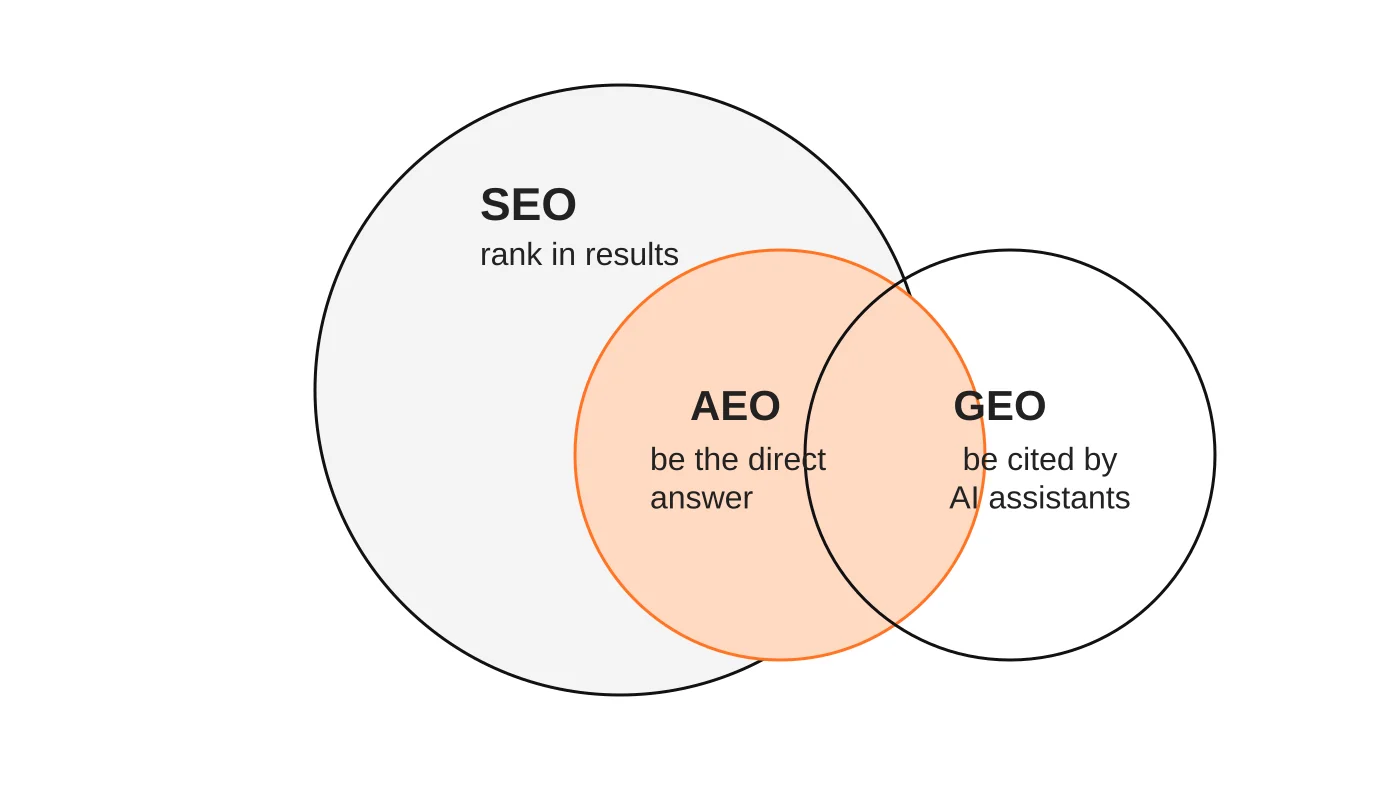
- SEO (search engine optimisation) is the long-running practice of helping your pages rank in search results.
- AEO (answer engine optimisation) is shaping your content so it can be lifted as a direct answer: a featured snippet, a voice answer, an AI summary.
- GEO (generative engine optimisation) is making your business easy for AI assistants to understand, trust and cite when they compose an answer.
These are not rival disciplines. AEO and GEO sit on top of good SEO, and the same foundations serve all three.
Why a Davao business can be invisible even with a good website
A well-designed site can still be skipped by answer systems for ordinary reasons:
- The page never states the answer plainly. It talks around the topic in marketing language.
- Your services and service areas are buried in one long page, so nothing matches a specific question like “web designer in Davao City”.
- Your business name, address, phone number or hours differ across your website, Google Business Profile and directories.
- You have few recent reviews, and no independent mentions that confirm what you do.
- The content is generic. If ten Davao firms publish the same advice, an AI system has no reason to prefer yours.
Many owners respond by changing keywords or publishing more posts. That treats the wrong problem. If people are getting what they need without clicking, the fix is to be present in the answer, not just to chase more visits.
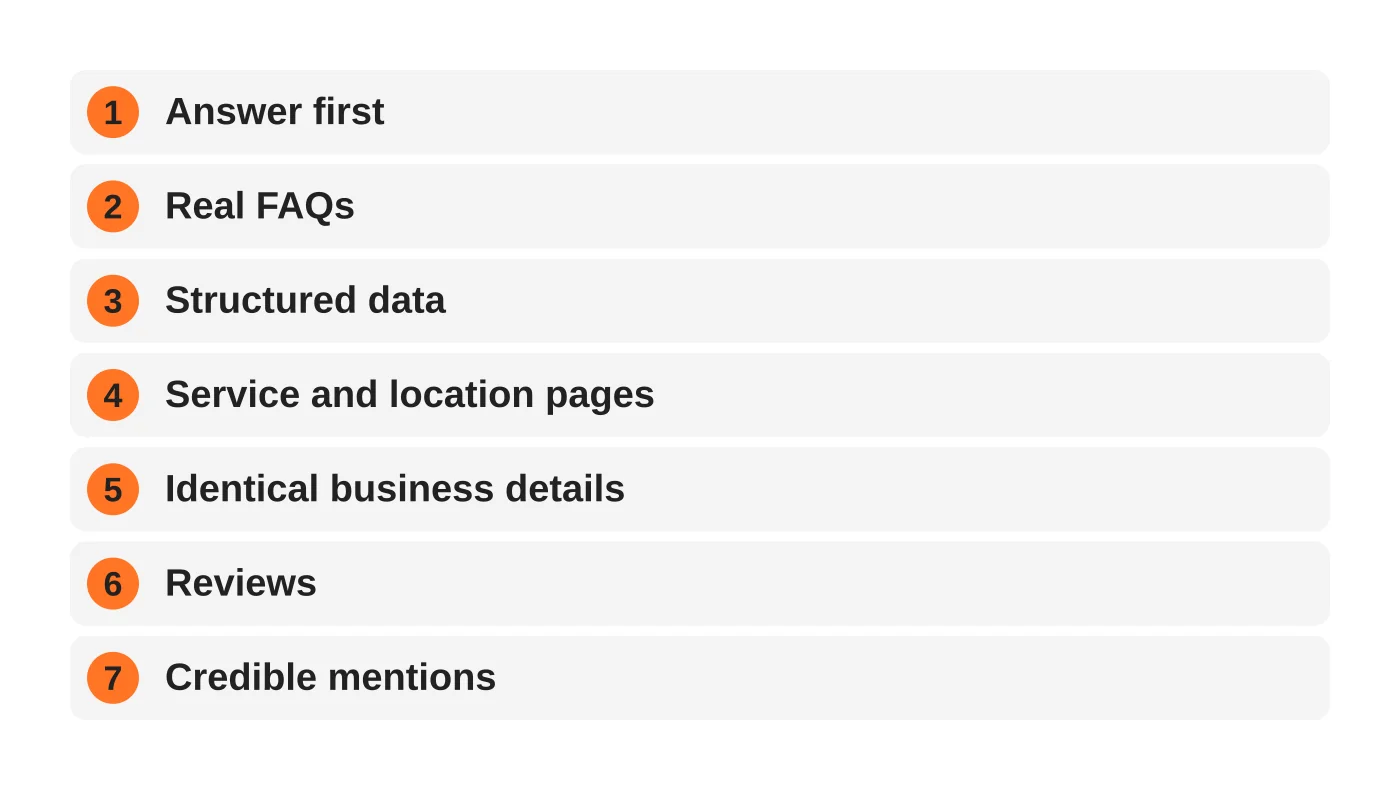
Seven changes that make your site easier to answer from
- Put the answer first. Open each page and section with a direct, one or two sentence answer, then add detail. If someone asked your question out loud, your first sentence should be the reply.
- Write real FAQ content. Answer the questions customers actually ask, in their words, on the relevant page. Note that Google has stopped showing FAQ rich results, so FAQ markup no longer earns a visible result in Search. Write FAQs because they help readers and answer engines, not for a snippet.
- Add structured data where it applies. Use LocalBusiness structured data so your name, address, hours and services are machine-readable. Validate it and keep it accurate.
- Give each service and location its own page. A page for each service, and where you genuinely serve different areas, a page for each area, lets systems match specific questions to specific answers.
- Keep business details identical everywhere. Use the same name, address, phone number, hours and service list on your site, your Google Business Profile and your directory listings. See our Google Business Profile checklist for Davao.
- Earn and answer reviews. Reviews are evidence that real customers use you. Why Google reviews matter for local SEO covers how to collect them well.
- Be mentioned by credible third parties. Local chambers, industry associations, client case studies and press mentions help confirm that you are who you say you are.
How to check where you appear today
You do not need special software for a first look. Spend 30 minutes on this:
- Write ten questions a customer might ask, such as “Who builds websites for clinics in Davao?” or “How much does a website cost in the Philippines?”
- Ask each one in Google (and open the AI Overview if one appears) and in the AI assistants your customers are likely to use.
- Record the date, the question, whether your business is named, who is named instead, and which pages are cited.
- Repeat monthly, using the same questions, so you can see movement.
Treat the results as a rough guide. AI answers vary from one run to the next, so look for patterns across many questions rather than reading too much into a single result.
What not to do
- Do not stuff pages with keywords or publish piles of thin AI-written pages. Google’s guidance says content produced with generative AI still has to meet its Search Essentials and spam policies. Volume without usefulness is a liability.
- Do not hide text or manipulate schema. Structured data must describe what is actually on the page.
- Do not chase every new acronym. The fundamentals, which are clear content, accurate details and genuine reputation, carry across every search surface.
- Do not block crawlers by accident. Google lists allowing crawling in robots.txt, and by any CDN or hosting layer, among its technical requirements for appearing in AI features.
A 30-day action plan
| Week | Focus | Actions |
|---|---|---|
| 1 | Baseline | Run your ten-question check. Audit business details across site, Google Business Profile and directories. |
| 2 | Content | Rewrite your top three service pages so each opens with a direct answer. Add a short FAQ to each. |
| 3 | Signals | Add LocalBusiness structured data. Start asking recent customers for reviews. Build a service-area page if you serve distinct areas. |
| 4 | Authority | Pitch one local mention (a chamber, partner or client story). Re-run your ten questions and compare. |
Related reading: A 90-Day GEO and AI Overviews Action Plan for a Small Business.
Frequently asked questions
Is SEO dead because of AI answers?
No. AI features draw on the same search index and still link to sources. What has changed is that earning the click is no longer the only goal. Being named in the answer also counts.
Do I need a separate strategy for ChatGPT, Google and other assistants?
Start with one set of fundamentals: clear pages, consistent details, reviews and credible mentions. Those help every system. Then spot-check how each assistant describes your business.
Can I guarantee my business will appear in AI answers?
No one can. Answers vary by question, location and time. What you can do is make your business easy to find, understand and trust, then measure.
How long does it take?
Fixing on-page basics and business details can show effect within weeks. Building reviews and third-party mentions is a longer, steadier effort.
From the Wired for Growth newsletter
This article expands on Your Website Isn’t Broken — It’s Being Ignored, an issue of Duarne Bernhagen’s LinkedIn newsletter, Wired for Growth, which argues that falling traffic often means customers no longer need to click, not that your site is broken. A related issue, First Page or Fade Out: Why SEO Just Got More Ruthless, looks at why the competition for first-page visibility keeps getting tougher.
Want a free AI visibility check?
Web Design Davao’s SEO and AI-search visibility service helps Davao businesses audit how they appear in search and AI answers, then fix the gaps. Ask for a free AI visibility check and we will show you where you stand.
Sources
- AI features and your website, Google Search Central
- Optimizing your website for generative AI features on Google Search, Google Search Central
- Local business structured data, Google Search Central
- Google drops FAQ rich results from Search, Search Engine Journal