

Quick answer
To plan 90 days of content, set one measurable goal, list the questions customers ask most, group topics into three monthly themes, choose a few sustainable formats and channels, and build a calendar with a buffer week. Use AI for research and drafts, but keep the angle, facts and approval with people.
- Choose one measurable outcome for the 90 days, such as 15 qualified enquiries from content.
- Give the AI your real context: audience, offer, tone examples and phrases to avoid, then read drafts aloud.
- Review monthly on reach, engagement, action and enquiry quality, then plan the next 90 days from real results.
Most business content plans fail for a plain reason: they are made one post at a time. Each week starts with “what should we post?” and ends with whatever was easiest. A 90-day plan, made in one sitting, replaces that weekly scramble with a calendar you can follow, measure and adjust.
AI tools can speed up the planning, but they can also make everything sound like everyone else. This guide shows a simple structure and how to use AI for the heavy lifting while keeping your own voice.
Why consistency fails
- No themes: random topics do not build a reputation for anything.
- Too many channels: spreading thin means none gets enough attention.
- No capacity check: plans assume more time than anyone has.
- No link to the business: content that is not tied to what you sell does not produce enquiries.
- Safe content: posts designed not to offend anyone also fail to attract anyone. The newsletter issue Why Safe Content Attracts the Wrong Buyers makes the point that safe content attracts the wrong buyers.
A 90-day structure
Step 1: Set one goal for the 90 days
Choose one measurable outcome, such as 15 qualified enquiries from content, a bigger email list or more bookings. One goal keeps choices simple.
Step 2: Define your audience and their questions
List the ten questions customers ask most often, the objections that stop them buying and the mistakes you see them make. These become your topics. If you are not sure what to say, our guide on website messaging and positioning helps clarify your angle.
Step 3: Choose three monthly themes
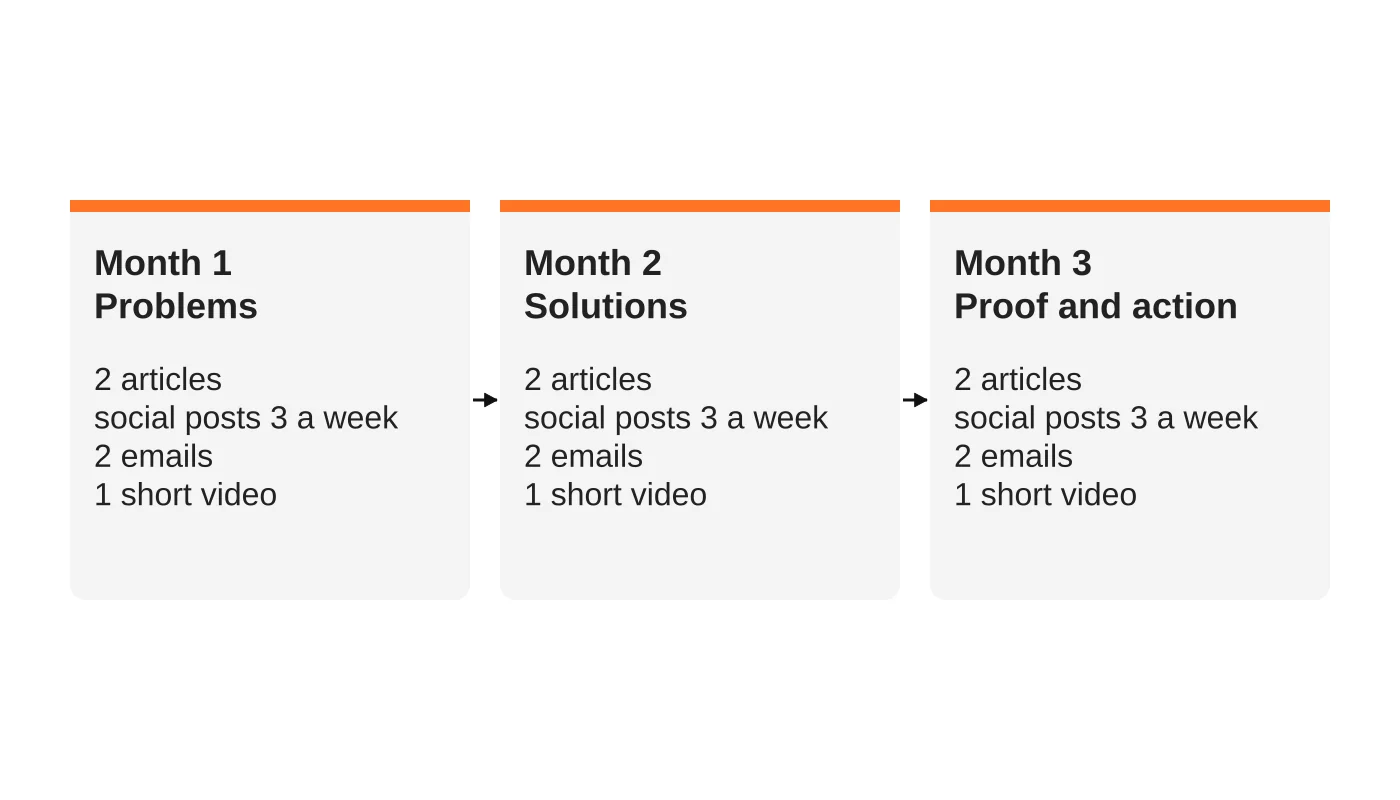
Group topics into three themes, one per month, that build on each other. For example:
- Month 1: Problems. Help people recognise the problem and its cost.
- Month 2: Solutions. Explain approaches, options and how to choose.
- Month 3: Proof and action. Show results, process and the next step.
Step 4: Pick formats and channels you can sustain
Choose two or three formats and one or two channels. A realistic mix for a small team might be:
| Format | Frequency | Purpose |
|---|---|---|
| In-depth article on your website | 2 per month | Search visibility, authority |
| Short social posts | 3 per week | Reach and reminders |
| Email newsletter | 2 per month | Relationship with existing contacts |
| One short video or audio piece | 1 per month | Personality and trust |
Step 5: Build the calendar
Put every piece in a simple table with these columns: date, theme, topic, format, channel, owner, status and call to action. Leave one week in each month blank for catching up and for timely items.
Step 6: Add local and seasonal hooks
Local events create natural topics. In Davao, Kadayawan in August, school and exam seasons, holiday periods and typhoon-season preparations might give you angles. Use real events relevant to your customers, and check dates each year.
If you run a resort, use social content that answers booking questions before guests need to message you.
Using AI for research and drafting while keeping a human voice
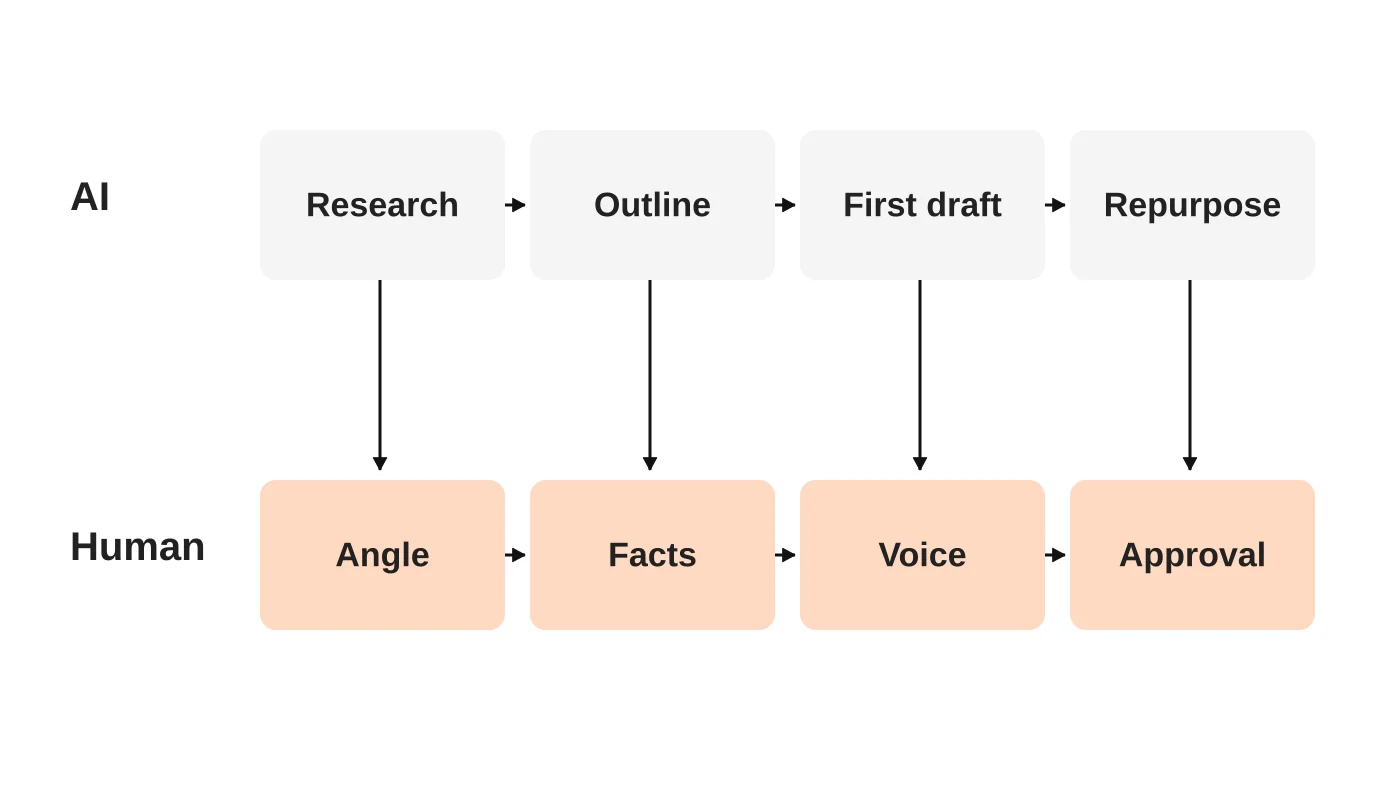
AI is useful for the parts of planning that are slow rather than creative. Use it to:
- Brainstorm topic lists from your audience questions.
- Cluster topics into themes.
- Summarise your own notes, calls and past enquiries.
- Draft outlines and first versions.
- Suggest ways to repurpose one piece in several formats. See content repurposing for small business.
- Prepare checklists and templates.
Keep these jobs for people:
- The angle. What do you believe that others in your field do not say?
- The facts. Check every claim, figure and quotation against a source.
- The voice. Add real examples, stories and opinions from your own work.
- The approval. A person decides what goes out under your name.
Some practical habits:
- Give the AI your real context: audience, offer, tone examples and phrases to avoid.
- Ask for several options, then choose and rewrite.
- Read the draft aloud. If it does not sound like you, rewrite it.
- Do not publish AI output unedited, especially for claims about law, health or finance.
- Keep your own examples and customer stories. They are what AI cannot invent honestly.
Search engines do not penalise content simply for being helped by AI, but they do expect it to be useful and meet quality standards. Thin or repetitive content does not become valuable because a tool wrote it quickly.
The planning template
Copy this table and fill it in for each month.
| Week | Theme | Topic | Format | Channel | Owner | Call to action | Status |
|---|---|---|---|---|---|---|---|
| 1 | |||||||
| 2 | |||||||
| 3 | |||||||
| 4 (buffer) |
If demand rises and falls through the year, plan seasonal campaigns before the rush begins.
Measuring and adjusting
Review at the end of each month, not each day.
- Reach: are more of the right people seeing your content?
- Engagement: what do people read, save, reply to or share?
- Action: enquiries, bookings, sign-ups, calls.
- Quality: do enquiries match your ideal customer?
Keep what works, change what does not and write down what you learned. In month 3, plan the next 90 days using real results.
For ideas and tactics, see top content marketing strategies that help Davao businesses rank and convert, our guide to social media content creation and trends for social media content ideas.
If posts keep getting stuck waiting for sign-off, set up a simple social media approval workflow.
If you run an accounting firm
Start with one topic per month that comes from a real client question, and one dated calendar page that links to official deadlines. Put review time in the plan. A topic you cannot keep accurate should not go in the plan. For the full approach and an example workflow, see Top Content Marketing Strategies That Help Davao Businesses Rank and Convert.
Frequently asked questions
How much content do I need?
Enough to be consistent without burning out. Two quality articles and a few short posts a month beats daily posting that stops after three weeks.
Can I use AI to write everything?
You can, but the result will usually sound generic. Use it for research and drafts, and add your own expertise.
What if I do not know what to write about?
Start from customer questions. Your emails, calls and enquiries are a source of topics.
Which channel is best?
The one where your customers already pay attention and you can post consistently. Start with one.
How do I keep to the plan?
Batch the work: plan once, write in blocks, schedule ahead and protect the time in your calendar.
From the Wired for Growth newsletter
This guide updates The AI-Powered Marketing Calendar: 90 Days of Content in One Sitting from Duarne Bernhagen’s LinkedIn newsletter, Wired for Growth, which showed an AI-assisted workflow for planning 90 days of content. It also draws on Why Safe Content Attracts the Wrong Buyers about why safe content attracts the wrong buyers.
Get a content marketing package
Web Design Davao’s content and social media marketing service plans, writes and publishes content for you. Ask about a content marketing package and we will build your first 90 days with you.