

Quick answer
Be wary of a GEO agency that promises AI citations or rankings, hides its method, sells llms.txt as the fix or has no clear monthly deliverables. Ask what they will do each month, how success is measured, who owns your accounts and data, and what happens if you stop.
- Honest GEO work looks like good SEO: fixing technical basics, improving content with original evidence and cleaning up business information.
- Ask for access to your own data, including Search Console, analytics and reports, and avoid lock-in contracts with no exit.
- Compare proposals by deliverables, not buzzwords, and keep part of the budget for the basics.
Whenever search changes, a wave of agencies arrives to sell the new magic. Generative engine optimisation, or GEO, is the current one. Some providers do honest, useful work. Others rebrand old tactics, sell tools that mostly produce reports and promise results nobody can guarantee. AI Is Making “More” Worth Less asked what happens when “more” is worth less. Paying for more activity that produces nothing is one of the ways it happens.
Here is how to tell the difference.
What Google says
Google’s guide on generative AI search warns against third-party tools that promise ranking success or claim access to internal Google metrics, and says such tools should be checked against official guidance. It also lists things to ignore for Google Search: llms.txt and special AI files, chunking content, rewriting content for AI, seeking inauthentic mentions and overfocusing on structured data. It adds that standard SEO still applies. See Google’s AI search guide in plain English.
Related reading: Mastering Search Engine Rankings: 7 Essential Techniques for Success.
Ten red flags
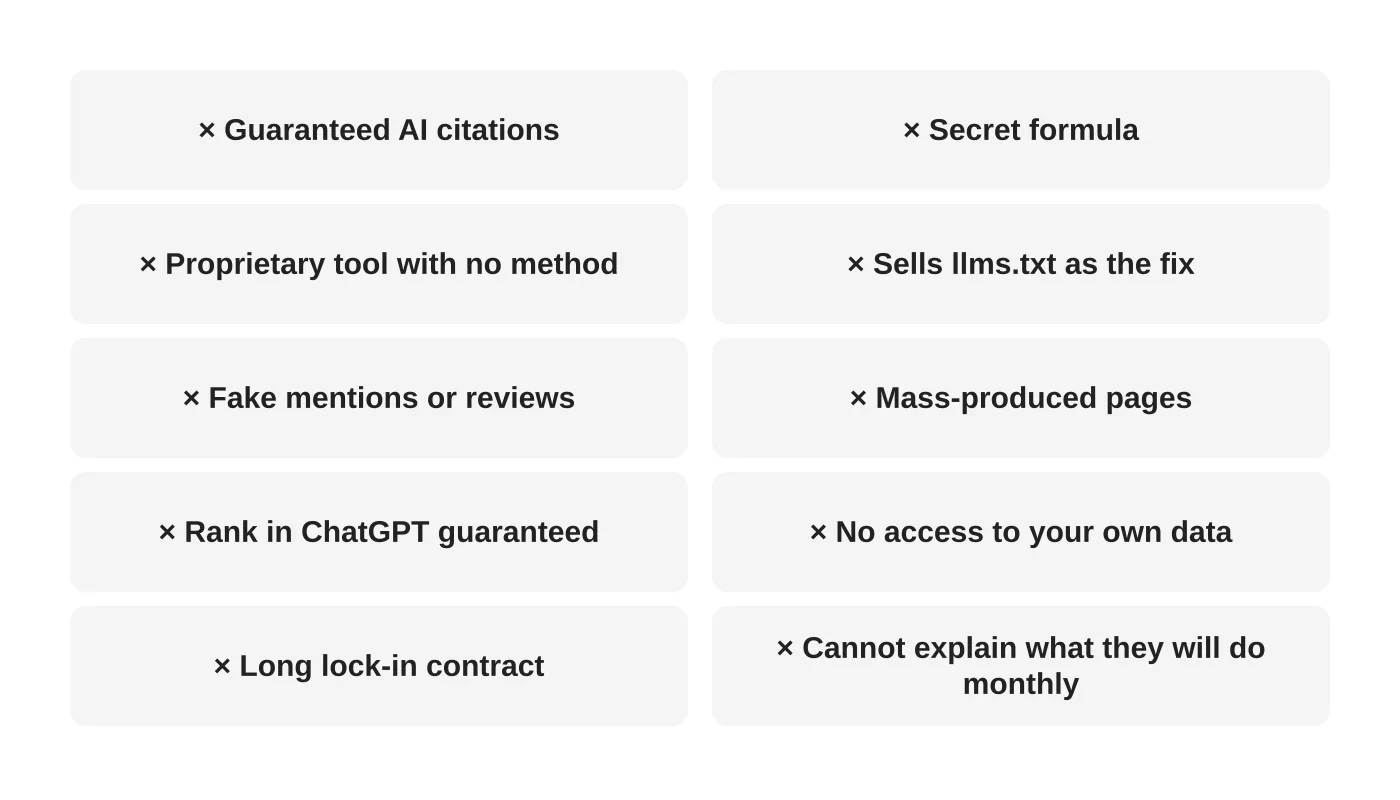
- Guaranteed AI citations or rankings. No one outside the platform controls them.
- A secret formula. Real methods can be explained.
- A proprietary tool with no method. Ask what it measures and how.
- Selling llms.txt as the fix. See do you need an llms.txt file.
- Fake or bought mentions and reviews. See reviews and brand mentions.
- Mass-produced pages. Dozens of near-duplicate pages are a risk, not a strategy.
- A guarantee in a specific AI tool. Answers vary by user, place and run.
- No access to your own data. You should see Search Console, analytics and reports.
- A long lock-in contract with no exit.
- No clear monthly deliverables.
Ten questions to ask any provider
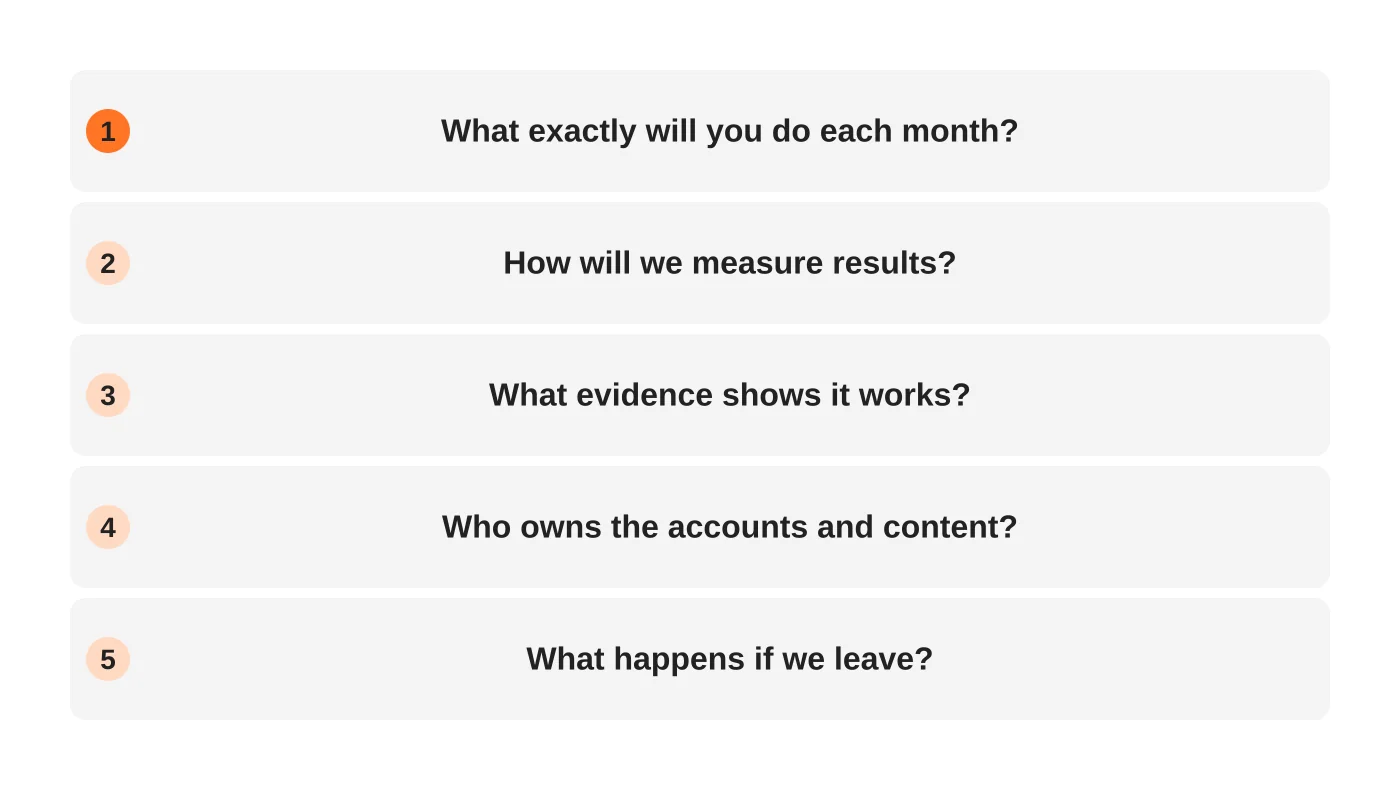
- What exactly will you do each month?
- How will we measure success, and which numbers matter to my business?
- What evidence shows this approach works, and what happened to a control group?
- Which of your tactics does Google say are unnecessary?
- Who owns the accounts, content and data?
- What will you need from me?
- What are the risks, and how do you avoid breaking guidelines?
- What happens if we stop?
- Can I speak to a client with a similar business in the Philippines?
- What would you do first, and what would you refuse to do?
A good provider will answer plainly, say what cannot be promised and begin with the basics.
What honest GEO work looks like
- Fixing technical basics: indexing, speed, crawl access. See website speed.
- Improving content with original evidence. See writing content AI assistants cite.
- Cleaning up business information across your site and profiles. See local business in AI search.
- Setting up measurement: Search Console, Bing, analytics. See the 30-minute audit.
- Setting realistic timelines. See how long SEO takes.
That list looks a lot like good SEO. That is the point.
How much should you spend?
It depends on your size, goals and current state. Pricing depends on your site and what you need. Contact us for a quote. Compare proposals by deliverables, not by buzzwords. If you spend on GEO, keep a share of the budget for the basics.
If you already signed
Ask for a written list of what has been delivered, request access to every account and check what was changed on your site. Compare results with the baseline from your first audit.
Frequently asked questions
Is GEO real?
Yes, as a label for making content discoverable in AI answers. Google says terms like AEO and GEO describe SEO for the new experience, so it is not a separate secret discipline.
Should I ignore all GEO tools?
No. Some tools help you monitor. Judge them by method and value, not by promises.
Can an agency make ChatGPT recommend me?
They can improve your chances. They cannot control the answer.
What if my current SEO agency adds GEO to the invoice?
Ask what is new, and what has been replaced.
From the Wired for Growth newsletter
This guide builds on AI Is Making “More” Worth Less from Duarne Bernhagen’s LinkedIn newsletter, Wired for Growth.
Sources
- Optimizing your website for generative AI features on Google Search, Google Search Central
- GEO: Generative Engine Optimization, Aggarwal et al., KDD 2024
A straight conversation
Web Design Davao’s SEO team will tell you what we can and cannot promise before you sign anything. Ask for an honest assessment.