

Quick answer
A commercial electrical contractor’s website should let procurement officers and facilities managers check credentials, capacity, safety and similar projects quickly. Describe the work you actually deliver and its limits, show only current credentials in your name, use approved project summaries, and offer separate routes for tenders, maintenance and general enquiries.
- Make the home page reach capabilities, projects, credentials and a project enquiry within one click.
- Keep capability statements and safety documents in one dated place, replacing old versions rather than leaving them online.
- Track enquiries by project type, size, buyer type, source and outcome to see which pages bring the work you want.
A procurement officer or facilities manager shortlisting electrical contractors checks credentials, capacity, safety culture and similar projects before ever calling. They may be comparing three or four contractors against a tender document and have little time. A commercial electrical website should make that checking easy, present what you can verify and route serious project enquiries to the person who can answer them.
Web Design Davao is a web design and digital marketing business. We are not an electrical contractor, engineer or certification body, so every capability, licence and safety statement below must come from, and be reviewed by, your own qualified people. This guide does not promise rankings, tenders or contracts.
1. Identify procurement and facilities buyers
Commercial and industrial electrical work is bought by several kinds of people, and each reads your site differently.
- Facilities and operations managers want maintenance support, response arrangements and a contractor who understands live operating environments.
- Project managers and main contractors want capacity, programme reliability, coordination with other trades and evidence on similar projects.
- Procurement and finance staff want documents: licences, insurance, safety policies, company details and a clear scope.
- Business owners commissioning a fit-out or upgrade want to know who will manage the job and what it involves.
Plan an entry point for each. At a minimum, the home page should let a buyer reach capabilities, projects, credentials and a project enquiry within one click.
2. Present capabilities and scope
Describe the work you actually deliver, for example power distribution and switchboard work, lighting and controls installation, industrial maintenance, testing and inspection support, or fit-out electrical packages, but only what applies. State the project types and typical sizes you handle, and be honest about limits.
A capability statement works best when it is specific. “We deliver electrical packages for commercial fit-outs from design coordination through to handover” tells a buyer more than “full electrical solutions”. If you do not design, say that you work to client or consultant designs. If you subcontract part of the work, say so rather than implying it is all in-house.
3. Show approved qualifications and projects
Commercial buyers check credentials. Show licences, accreditations, memberships and safety documentation only where they are current and in your name, with dates where appropriate. Do not use a logo you are not entitled to use, and do not describe a credential in language broader than it covers. If a credential is being renewed, say nothing that would mislead a buyer reading it today.
For projects, use approved summaries that describe scope, site constraints, coordination and handover, without client-sensitive detail. Method and structure are covered in commercial electrical project case studies. A small number of well-documented projects beat a long gallery.
4. Structure commercial enquiries
A tender request is not the same as a maintenance call or a small works enquiry. Offer separate routes and ask for what each needs.
- New project or tender: project type, location, timeline, documents available and key contact.
- Maintenance or service: site, equipment type, urgency and access arrangements.
- General or supplier enquiry: a simple form routed to the right person.
Route each to a named estimator or manager and state the expected reply time only if you can meet it. See SEO for commercial and industrial electricians for how buyers find the right pages, and maintaining capability statements and credentials for keeping them current.
5. Make documents easy to find and to trust
Buyers often download capability statements and safety documents. Give them a single, clearly labelled place, with the document date shown, and replace old versions rather than leaving them online. A buyer who finds an expired credential or an old figure may doubt everything else on the site.
6. Measure project-quality enquiries
Track enquiries by type and quality, not just by count. For each, note the project type, size, buyer type, source and outcome, such as whether it led to a meeting, a tender submission or a job. After some months you will see which pages and routes bring the work you want.
Commercial electrical capability checklist
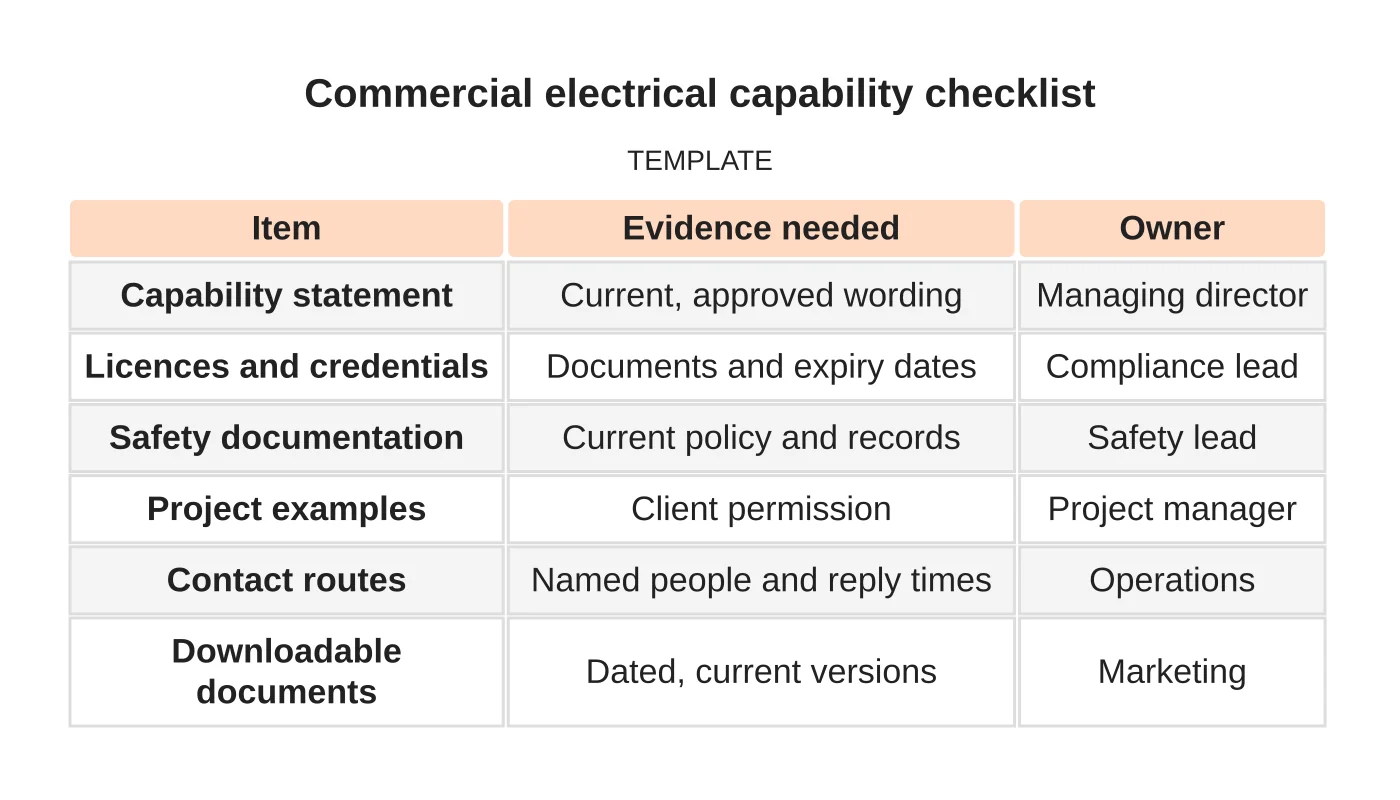
| Item | Evidence needed | Owner |
|---|---|---|
| Capability statement | Current, approved wording | Managing director |
| Licences and credentials | Documents and expiry dates | Compliance lead |
| Safety documentation | Current policy and records | Safety lead |
| Project examples | Client permission | Project manager |
| Contact routes | Named people and reply times | Operations |
| Downloadable documents | Dated, current versions | Marketing |
Common mistakes
- Vague capability wording with no scope or limits.
- Out-of-date credentials or documents.
- Safety statistics or claims with no evidence.
- One enquiry form for tenders, maintenance and general questions.
- Publishing client details without permission.
Questions contractors ask
Should I publish my safety record? Only if you can document it and it is current, and only after review of the wording. Avoid claims such as “zero incidents” unless records support them.
How many projects should I show? A few well-documented projects are enough. Quality and relevance matter more than quantity.
Can the website win tenders? It can help buyers evaluate you and reach the right person. Tenders are won on price, capacity, relationships and track record as well as presentation.
Do I need separate pages for industrial and commercial work? If your buyers and services differ, yes. If they are the same, one page may suffice. Test by asking what your customers call each job.
Next step
Request a website review or discuss the pages and enquiry workflow your business needs. Read about our web design service or contact us.
Frequently asked questions
Should a contractor publish its safety record?
Only if you can document it, it is current and the wording has been reviewed. Avoid claims such as zero incidents unless records support them. Show safety documentation in a single clearly labelled place with the document date shown.
How many projects should an electrical contractor show?
A few well-documented projects are enough. Quality and relevance matter more than quantity. Use approved summaries describing scope, site constraints, coordination and handover, without client-sensitive detail, and publish nothing without client permission.
Can a website win electrical tenders?
It can help buyers evaluate you and reach the right person. Tenders are won on price, capacity, relationships and track record as well as presentation. Offer separate enquiry routes and route each to a named estimator or manager.
Sources and notes
Last updated 21 November 2026. This guide is general information based on Web Design Davao’s web design and digital marketing practice. It cites no statistics and makes no promise about rankings, enquiries or contracts. Web Design Davao is not licensed or certified in this industry, so check technical, safety, legal and regulatory matters with a suitably qualified professional. Examples are templates or illustrations, not client results.