

Quick answer
A roofing project story should record the customer problem, inspection findings, agreed scope, work done and aftercare, using real facts, safe approved photography and written permission. Photograph from the ground or a safe platform, never encourage customers to climb on roofs, have a qualified person review technical wording, and avoid lifespan or compliance claims you cannot support.
- Interview the crew lead about the problem, inspection, agreed scope, site difficulties and what the customer was told afterwards.
- Avoid showing house numbers, faces, number plates or identifying details, and use a small set of clear captioned photographs.
- Keep written permission on file and remove the page promptly if the customer withdraws it.
A project story shows homeowners and commercial clients how you work. It needs real facts, safe photography and permission. Do not publish one without those. This template helps you collect what is needed and write it up honestly, without inventing results or exaggerating.
1. Explain the customer problem and agreed scope
Start with the customer’s situation: what prompted the job, what they were worried about and what the inspection found. Then describe what was agreed. Keep personal details out, and use general terms for the location.
Write in plain language, for example: “The owner noticed water marks on a ceiling after heavy rain. An inspection found damage in one section and we agreed a repair of that section with a check of the surrounding area.” Keep to what happened.
2. Use safe approved site photography
Photography around roofs carries risk. Set rules and follow them.
- Take photographs from the ground, from a safe platform or with approved access, never from unsafe positions.
- Never encourage customers to climb on their roofs to take photographs.
- Do not show unsafe work practices.
- Get the owner’s permission before publishing images of the property, and avoid showing house numbers, faces, number plates and other identifying details.
A small set of clear photographs with captions is better than a long gallery.
3. Present materials and decisions with technical review
Explain why materials and methods were chosen only after a qualified person has reviewed the wording. Customers like to know the reasons, but incorrect or exaggerated statements create risk. Avoid claims about lifespan, weather resistance or compliance unless you can support them.
4. Document outcomes and permissions
Record what was completed, what the customer was told about ongoing care and any agreed follow-up. Keep written permission on file for the story and the photographs. If the customer withdraws permission, remove the page promptly.
5. Interview the crew lead and the customer
A short interview gives better material than memory. Ask the crew lead:
- What was the problem and what did the inspection show?
- What did you agree and why?
- What was difficult about the site?
- What did you tell the customer afterwards?
If the customer agrees, ask what they were worried about and how the process felt. Use their words only with permission.
Roofing project story template
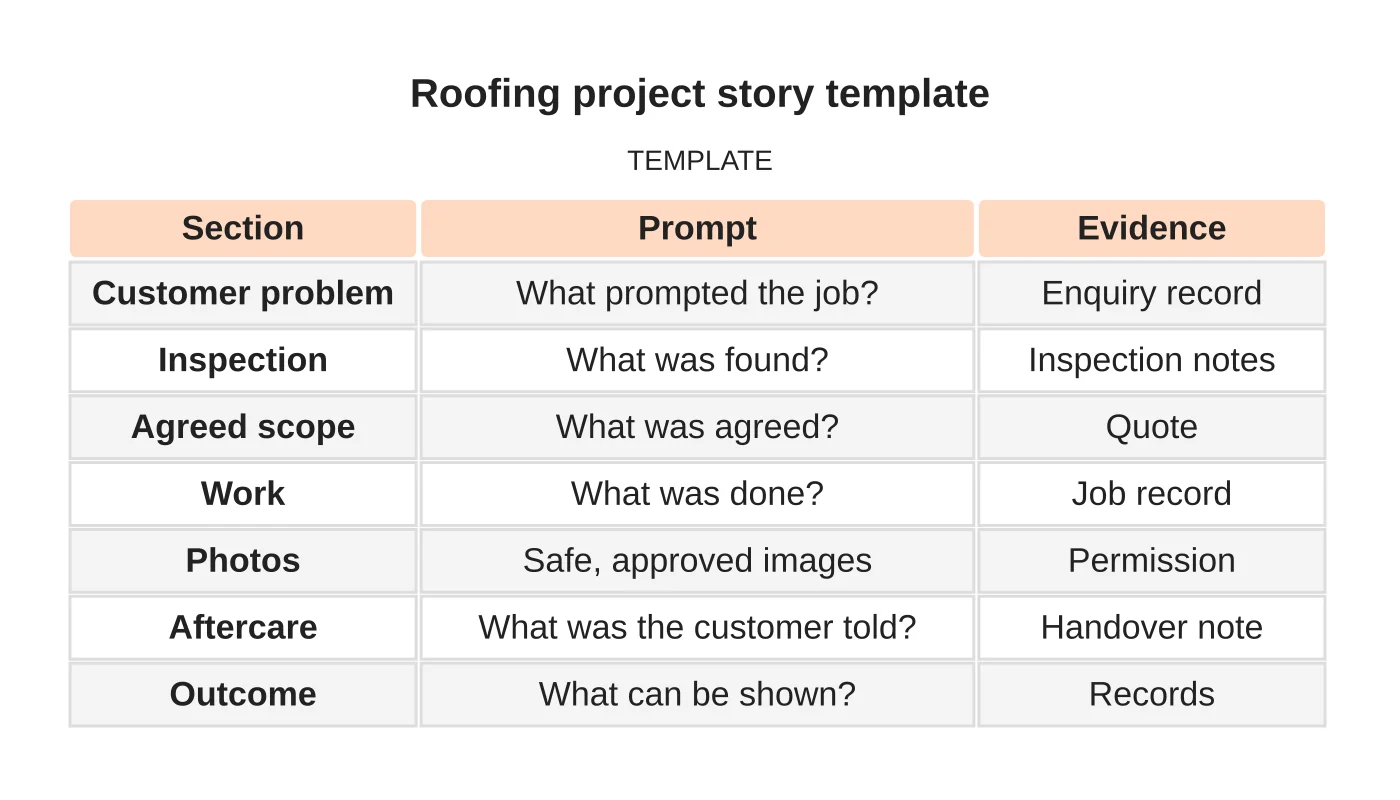
| Section | Prompt | Evidence |
|---|---|---|
| Customer problem | What prompted the job? | Enquiry record |
| Inspection | What was found? | Inspection notes |
| Agreed scope | What was agreed? | Quote |
| Work | What was done? | Job record |
| Photos | Safe, approved images | Permission |
| Aftercare | What was the customer told? | Handover note |
| Outcome | What can be shown? | Records |
Common mistakes
- Publishing without written permission.
- Showing unsafe positions or encouraging customers to climb.
- Claims about lifespan or performance with no evidence.
- Identifying the property or the customer.
- Using one story text for many pages.
Using the story
Link each story from the relevant service page and from the main roofing page. Make sure the story ends with a clear action, such as requesting an inspection. See a roofing quote pipeline for how to follow up the enquiries it generates.
Next step
Request a website review or discuss the pages and enquiry workflow your business needs. Read about our web design service or contact us.
Frequently asked questions
Why do I need permission to publish a roofing project story?
Publishing shows a customer’s property, so keep written permission on file for both the story and the photographs. If the customer withdraws permission, remove the page promptly. Avoid showing house numbers, faces, number plates and other identifying details.
How should roofers take photographs safely?
Take photographs from the ground, from a safe platform or with approved access, never from unsafe positions. Never encourage customers to climb on their roofs to take photographs, and do not show unsafe work practices. A small set of clear captioned photographs beats a long gallery.
Can I explain materials and outcomes in a project story?
Explain why materials and methods were chosen only after a qualified person has reviewed the wording. Avoid claims about lifespan, weather resistance or compliance unless you can support them, and record what was completed and what the customer was told about ongoing care.
Sources and notes
Last updated 21 November 2026. This guide is general information based on Web Design Davao’s web design and digital marketing practice. It cites no statistics and makes no promise about rankings, enquiries or contracts. Web Design Davao is not licensed or certified in this industry, so check technical, safety, legal and regulatory matters with a suitably qualified professional. Examples are templates or illustrations, not client results.


