

Quick answer
Local SEO for solar installers starts with matching page intent: separate service pages that explain what you install from project pages that show completed jobs with permission. Describe the areas you genuinely serve, keep your Google listing and website details consistent, ask for honest reviews and judge success by relevant enquiries, not total volume.
- Create area pages only with distinct content; one coverage page often beats many thin town pages.
- Write project pages covering property type, goal, scope, constraints and ongoing care, with written owner permission.
- Show system size or output only if verified and explained, and never write or buy reviews.
Solar searches mix service intent, such as “solar installer near me”, with project intent, such as “solar for a small factory” or “battery backup for a home”. Pages should match the intent and describe where you actually work. This guide gives a planning matrix and explains how to keep profile details accurate. It makes no ranking claim, because local search results depend on many factors beyond your control.
1. Separate service and project intent
A service page explains what you install, who it suits and how the process works. A project page shows a completed job with its scope and context. They answer different questions, so keep them separate and link them.
- Service pages: residential solar, commercial solar, site assessment.
- Project pages: individual installations, with permission.
- Supporting pages: how the quote process works, what to prepare for an assessment.
Avoid mixing them into one long page. A buyer who wants to understand the process should not have to read a project diary, and a buyer checking evidence should not have to find it in a sales page.
2. Describe genuine service coverage
State the areas you serve, how you handle travel and any limits. Create a separate area page only if you have distinct content: for example, completed projects there or local arrangements that differ. Do not create one page per town with the same paragraph and a different name.
If you serve a wide area, a single clear coverage page that lists the areas and links to relevant projects often works better than many thin pages.
3. Add accurate business details and reviews
Keep your Google listing and website consistent on name, address or service area, phone and hours. Google’s guidelines emphasise representing the business accurately as it is known in the real world. Use real photographs of your team and projects. Ask customers for honest reviews after handover and reply politely to all of them. Never write or buy reviews.
4. Write project pages that help buyers evaluate
A useful project page covers:
- the type of property and the customer’s goal,
- the scope you delivered and what was handed over,
- constraints, such as roof access or approvals,
- what the owner was told about ongoing care.
Include system size or output only if verified and stated with context. Obtain written owner permission and remove personal details.
5. Measure relevant enquiries
Record whether each enquiry is within your area, for the right property type and for work you want. Compare enquiry sources and the number that become site assessments. Fewer, more relevant enquiries beat many you cannot serve. See the solar digital marketing guide for the wider journey and solar quote request forms for qualifying on the form.
Service-area and project-page planning matrix
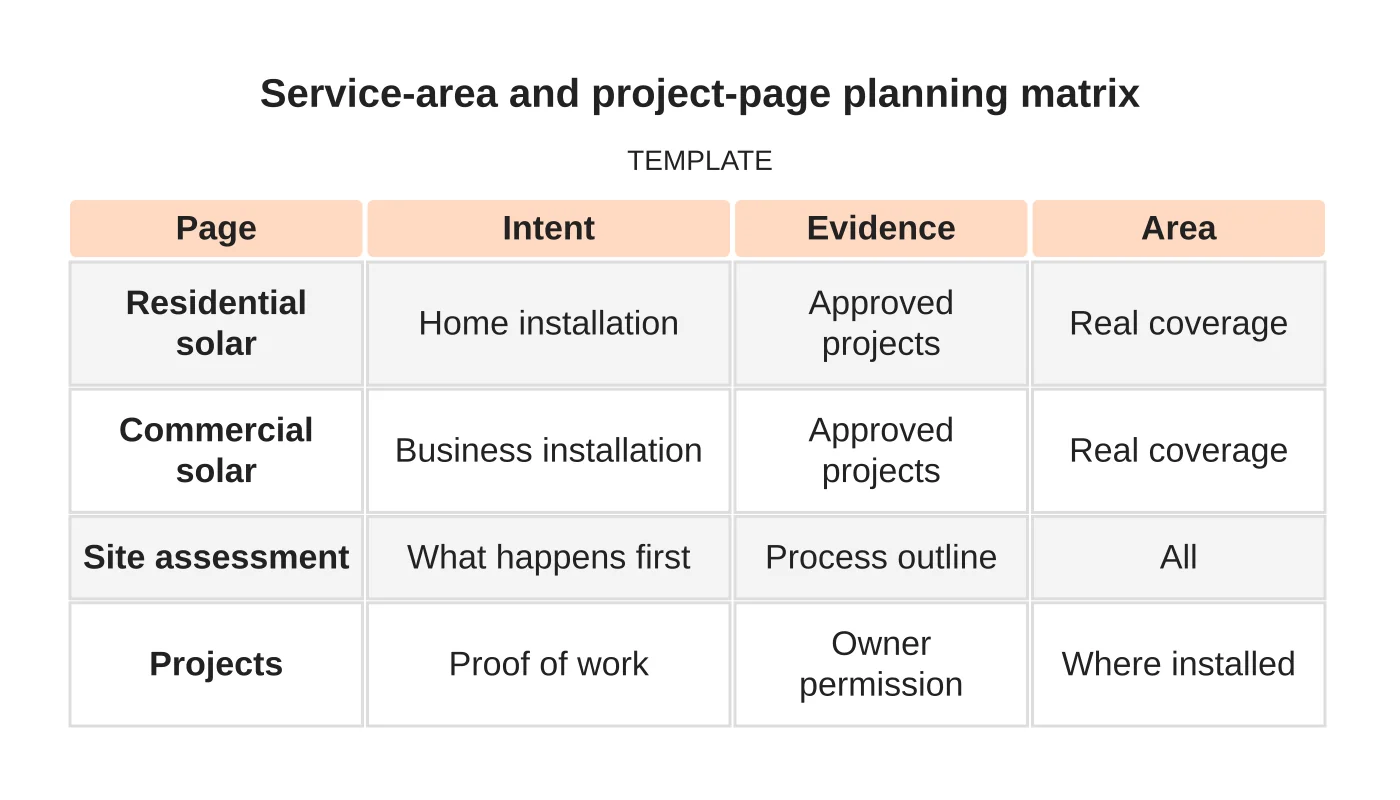
| Page | Intent | Evidence | Area |
|---|---|---|---|
| Residential solar | Home installation | Approved projects | Real coverage |
| Commercial solar | Business installation | Approved projects | Real coverage |
| Site assessment | What happens first | Process outline | All |
| Projects | Proof of work | Owner permission | Where installed |
Common mistakes
- Thin pages for every town.
- Claims about savings with no basis.
- Inaccurate listing details.
- Publishing projects without permission.
- Judging success by total enquiries.
Questions installers ask
How many pages do I need? As many as you have distinct, useful content for. A small installer may need only a few service pages and a handful of project pages.
Should I show system sizes? Only if accurate, verified and explained. Avoid implying that the same result applies to every customer.
Do I need a blog? Not necessarily. A few accurate guides that answer questions you hear often can help, but they should be reviewed.
Next step
Discuss your target customers, service area and lead-generation priorities with Web Design Davao. Read about our digital marketing service or contact us.
Frequently asked questions
How many pages does a solar installer need?
As many as you have distinct, useful content for. A small installer may need only a few service pages and a handful of project pages. Avoid thin pages for every town, and keep service pages and project pages separate but linked.
Should I show system sizes on project pages?
Only if they are accurate, verified and explained with context. Avoid implying that the same result applies to every customer, and make no claims about savings that you have no basis for. Get written owner permission and remove personal details.
How do I measure whether solar enquiries are working?
Record whether each enquiry is within your area, for the right property type and for work you want. Compare enquiry sources and how many become site assessments. Fewer, more relevant enquiries are worth more than many you cannot serve.
Sources and notes
Last updated 21 November 2026. This guide is general information based on Web Design Davao’s web design and digital marketing practice. It cites no statistics and makes no promise about rankings, enquiries or contracts. Web Design Davao is not licensed or certified in this industry, so check technical, safety, legal and regulatory matters with a suitably qualified professional. Examples are templates or illustrations, not client results.