

Quick answer
Service reminders bring customers back when they are wanted and proportionate. Keep only the information you need, ask at booking how the customer prefers to be contacted and whether they agree to reminders, send a small number of messages with an easy opt-out, and track bookings and opt-outs.
- Keep only contact details, vehicle and last service date, restrict access and delete data you no longer need.
- Follow the interval your technicians recommend, send one reminder and one follow-up, then stop if there is no response.
- Do not claim a vehicle is unsafe without inspection, and mention discounts only if you really offer them.
Reminders bring customers back, but only if they are wanted and proportionate. Done carelessly they feel like spam. This guide covers what to record, how often to message and what to measure. It does not promise repeat business.
1. Agree what customer information to retain
Keep only what you need to provide the service and the reminder: contact details, vehicle and last service date. Store it securely, limit who can see it and delete what you no longer need.
Related reading: Workshop Service Pages That Help Drivers Choose the Right Booking.
2. Record service and contact preferences
At booking or handover, ask how the customer prefers to be contacted and whether they agree to reminders. Record the answer. Do not add customers to reminders without agreement.
3. Plan proportionate reminders
Use the interval your technicians recommend for each service type and the customer’s preference. Keep the number small, such as a reminder when due and one follow-up. Make opting out easy in every message. Stop if the customer does not respond after the planned messages.
4. Measure repeat bookings and opt-outs
Track how many reminders led to bookings, how many people opted out and any complaints. If opt-outs rise, reduce frequency or review the wording. Compare against customers who were not reminded only if the groups are comparable. See the workshop website guide and Google Maps profiles.
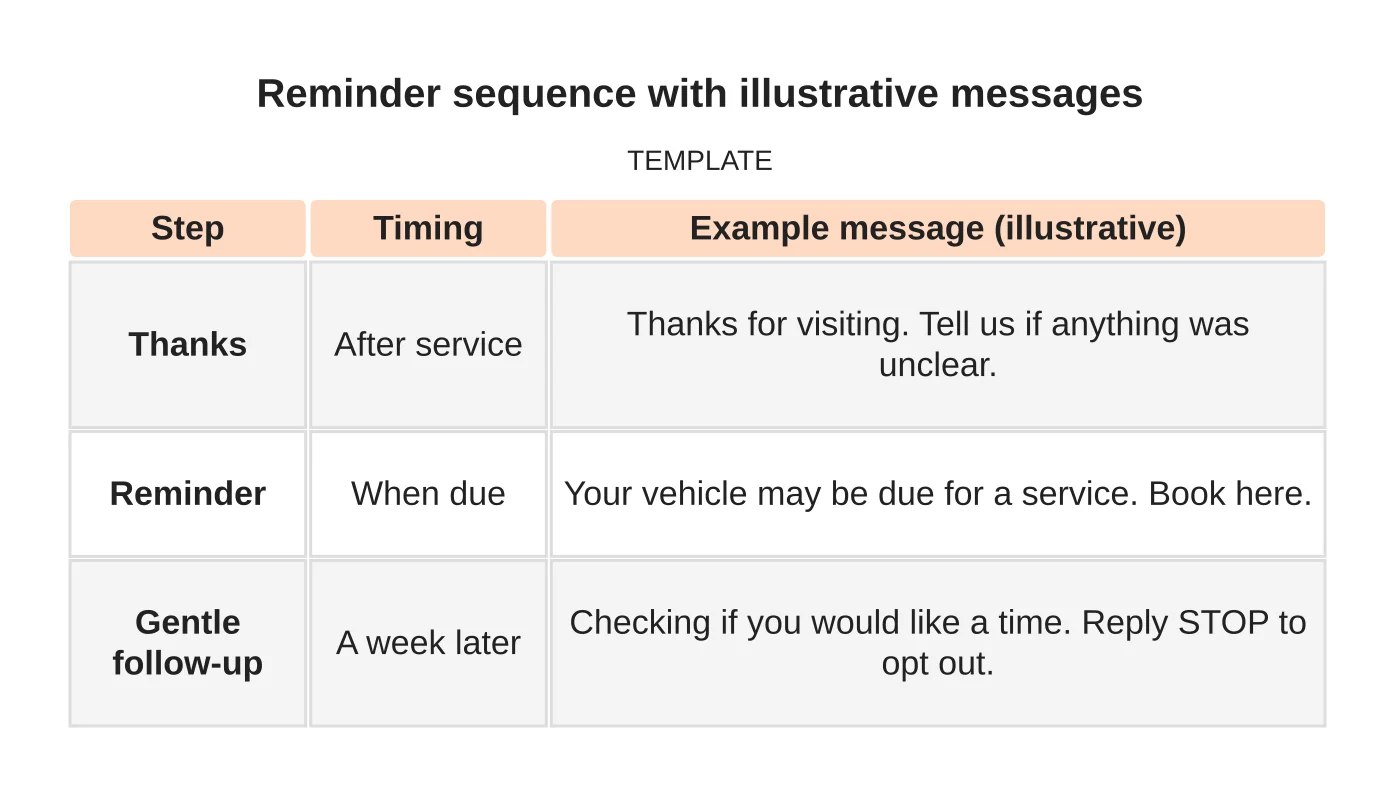
Reminder sequence with illustrative messages
| Step | Timing | Example message (illustrative) |
|---|---|---|
| Thanks | After service | Thanks for visiting. Tell us if anything was unclear. |
| Reminder | When due | Your vehicle may be due for a service. Book here. |
| Gentle follow-up | A week later | Checking if you would like a time. Reply STOP to opt out. |
Common mistakes
- Reminding customers who did not agree.
- Too many messages.
- Claiming a vehicle is unsafe without inspection.
- No opt-out.
- Keeping data forever.
Questions workshops ask
How often should I remind? Follow the recommended service interval and the customer’s preference.
Should messages mention discounts? Only if you really offer them and can honour them.
Next step
Discuss your target customers, service area and lead-generation priorities with Web Design Davao. Read about our digital marketing service or contact us.
Frequently asked questions
How often should a workshop send service reminders?
Follow the recommended service interval for each service type and the customer’s preference. Keep the number small, such as a reminder when due and one follow-up, and stop if the customer does not respond after the planned messages.
Do customers need to agree to reminders?
Yes. At booking or handover, ask how the customer prefers to be contacted and whether they agree to reminders, and record the answer. Do not add customers without agreement, and make opting out easy in every message.
What should a workshop measure about reminders?
Track how many reminders led to bookings, how many people opted out and any complaints. If opt-outs rise, reduce frequency or review the wording. Compare with customers who were not reminded only if the groups are comparable.
Sources and notes
Last updated 21 November 2026. This guide is general information based on Web Design Davao’s web design and digital marketing practice. It cites no statistics and makes no promise about rankings, enquiries or contracts. Web Design Davao is not licensed or certified in this industry, so check technical, safety, legal and regulatory matters with a suitably qualified professional. Examples are templates or illustrations, not client results.


