
Quick answer
A website that sells an independent course should answer, without hype, who it helps, what is covered, how it is delivered, what it costs and what happens after payment. State the problem solved, outline the curriculum, show instructor experience and real student feedback, and explain price, access, support and refund terms. It cannot promise enrolments or outcomes.
- Say who the course is for and not for, and what learners can reasonably do afterwards without promising results.
- Use genuine student feedback with permission and never invented testimonials or results you cannot document.
- Plan the follow-up after sign-up: welcome message, access instructions and first steps, then track sign-ups and refund requests.
An independent course sells on clarity: who it helps, what is covered, how it is delivered, what it costs and what happens after payment. A website should answer these without hype. It cannot guarantee enrolments or outcomes.
1. Identify learner need and delivery format
State the problem the course solves and for whom, and what a learner can reasonably do afterwards, without promising results. Describe the delivery format: live, recorded or blended, time commitment and tools needed. Say who the course is not for.
2. Explain curriculum and evidence
Outline the curriculum in a clear structure: modules, lessons and any assessments. Describe the instructor’s relevant experience, only as can be verified. Use genuine student feedback with permission, not invented testimonials, and do not show results you cannot document.
3. Describe price, access and support
State the price, any payment plan, how long access lasts, what support is included and how to get it. Explain refund terms in plain words.
4. Plan enrolment and follow-up
Choose an enrolment route and plan the follow-up after sign-up: welcome message, access instructions and first steps. See enrolment or direct checkout, campaigns and landing pages and course launch dependencies.
5. Measure
Track visits, sign-ups, completed enrolments and refund requests. Review what questions learners ask before buying and answer them on the page.
Independent course website map
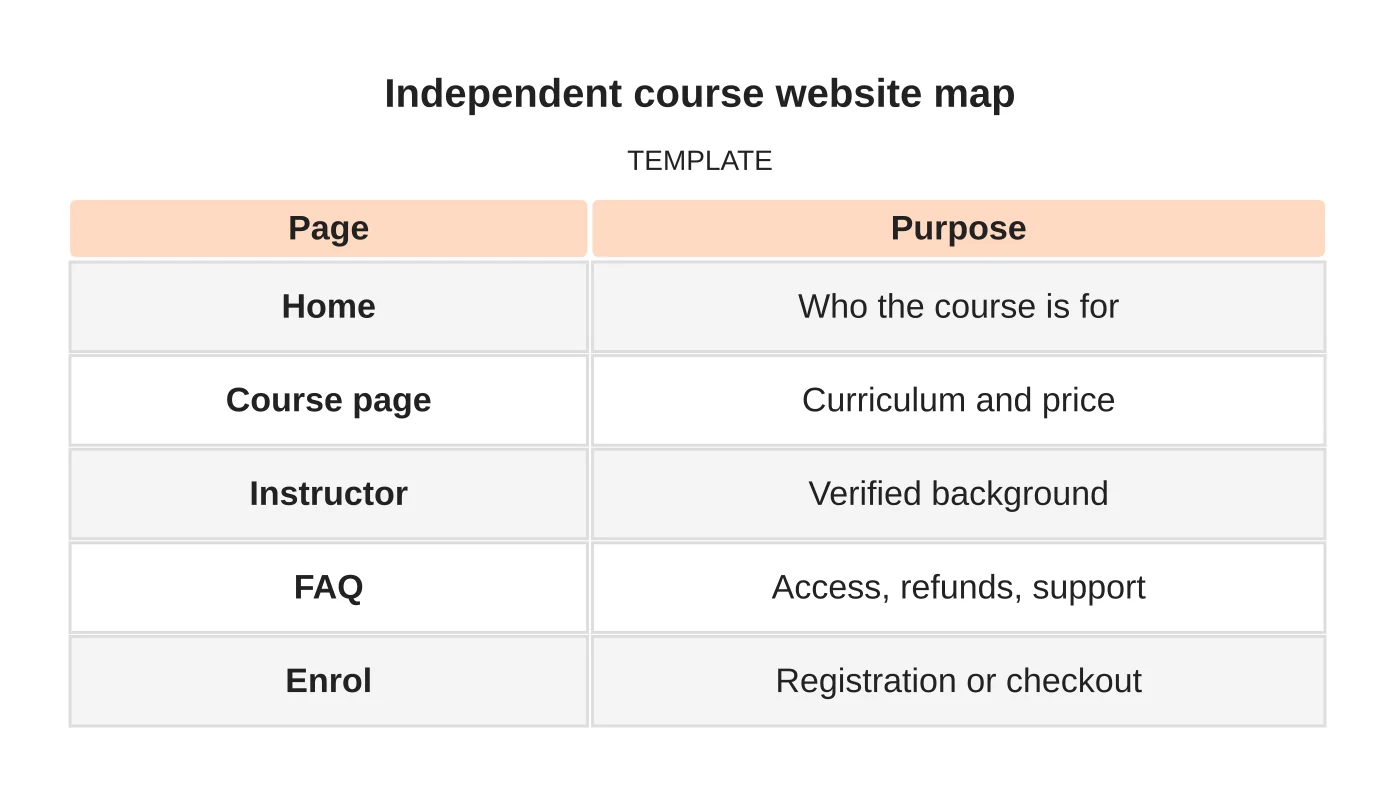
| Page | Purpose |
|---|---|
| Home | Who the course is for |
| Course page | Curriculum and price |
| Instructor | Verified background |
| FAQ | Access, refunds, support |
| Enrol | Registration or checkout |
Common mistakes
- Outcome promises.
- Invented testimonials.
- Hidden refund terms.
- Long pages with no clear action.
- No post-purchase journey.
Questions course creators ask
Do I need my own website? A platform may suffice at first. A site gives control and clarity as you grow.
How long should the sales page be? Long enough to answer buyers’ questions honestly.
Related: training centres.
Next step
Request a website review or discuss the pages and enquiry workflow your business needs. Read about our web design service or contact us.
Frequently asked questions
Do I need my own website to sell a course?
A platform may suffice at first. A site gives control and clarity as you grow. Either way, the page should answer who the course is for, what is covered, how it is delivered, the price and what happens after payment.
How long should a course sales page be?
Long enough to answer buyers’ questions honestly. Cover the curriculum in a clear structure of modules, lessons and any assessments, the price and payment plan, how long access lasts, what support is included and refund terms in plain words.
What proof should a course page show?
Describe the instructor’s relevant experience only as far as it can be verified. Use genuine student feedback with permission, not invented testimonials, and do not show results you cannot document. Review the questions learners ask before buying and answer them on the page.
Sources and notes
Last updated 21 November 2026. This guide is general information based on Web Design Davao’s web design and digital marketing practice. It cites no statistics and makes no promise about rankings, enquiries or contracts. Web Design Davao is not licensed or certified in this industry, so check technical, safety, legal and regulatory matters with a suitably qualified professional. Examples are templates or illustrations, not client results.