
Quick answer
An export business website builds buyer confidence by explaining what you supply, in what forms and quantities, and which markets you really serve. Add verified company details and certificates you hold, a written enquiry and sample process, and contact options with response times you can meet in the buyer’s time zone.
- Avoid claiming to ship worldwide unless you do, and name the markets and buyer types you actually serve.
- Display only certifications and quality documents you can support, with the issuing body and validity where relevant.
- Record enquiries by country, buyer type and product, and whether they had enough detail to quote.
An overseas buyer cannot visit you, so your website has to answer: who are you, what exactly do you supply, can I trust the company and what is the process. For an export business, the website is often the first and sometimes the only evidence a buyer sees before sending an enquiry. This guide covers product range, company evidence, the enquiry and sample process and international contact. It makes no promise about rankings or orders.
Web Design Davao is not a trade, customs or certification adviser. Trade terms, certifications, regulatory and shipping statements must come from, and be reviewed by, your own qualified people.
1. Explain product range and supply scope
Describe what you supply, in what forms and in what quantities. List products clearly, with variants and options, and say whether items are supplied from stock, to order or both. State the markets you really serve and the types of buyers you work with, such as distributors, retailers or manufacturers. Avoid claiming to ship “worldwide” unless you do.
2. Present verified company and quality evidence
Buyers want to know the company is real and reliable. Provide company details, location, years of operation if verified, certificates you hold and quality documents. Put the issuing body and validity where relevant. Do not display certifications or logos you cannot support.
Evidence can be practical too: photographs of facilities and packing with permission, descriptions of quality checks and sample documentation, as true.
3. Describe enquiry and sample process
Tell buyers how to enquire, what information to include, how samples are handled and what to expect next. Do not invent terms. If sample charges or conditions vary, say they are confirmed at enquiry. A clear process reduces back-and-forth and signals professionalism.
4. Support international contact and follow-up
Provide email and the messaging channels buyers use in your target markets, and state response times you can meet in the buyer’s time zone. A simple acknowledgement that says when to expect a reply helps. Consider how you will keep records of buyer enquiries; see administrative support for export enquiries.
5. Plan content for the markets you serve
International search and language choices need care; see international SEO for export businesses. Design product pages so that buyers can request accurate quotes; see export product catalogues.
6. Measure qualified buyer enquiries
Record enquiries by country, buyer type and product, and whether they included enough detail to quote. Track samples requested and orders. Do not assume that traffic from a country indicates demand.
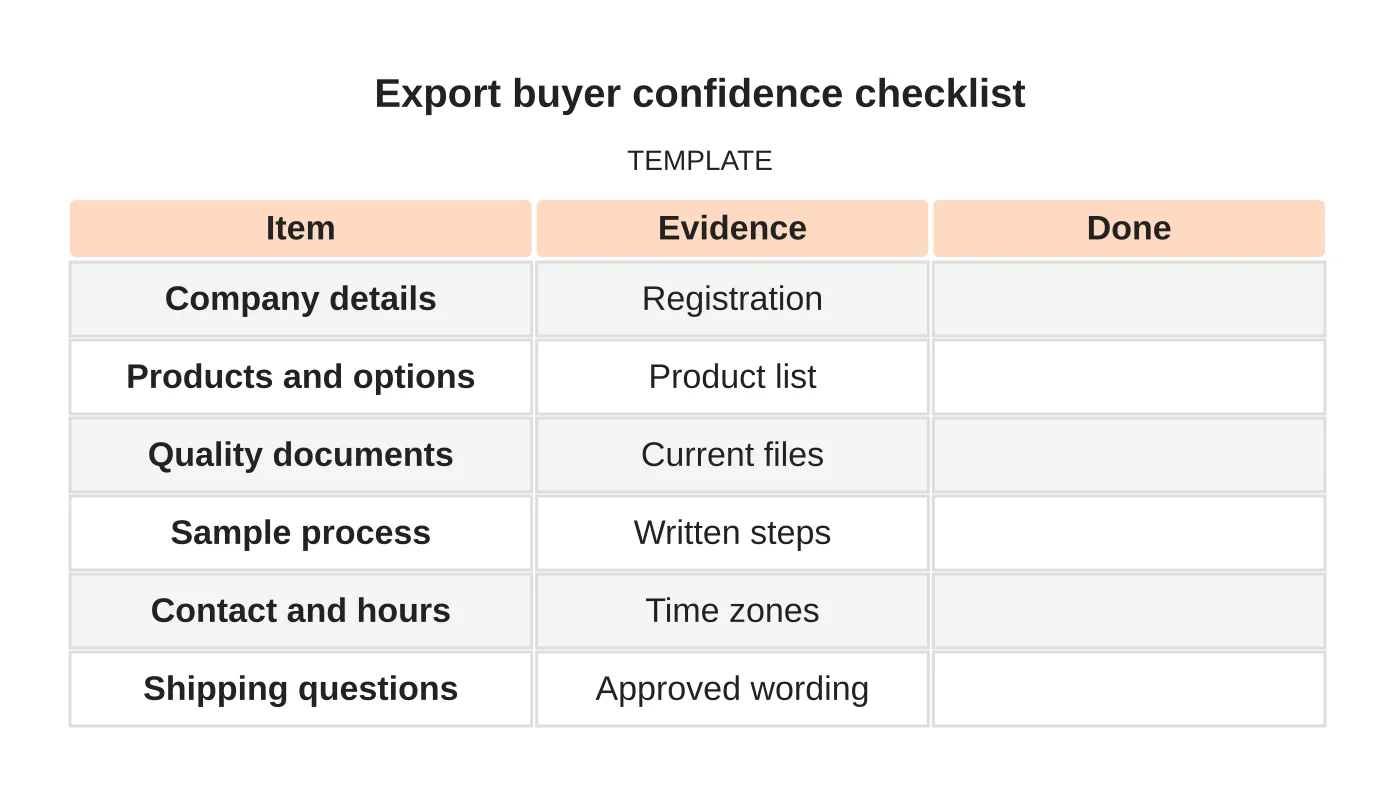
Export buyer confidence checklist
| Item | Evidence | Done |
|---|---|---|
| Company details | Registration | |
| Products and options | Product list | |
| Quality documents | Current files | |
| Sample process | Written steps | |
| Contact and hours | Time zones | |
| Shipping questions | Approved wording |
Common mistakes
- Claiming worldwide supply without support.
- Certifications you cannot show.
- No clear sample or enquiry process.
- Ignoring time zones in replies.
- Inventing trade terms.
Questions exporters ask
Do I need a translated site? Not always. Choose languages by the buyers you serve and have translations reviewed; see international SEO.
Should I show prices? Many exporters quote on request because prices depend on quantity and terms. State the approach.
Related: manufacturing websites address a similar buyer.
Next step
Request a website review or discuss the pages and enquiry workflow your business needs. Read about our web design service or contact us.
Frequently asked questions
What should an export website show about the company?
Company details, location, years of operation if verified, certificates you hold and quality documents, with the issuing body and validity where relevant. Photographs of facilities and packing, shown with permission, can also help. Never display certifications you cannot support.
Do I need a translated site?
Not always. Choose languages by the buyers you serve and have translations reviewed. International search and language choices need care, so plan your content around the specific markets you actually serve and sell into.
Should I show prices?
Many exporters quote on request because prices depend on quantity and terms. State that approach clearly. If sample charges or conditions vary, say they are confirmed at enquiry, and explain how samples are handled.
Sources and notes
Last updated 21 November 2026. This guide is general information based on Web Design Davao’s web design and digital marketing practice. It cites no statistics and makes no promise about rankings, enquiries or contracts. Web Design Davao is not licensed or certified in this industry, so check technical, safety, legal and regulatory matters with a suitably qualified professional. Examples are templates or illustrations, not client results.