
Quick answer
Most growing businesses have three routes to an AI team: buy a packaged platform, build a tailored system, or blend AI tools with a managed human team. Choose one complete workflow first, name a human owner for the result, and compare options on speed, fit, control, skills needed, ongoing ownership and cost including review time.
- Pick one complete workflow with a clear start and finish, and define what a useful finished result looks like.
- Name a human process owner and decide which actions agents may take alone and which need approval.
- Compare total cost including subscriptions, model usage, configuration, maintenance and human review, and measure time to an accepted result.
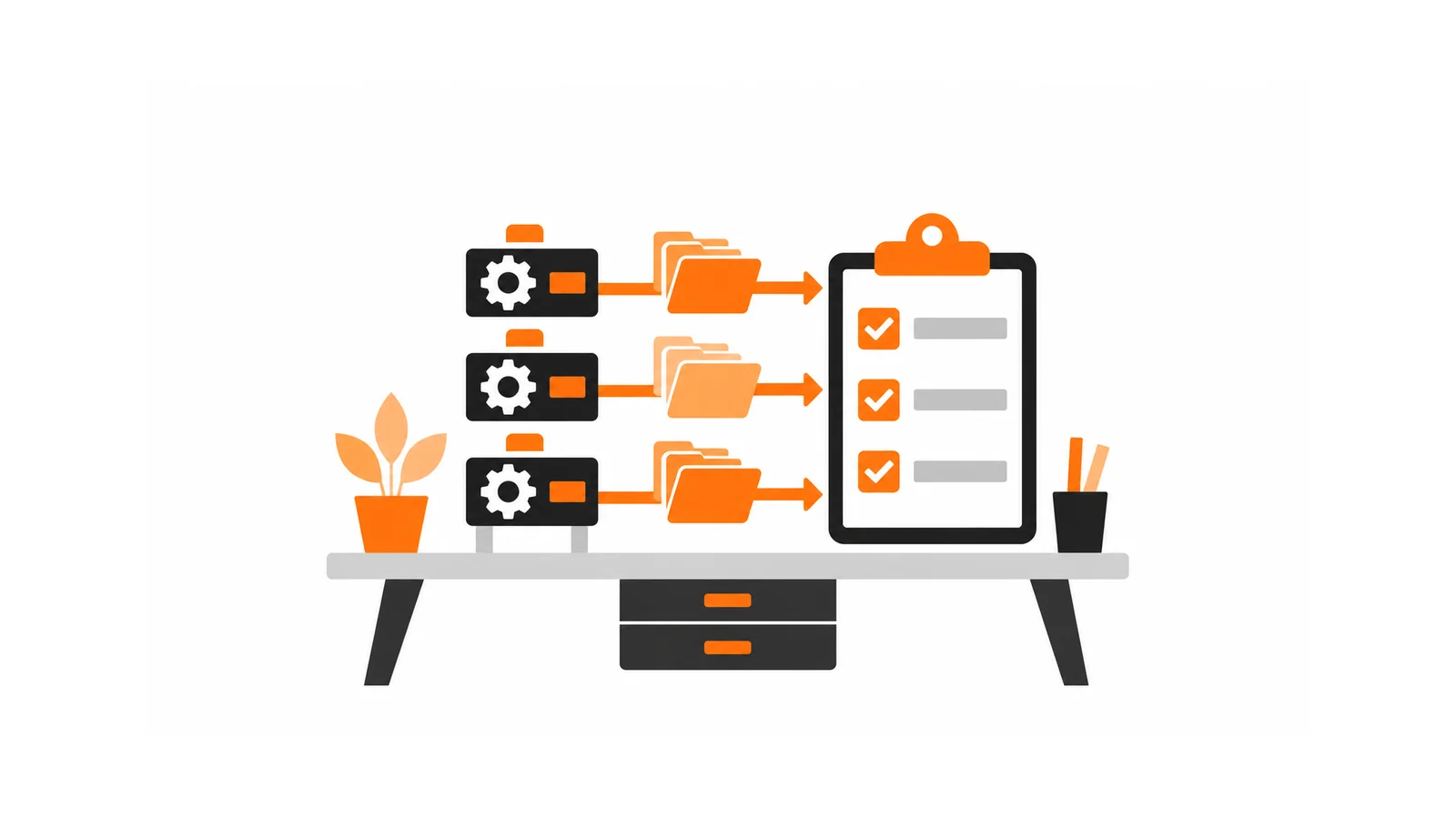
An AI team sounds like a leap: agents that gather information, prepare responses, check each other’s work and hand a finished result to a person. Some companies are already trying it. The question for most growing businesses is not whether it is possible, but how to get it: buy something ready, build something tailored, or blend technology with a managed human team.
This guide sets out the three routes, a decision matrix and a hiring checklist, and it starts with a question to ask before any hire.
Start with the work, not the technology
The newsletter issue Your Company Could Run an AI Team. Should You Buy or Build It? describes a morning where enquiries are organised, follow-ups identified, meeting briefs prepared and campaign reports ready, with unusual results flagged for a person to investigate. Each part is handled by an agent with a defined responsibility, and humans review the output.
Two cautions from that issue are worth keeping. First, a workflow like that is a proposal, not a guarantee that any platform will perform reliably out of the box. Second, the value comes from the business process the team carries through to a useful result, not from having several agents with different names.
Before choosing a route, pick one complete workflow with a clear beginning and end: a weekly client report, an incoming support request or a sales meeting brief. Define what a useful finished result looks like.
Three routes: buy, build, blend
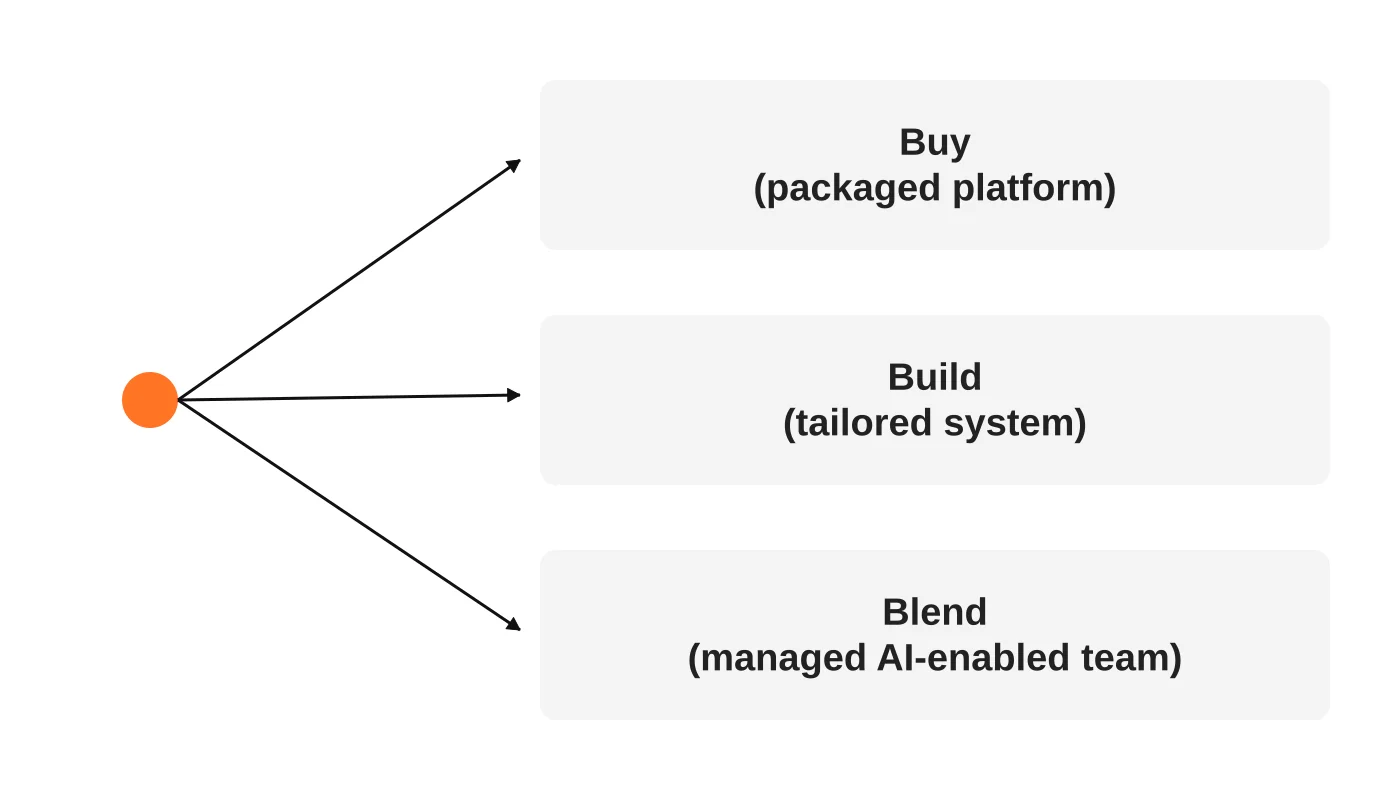
Buy: start with a packaged platform
A packaged agent platform gives you an assembled environment: several agents, connections to common applications and scheduled routines. The attraction is a shorter path to a trial, so your effort goes into defining roles, connecting apps and testing results.
“Ready to go” still requires implementation. The system needs your procedures, access limits, examples and approval rules.
Build: shape the system around your operations
A more tailored route uses an open-source or configurable foundation, with your choice of models, memory, skills and integrations. If you have the technical capability, you control how agents connect to internal systems and where the software runs.
That flexibility brings ongoing work: deployment, integration, updates, monitoring and troubleshooting all need an owner. Self-hosting agent software does not automatically keep information local if it calls external model services.
Blend: AI plus a managed human team
The third route is often overlooked. A provider combines AI tools with trained staff who brief the tools, check the output, handle exceptions and speak to customers. You get the capacity of automation without needing in-house technical capability to run it.
This suits businesses that want results from AI without becoming an AI operations business. See why Davao is emerging as a hub for AI-enabled outsourcing and how AI and offshore staffing combine to cut costs without cutting corners.
Decision matrix
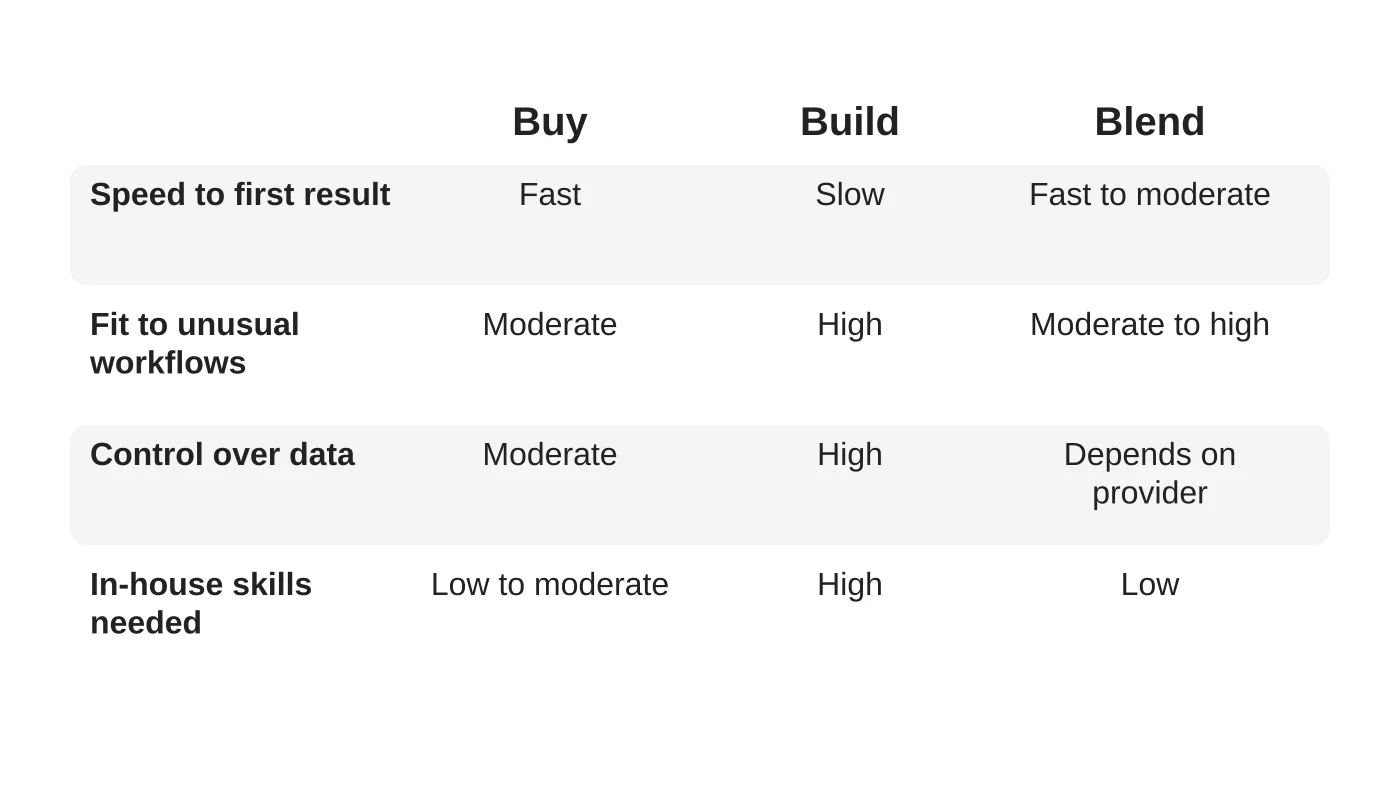
Use this as a prompt for discussion. Ratings are general, so adjust them for your situation.
| Factor | Buy | Build | Blend |
|---|---|---|---|
| Speed to a first working result | Fast | Slow | Fast to moderate |
| Fit to unusual workflows | Moderate | High | Moderate to high |
| Control over data and hosting | Moderate | High | Depends on provider |
| In-house technical skills needed | Low to moderate | High | Low |
| Ongoing ownership burden | Moderate | High | Shared with provider |
| Cost profile | Subscription plus usage | Build plus run costs | Service fee |
| Main risk | Lock-in, limits on integration | Underestimating upkeep | Provider quality |
Questions to settle first:
- Which complete workflow will benefit? Choose one with a clear finish.
- Who owns the result? Name a human process owner. Decide what agents may do alone, what needs approval and what happens when tools fail or information conflicts. An agent checking another agent’s work may help, but it does not prove the result is right.
- How closely must it fit? If a packaged platform’s connections suit the work, it may be enough. If you need unusual integrations or specific infrastructure, a tailored build may justify the effort. Compare options against the same requirements.
- What does useful delivery cost? Include subscriptions and model usage, configuration, maintenance and human review. Measure the time to an accepted result, including corrections. A system that completes more tasks while consuming more staff attention needs more work.
Before you hire the next role, ask what AI can do
The newsletter issue Before You Hire That Next Role—Ask What AI Can Do First offers a related habit: before you open a role, ask what AI can already do with the work. That does not mean no hire. It means defining the task first, then deciding whether the role is a person, a tool or a person using a tool.
A simple filter:
- Repetitive, rule-based, high-volume work is a candidate for automation, with human review.
- Judgement, relationships and exceptions need people.
- A mix of both suits an AI-enabled team member.
Related reading: the 10 essential AI skills every modern virtual assistant needs lists what to look for when you do hire.
What an AI-enabled outsourced team looks like
- A named team lead who owns outcomes.
- Staff trained in the AI tools your workflow uses.
- A documented process: who briefs the tools, who reviews and who approves.
- Clear access controls, covered in our offboarding checklist.
- Reporting on results, not just hours.
Hiring checklist
- [ ] We have chosen one workflow and defined what a finished result looks like.
- [ ] A named person on our side owns the outcome.
- [ ] We know which data and systems the team will access, and we have limited that access.
- [ ] We have agreed which actions need human approval.
- [ ] We have a way to measure time to an accepted result, including corrections.
- [ ] We know who maintains the system and who is on call when it fails.
- [ ] We have checked privacy and security obligations. See how to choose AI tools for your business for the foundation questions.
- [ ] We have a plan to prove one workflow before expanding.
Frequently asked questions
Do I need technical staff to run an AI team?
For a packaged platform, you need someone who can configure and supervise it. For a tailored build you need real technical capability. A managed team reduces that need.
Is an AI team cheaper than hiring people?
Sometimes, but compare total cost including setup, maintenance and review time, not just subscriptions.
Are AI agents reliable enough to run unsupervised?
Treat them as capable assistants that need review, especially at first. Define which actions can be taken without approval.
What should I automate first?
One valuable, repeatable workflow with a clear start and finish.
Can I switch routes later?
Yes. Many businesses begin with a packaged or managed approach and bring parts in-house if they need more control.
From the Wired for Growth newsletter
This guide expands on Your Company Could Run an AI Team. Should You Buy or Build It? from Duarne Bernhagen’s LinkedIn newsletter, Wired for Growth, which asks whether to buy or build an AI team. A related issue, Before You Hire That Next Role—Ask What AI Can Do First, asks what AI can do before you hire the next role.
Discuss an AI-enabled team
Web Design Davao’s virtual staffing service provides managed teams that combine people and AI tools. Discuss an AI-enabled team and bring one workflow you would like to hand over.