

Quick answer
Measure an offshore service desk by quality, reliability and fit, not ticket counts. Define first response and resolution exactly, track the share of tickets reopened within a defined period, add customer feedback and read the comments, and report by ticket type and complexity with escalations. Set targets only after a few months of baseline data.
- Write down which clock pauses and when, and use identical definitions for offshore and local staff so comparisons are fair.
- Sample a few tickets each week and have a reviewer score the notes and actions.
- Review the scorecard monthly, assigning each recurring problem an action with an owner and a date.
Counting tickets closed is easy and misleading. A technician can close many easy tickets quickly while hard problems wait, or close tickets that come straight back. For an MSP using an offshore service desk, good measures show quality, reliability and fit, not just volume.
This guide offers definitions, a sample scorecard with no invented results and a monthly review routine. Targets must come from your own baselines and contracts. For the delegation behind the numbers, see what to delegate to an offshore service desk.
Define response and resolution first
Agree exactly what is measured. “First response” could mean the automatic acknowledgement or the first human reply. “Resolution” could include time waiting for the client or exclude it. State which clock pauses and when. Use the same definitions for offshore and local staff, so comparisons are fair. Write them into the service description and your PSA configuration.
Track reopened tickets and customer feedback
A ticket that returns soon after closure was not truly resolved. Track the share reopened within a defined period, and look at the reasons: unclear instructions, a wrong fix or the user not confirming. Add short customer feedback on closed tickets and read comments, not just scores. Themes in comments often show training needs earlier than numbers do.
Add complexity and escalation context
Raw averages hide mix. A month with many hard tickets will look slower. Report by ticket type and by complexity, and track escalations: how many, why, and whether the handover note was usable. A healthy desk escalates appropriately. See escalation and handover. Sample a few tickets each week and have a reviewer score the notes and actions.
A sample scorecard
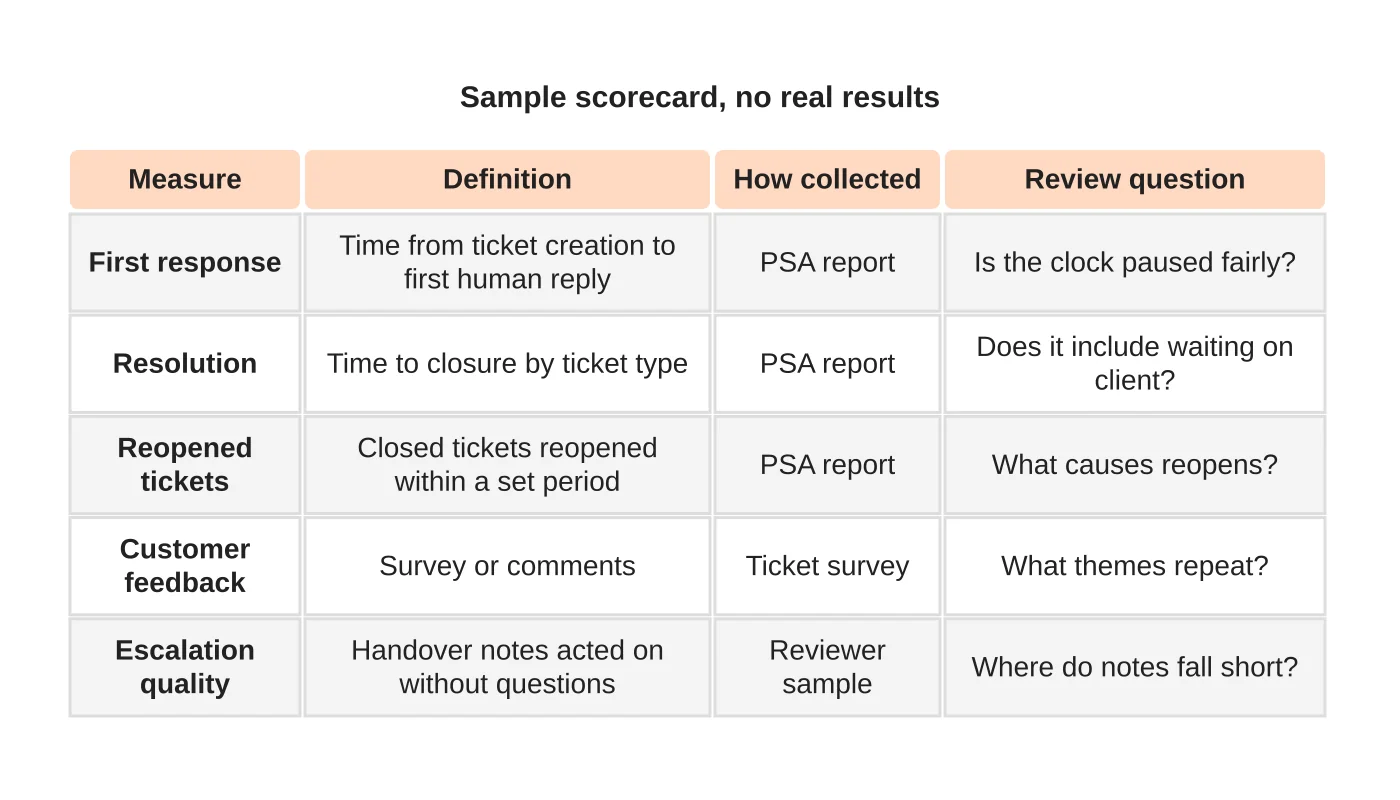
Use the scorecard as a template. Fill it with your own data. Avoid targets until you have a few months of baseline. Where a measure is not available in your tools, say so instead of estimating.
Hold a monthly review with actions
Review the scorecard with the team lead and the service desk manager. For each measure that moved, ask what changed. For each recurring problem, assign an action with an owner and a date: update a runbook, retrain on a ticket type or change a permission. Next month, check whether it worked. Share findings with the technician in a constructive way.
Avoid common mistakes
- Ranking individuals on volume alone.
- Comparing offshore and local staff without adjusting for ticket type.
- Setting targets before there is a baseline.
- Presenting a number without its definition.
Staff capacity versus service outcomes
How you measure depends on what you bought. A dedicated technician is measured differently from a contracted help desk service. See dedicated technicians versus an outsourced help desk. For the pillar view, see how MSPs can scale with outsourced tech support.
Frequently asked questions
Why are ticket counts a poor measure?
A technician can close many easy tickets quickly while hard problems wait, or close tickets that come straight back. Good measures show quality, reliability and fit, such as reopened tickets, customer feedback, complexity and escalation quality.
What should we agree before measuring response and resolution?
Exactly what is measured. First response could mean the automatic acknowledgement or the first human reply, and resolution could include or exclude time waiting for the client. State which clock pauses and when, and write it into the service description.
When should we set targets?
Not until you have a few months of baseline from your own data. Targets must come from your own baselines and contracts. Where a measure is not available in your tools, say so instead of estimating.
Sources
Talk through the role
Send us your ticket categories, tool stack, required hours and escalation structure so we can discuss the role. Learn about our outsourced staffing service or get in touch.