
Quick answer
Customers buy from people who listen first, so open a customer meeting with a conversation and hold the proposal back until you understand what the customer needs. Prepare an agenda of three questions, share it in advance, keep the proposal in reserve, and close by summarising what you heard and agreeing the next step.
- Ask plain questions, such as what made them start looking now and what they have tried so far.
- Use your summary of what you heard to open the proposal, in the customer’s own words.
- Treat your website as the first conversation: state who you help, what you do, and one clear next step.
Customers buy from people who listen first, so the most reliable way to win business is to open with a conversation and hold the proposal back until you understand what the customer needs. That applies in a meeting room in Davao and on your website. This post starts with a story from one of our own team meetings, then shows how the same idea shapes a website that brings in enquiries.
A pitch that started with the proposal
Recently I spent time with two of our customer-facing team who were preparing to present a proposal for a new business website. The proposal was strong, and they had worked hard to understand what the solution should be. When I overheard how they planned to pitch it, I noticed two things. They were nervous, and they intended to lead with the document.
There is a time to be direct and get straight to business. But they were so focused on winning the work that they overlooked a simple fact: a customer is a person, like any other. So I suggested we reverse the roles. I played the customer first, and then they did.
What changed when we turned it into a conversation
I began with an introduction, then asked questions about the business and about the person across the table. We were not only providing the business with a solution. We were working with a person who had their own concerns about cost, time and risk.
After about ten minutes of back and forth, my team relaxed. They did not need to sell a solution. They needed to ask questions that showed what the customer really wanted. Now they prepare an agenda for every meeting, but they run it as a conversation, not a presentation. We have seen more follow-up meetings booked since, and they go in more confident.
The advice is simple. Treat every customer meeting as a conversation. We all have conversations every day, so this is not a skill to learn from scratch. It is one to refine.
Questions that open a customer conversation
A few plain questions do most of the work. Ask them in your own words and let the answers lead.
- What made you start looking for this now?
- What have you tried so far, and what happened?
- How do your customers usually find you today?
- What would a good result look like in six months?
- Who else needs to be comfortable with the decision?
In the Philippines, relationships carry weight in business. A customer in Davao who feels listened to is more likely to introduce you to others, so the conversation is part of the sale, not a delay before it.
How to prepare for a conversation, not a pitch
Preparing for a conversation is different from preparing a script. Use this short routine before each customer meeting, whether it is in person, on a call or over chat.
- Research the person and the business. Read their website and social pages, and note what they appear to care about.
- Write an agenda of three questions, not ten slides. Share it in advance so the customer knows what to expect.
- Decide what you want to learn. Write down the one thing you must understand before you can recommend anything.
- Keep the proposal in reserve. Bring it, but present it only after you have heard the answers.
- Close with a summary. Repeat back what you heard and agree the next step, so the customer can correct you.
The summary in step five matters most. It shows you were listening and it catches misunderstandings while they are cheap to fix. It also gives you the opening lines of your proposal, written in the customer’s own words.
Your website is the first conversation
Many customers meet your business online before they ever speak to you. Your website is the first conversation, and it can go wrong in the same way the pitch did: it talks about you, and it does not answer the visitor’s question. Google’s guidance on helpful content asks the same of any page. It should be written for people first, show real experience, and leave the reader with enough to reach their goal.
If your pages read like a brochure, start with the message. Our guide on why website copy attracts the wrong customers explains how to say who you help and what you do for them.
What a results-driven page looks like
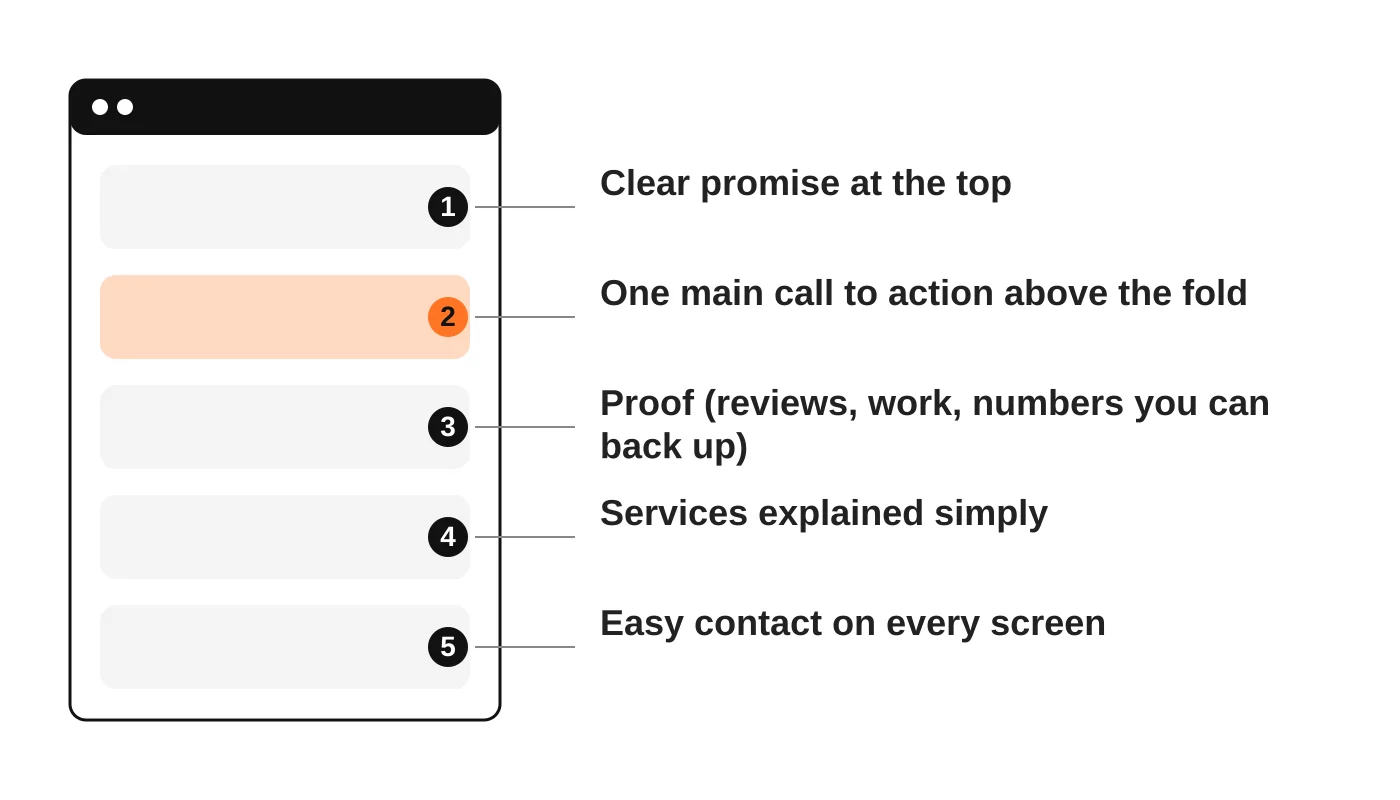
A page that brings in enquiries behaves like a good first meeting. It greets the visitor, shows it understands them, and offers one clear next step. Look for these elements:
- A clear promise at the top. One line that says who you help and how.
- One main call to action above the fold. Call, message or book. Choose one and make it obvious.
- Proof. Reviews, examples of your work and numbers you can back up.
- Services explained simply. Use the words your customers use.
- Easy contact on every screen. A phone number or button that is always within reach.
Check each page against this list and fix the weakest element first. Most pages fail at the first one, because the promise is vague or missing. Ask a friend outside your industry to read the top of the page for five seconds and tell you what the business does. If they cannot, rewrite the opening line before you touch the design.
The path from visitor to enquiry
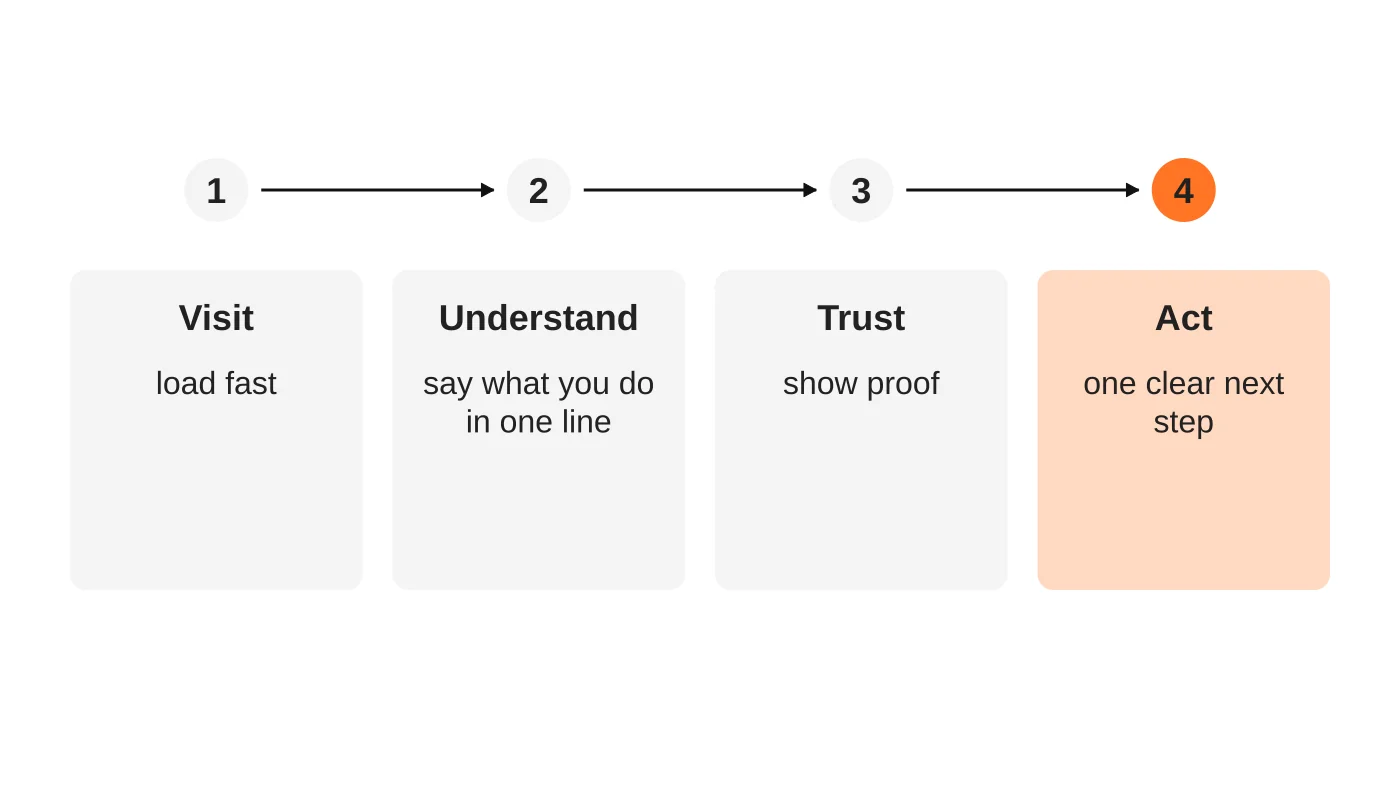
Every enquiry follows the same four steps. If one step fails, the visitor leaves.
- Visit. The page loads fast, including on a mobile connection.
- Understand. The visitor knows what you do within a few seconds. Say it in one line.
- Trust. You show proof that matches the promise.
- Act. There is one clear next step, and it takes little effort.
Walk through this path as a stranger would. Open your site on a phone, read only the top of the page, and ask whether you would know what to do next. If you hesitate, your visitors do too. A site that cannot guide visitors is often a structure problem. Our guide on website infrastructure for Davao businesses covers how to build it so it keeps working as you grow.
Being found by the right people
A good conversation needs someone to start it. For a local business, that means showing up when Davao customers search for what you offer. We explain how in our guide to local SEO structure. Once people arrive, the page should carry on the conversation you would have had in person.
Frequently asked questions
What is the first thing a small business should fix online?
Fix the message at the top of your main page. A visitor should see who you help, what you do and what to do next within a few seconds. Once that is clear, add proof such as reviews and examples of your work, and make contact easy on every screen.
How do we know it is working?
Decide what counts as success, such as calls, form submissions or bookings, and track each one. In Google Analytics you can mark these as key events, which lets you see how many people complete them and which channels brought them. Review the numbers monthly and change one thing at a time.
Start the conversation
If your website is not producing enquiries, we are happy to talk through what you offer, who you want to reach and what is getting in the way. Contact us and we will start with questions, not a pitch.