
Quick answer
Content that AI assistants want to cite carries original evidence, not rewrites of what is already available. Google’s guide says unique, compelling and useful content will likely influence your presence in generative AI search more than its other suggestions. Add your own numbers, real examples, photos, local detail, named sources and a reasoned opinion.
- Add original evidence to your five most important pages: at least one real example and one sourced fact each.
- Gather evidence by interviewing your team, mining anonymised records and running one small experiment on one page.
- Avoid fake statistics, near-duplicate pages and bought mentions, and never invent testimonials or case studies.
AI can write the average answer to any question in seconds. That is the problem for anyone publishing the average answer: it is a commodity. AI Is Making “More” Worth Less asked what happens when “more” becomes worth less. The same applies to content. When everyone can produce more, the scarce thing is something only you can say.
This is where Google’s advice and the early GEO research line up.
What the sources say
Google’s AI optimisation guide says creating content people find unique, compelling and useful will likely influence your presence in generative AI search more than its other suggestions. It asks for a unique viewpoint, such as first-hand experience, and warns against restating what is already available.
The research paper that introduced the term GEO, from researchers at Princeton, Georgia Tech, the Allen Institute for AI and IIT Delhi, reported that adding relevant statistics, quotations and citations could raise visibility in generative engine responses by up to 40 per cent in its tests. The effects varied by topic. It was an experiment on a research benchmark, so treat it as direction, not a guarantee for your site. In the Age of AI, Expertise Is About Asking the Right Questions, Not Knowing All the Answers makes the human version of the point: expertise is about asking the right questions.
Six kinds of original evidence
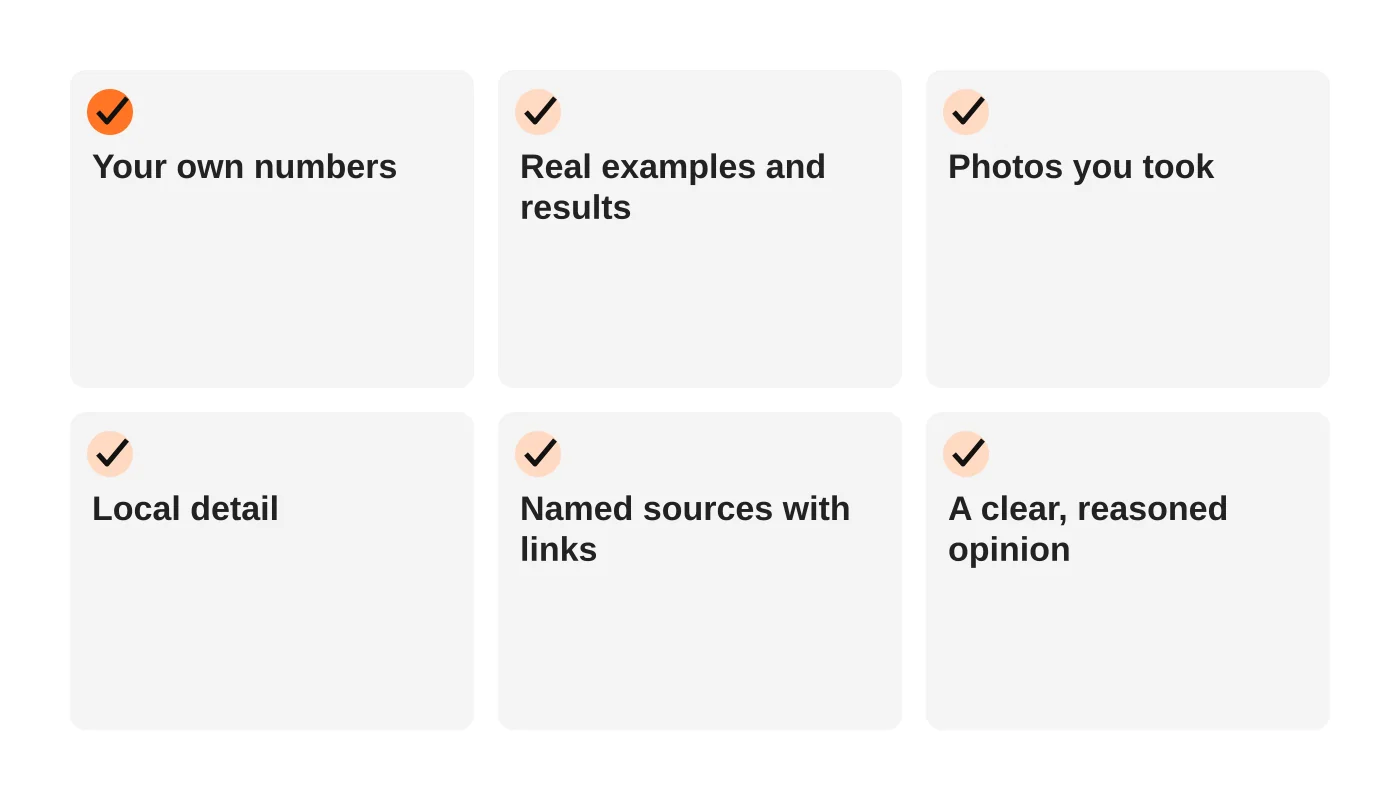
- Your own numbers. Turnaround times, quote-to-sale rates, survey results from your customers. Say how you measured them.
- Real examples. A named project, with permission, or a clearly labelled “Illustrative example”.
- Photos you took. Real work, real people with consent, real places. Avoid stock photos where proof is the point.
- Local detail. Davao streets, seasons, regulations, suppliers and customer habits.
- Named sources. Link to the study, the law or the guidance you rely on. The Data Privacy Act checklist shows a sourced approach.
- A reasoned opinion. Say what you recommend and why, including when you would not recommend your own service.
A before and after
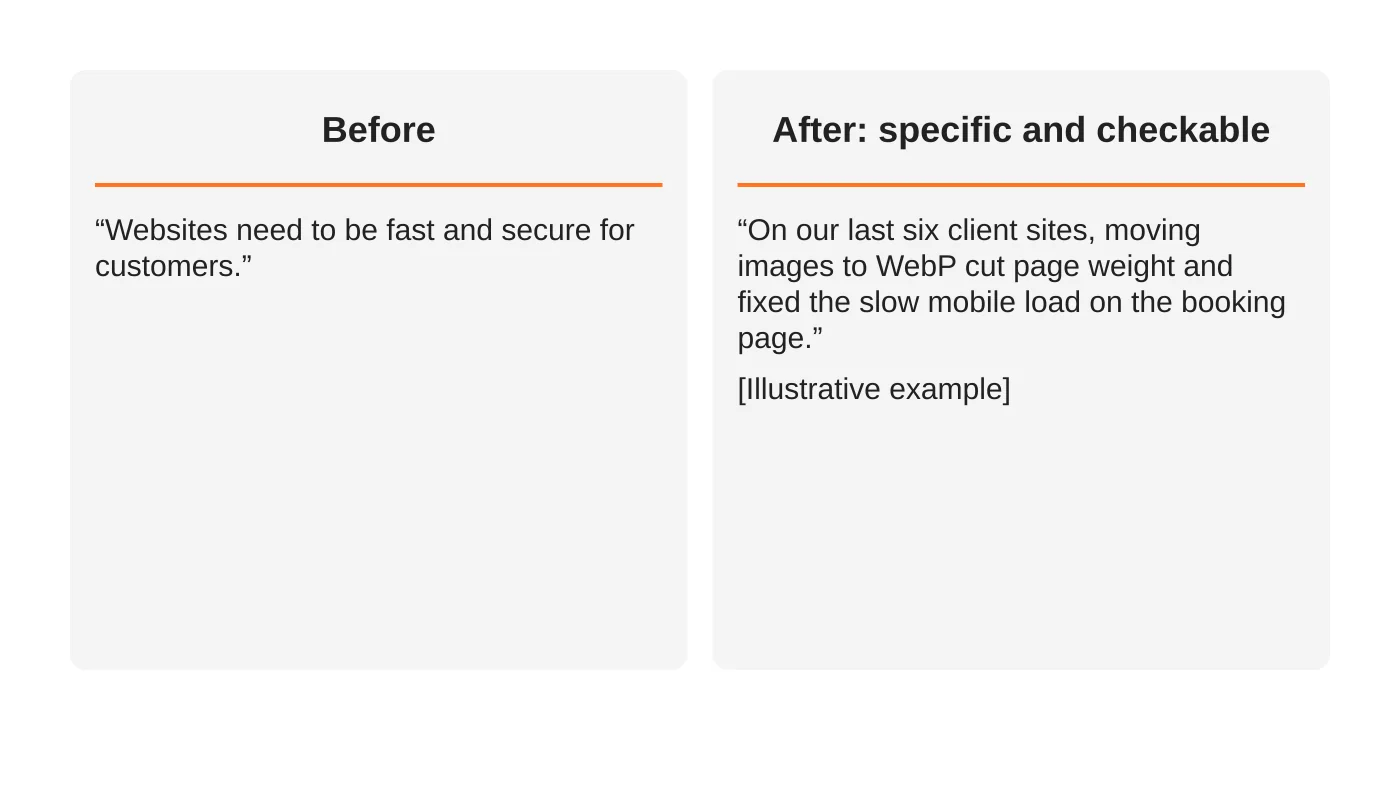
Generic text can be written by anyone. Specific, checkable text signals real experience and is more useful to readers and to any system looking for something to quote.
How to gather the evidence
- Interview your own team. Ask what they see every week that outsiders do not.
- Mine your records. Anonymised enquiry data, support questions and project notes are original data.
- Run a small experiment. Test one change on one page and report what happened.
- Keep a swipe file of customer questions, with permission.
- Ask customers for permission to use their stories. Never invent testimonials or case studies.
Using AI in the process
AI is fine for outlines, first drafts and tidying. It cannot supply your experience. Give it your notes, then edit hard and fact-check every claim. See what to hand over to an AI marketing assistant and the one-page AI use policy.
What to avoid
- Fake statistics and quotes. They damage trust and break the point of citing evidence.
- Stuffing pages with numbers that do not matter.
- Mass-producing near-duplicate pages. Google’s guide warns against it.
- Buying mentions or links to fake authority. Google says artificial mentions do not help.
Apply it to your best pages first
Start with your five most important pages. For each, add at least one piece of original evidence and one sourced fact. Use the content audit to choose which to improve. Then see answer-first pages and real FAQs for structure.
Frequently asked questions
Do I need original research?
You need original evidence, which can be small: one real number, one real photo, one real example.
Will AI cite my page if I add statistics?
Not guaranteed. Evidence makes a page more useful, and usefulness is what the systems are trying to find.
Can I use AI-written text?
Yes, if it is edited, accurate and carries your real experience.
How long should the page be?
Google says there is no ideal length. Be complete and clear.
From the Wired for Growth newsletter
This guide builds on AI Is Making “More” Worth Less and In the Age of AI, Expertise Is About Asking the Right Questions, Not Knowing All the Answers from Duarne Bernhagen’s LinkedIn newsletter, Wired for Growth.
Sources
- Optimizing your website for generative AI features on Google Search, Google Search Central
- GEO: Generative Engine Optimization, Aggarwal et al., KDD 2024
- Generative Engine Optimization framework introduced in new research, Search Engine Land
Get content with substance
Web Design Davao’s content team can help you pull real evidence out of your business and turn it into pages worth citing. Ask about content.