
Quick answer
Answer-first writing puts the direct answer at the top of the page, then adds detail for those who want it. It helps skimming readers and gives search and AI systems a clear statement to find. Follow it with who the page suits, how it works, cost, proof, a next step and real FAQs.
- Take FAQs from real customer emails, calls, chats and stalled quotes, not from keyword-shaped questions nobody asked.
- Place questions on the relevant service page under clear subheadings, in readable text rather than hidden in tabs.
- If you cannot publish prices, explain what changes the price, and never publish a number you cannot back up.
When someone asks an AI assistant “how much does it cost to redesign a clinic website in Davao?”, the assistant looks for pages that answer that question directly. Many business websites do not. They open with a slogan, a company history or a vague promise, and make the reader dig.
Your Website Isn’t Broken — It’s Being Ignored said a website is not broken, it is being ignored. One reason is that it never answers the question the visitor came with. This guide shows how to fix that.
Write the answer first
Answer-first writing puts the direct answer at the top, then adds the detail for those who want it. It helps human readers who skim, and it gives search and AI systems a clear statement to find. Google’s guidance says content should be organised clearly and be satisfying for visitors. It also says there is no need to chop content into tiny pieces, so this is about clarity, not formatting tricks.
Related reading: Branch Pages That Answer Local Questions and Route Enquiries Correctly.
A page pattern that works
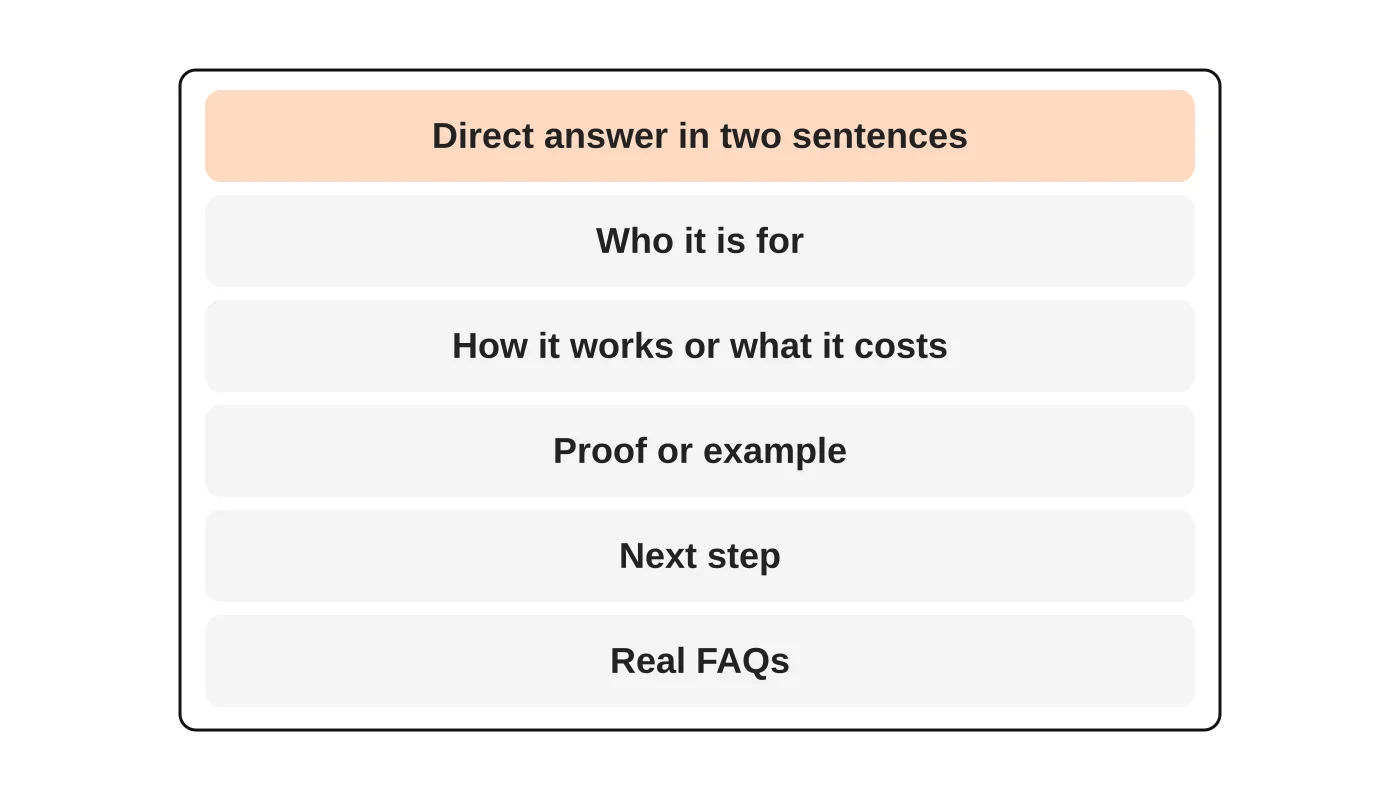
- Direct answer. One or two plain sentences, no jargon.
- Who it is for and when it is not right for them.
- How it works or what is involved, in steps.
- Cost or how pricing works. If you cannot publish prices, explain what changes the price.
- Proof or an example. Real, labelled, with permission.
- Next step. One clear action.
- FAQs at the bottom.
See headlines and opening lines that get enquiries for the first lines, and why website copy attracts the wrong customers for the promise behind them.
Related reading: B2B SEO for Manufacturers: Processes, Applications and Buyer Questions.
What counts as a real FAQ
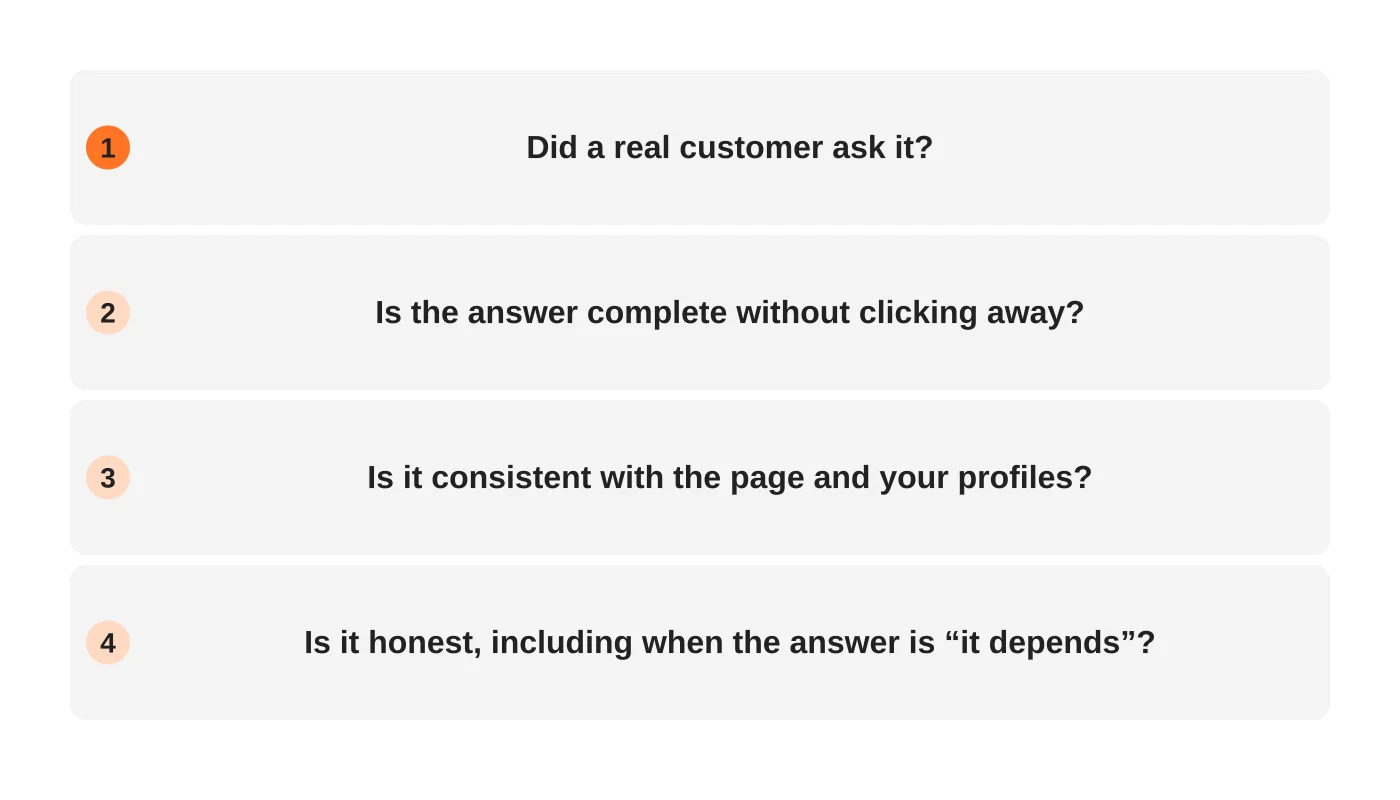
A real FAQ comes from real customers. Take it from emails, calls, chats, quotes that stalled and what your team keeps explaining. A fake FAQ is a list of keyword-shaped questions nobody asked. It adds noise and makes the page worse.
Good FAQ answers:
- Are complete. They answer without making the reader click away.
- Are honest. “It depends, and here is what it depends on” beats a vague claim.
- Match the rest of your site and your Business Profile. Mixed information confuses people and systems.
- Link to deeper pages where useful.
Where to put the questions
- On the relevant service page, not all on one giant FAQ page.
- Under a clear heading, with each question as a subheading.
- In readable text, not hidden in tabs that need a script to open if you can avoid it.
Google no longer shows FAQ rich results for most sites, so FAQ markup brings little visible benefit. Write FAQs for readers. See schema markup for AI search.
Examples of answer-first openings
- Weak: “We are a passionate team dedicated to excellence in web solutions.”
- Better: “A basic business website in Davao usually takes four to eight weeks, depending on how fast you send content and approve designs.”
Note the second example sets an expectation and invites the next question. Never publish a number you cannot back up.
Check your top five pages
For each page, ask:
- Does the first screen answer the visitor’s question?
- Is there something here that only my business can say?
- Are the FAQs real?
- Is the next step obvious?
Then update the worst page first. The content audit guide helps prioritise.
Frequently asked questions
Should every page have an FAQ?
No. Add one where real questions exist.
How many questions?
As many as customers really ask, usually four to eight per page.
Will answer-first writing get me cited by AI?
It makes your page clearer and more useful. Citation is never guaranteed.
What about voice and chat search?
Natural, direct answers suit both. See how AI search chooses its sources.
From the Wired for Growth newsletter
This guide builds on Your Website Isn’t Broken — It’s Being Ignored from Duarne Bernhagen’s LinkedIn newsletter, Wired for Growth.
Sources
- Optimizing your website for generative AI features on Google Search, Google Search Central
- Top ways to ensure your content performs well in Google’s AI experiences on Search, Google Search Central
Rewrite your key pages
Web Design Davao’s content team can rewrite your top pages so they answer first and convert. Ask for a rewrite.


