

Quick answer
Assess an offshore help desk technician with a structured, paid assessment in a sandbox, never on production systems. Use three to five scenarios and redacted sample tickets, score against a rubric set in advance with two reviewers, weight identity verification heavily, and include a scenario where information is missing to see how they escalate.
- Test ticket writing, troubleshooting order, identity verification and escalation, since these decide results on a service desk.
- Use a lab tenant or test environment with fake users, and never give candidates production credentials or real client data.
- Agree the rate and time limit up front, tell candidates the data is fictional, and give feedback afterwards.
Certificates and interviews tell an MSP little about how a technician writes a ticket at 4 p.m. on a bad day. A structured, paid assessment in a sandbox shows how they reason, communicate and handle limits, without risking client systems.
This guide is for MSP owners and service desk managers. It covers what to test, how to build the sandbox, a scoring rubric and how to treat candidates fairly. It does not assert the qualifications of any particular Web Design Davao staff. See also what to delegate to an offshore service desk.
What you are testing
Technical knowledge matters, but on a service desk the other skills decide results:
- Ticket writing and customer communication: can they record what happened and explain it to a non-technical user?
- Troubleshooting reasoning: do they work in a sensible order and change one thing at a time?
- Identity verification and escalation: do they follow security procedure under pressure, and know when to hand over?
Build a sandbox, never use production
Use a lab tenant, virtual machines or a documented test environment with fake users. Do not give a candidate production credentials, client names or real data. Prepare three to five scenarios, such as a locked-out user, a slow laptop, a mailbox issue and a suspicious email report. Write expected steps and the points where escalation is right.
Use redacted sample tickets
Give the candidate two or three redacted tickets that mirror real work. Remove names, domains and any identifying details. Ask them to respond as they would to the user and to write the internal notes. Compare the notes with what a colleague would need to continue the ticket.
Score against a rubric
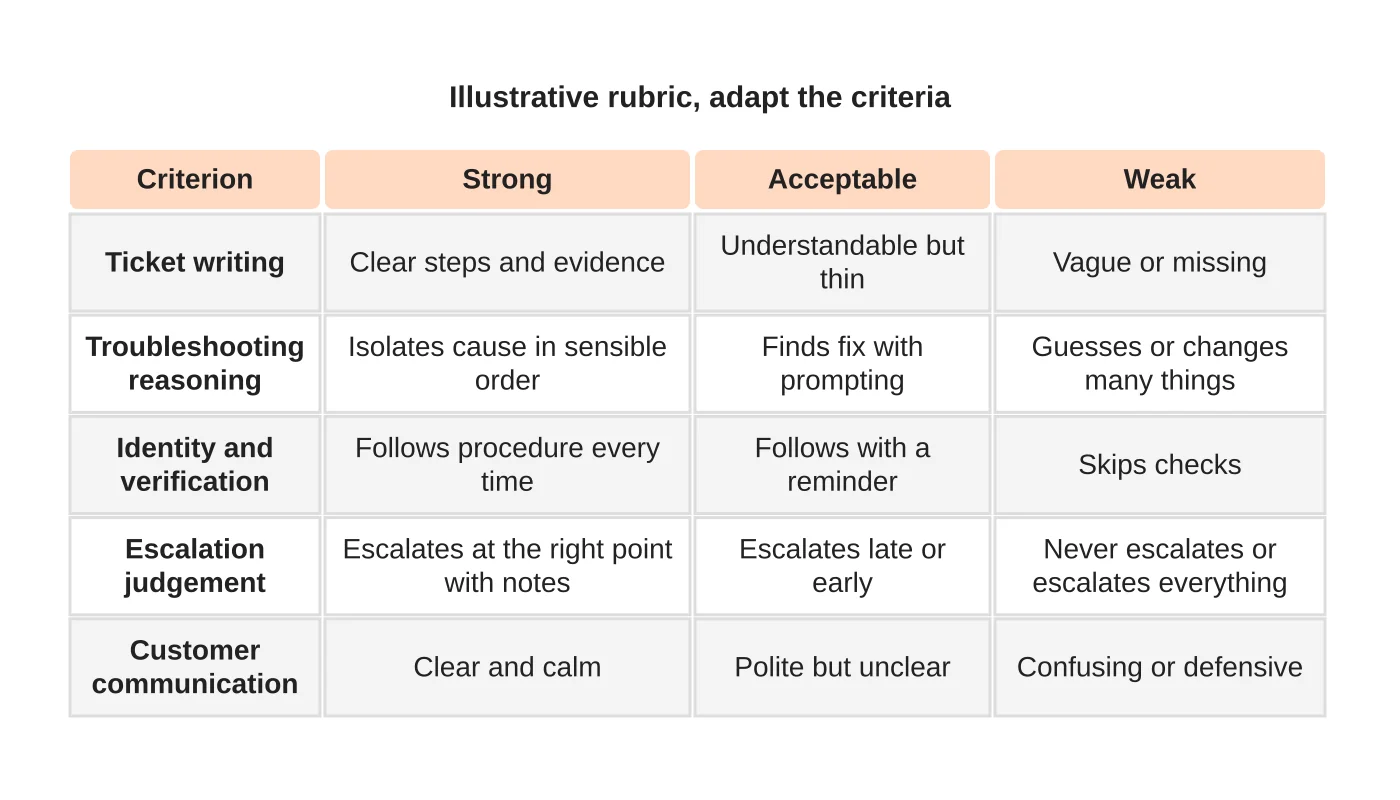
Define strong, acceptable and weak for each criterion before you see any candidate. Have two reviewers score separately, then discuss differences. Weight identity verification heavily. A technician who is quick but skips verification is a risk to your clients. Keep scores and notes for a fair comparison between candidates.
Pay for the assessment
A paid assessment respects the candidate and filters for people who take it seriously. Agree the rate and time limit up front, tell them it uses fictional data and do not reuse their work for production. Keep the task short. This is general information, not legal advice. Check your situation with a qualified adviser.
Look at how they handle not knowing
Include one scenario with a missing piece of information or an out-of-scope request. Strong candidates ask a clear question, state what they know, and escalate with a useful note. Weak ones guess, or stay silent. See offshore help desk escalation for what a good handover contains.
After the assessment
Give feedback to each candidate. Decide on evidence, not impressions. If hired, connect the results to onboarding: skills that scored acceptable become your first coaching items. See onboarding into PSA, RMM and documentation tools and access controls for offshore working.
Things to avoid
- Trick questions that test trivia, not work.
- Free labour: never use real client work as the test.
- Judging accent or style instead of clarity.
- Skipping the security scenario.
What Web Design Davao can say
Assessment and selection arrangements depend on the agreed role and scope.
Frequently asked questions
Why use a sandbox to assess a technician?
A sandbox shows how a candidate reasons, communicates and handles limits without risking client systems. Use a lab tenant, virtual machines or a documented test environment with fake users, and never give production credentials, client names or real data.
How should the assessment be scored?
Define strong, acceptable and weak for each criterion before seeing any candidate. Have two reviewers score separately, then discuss differences. Weight identity verification heavily, because a technician who skips it under pressure is a risk to your clients. Keep scores and notes for fair comparison.
Should the assessment be paid?
A paid assessment respects the candidate and filters for people who take it seriously. Agree the rate and time limit up front, tell them it uses fictional data and do not reuse their work for production. This is general information, not legal advice.
Sources
Talk through the role
Send us your ticket categories, tool stack, required hours and escalation structure so we can discuss the role. Learn about our outsourced staffing service or get in touch.


