

Quick answer
A month-end workflow for offshore bookkeeping support separates preparation from review. The assistant collects source records, codes and reconciles, and flags exceptions with evidence. An authorised reviewer in the firm approves reconciliations, decides how exceptions are treated, and signs off the close summary. Tax advice and lodgements stay with the firm.
- Start chasing missing statements and invoices early, not on the last day.
- Keep preparer and reviewer roles separate and record who approved and when.
- After close, note reasons for exceptions and rework and update the instructions, since patterns appear over a few months.
Month-end is where bookkeeping quality is tested. Late records, unreconciled accounts and unanswered queries pile up. A clear workflow lets a supervised offshore bookkeeping assistant prepare the work while an authorised reviewer in the firm keeps control of decisions.
This guide gives an example checklist and the checkpoints. It distinguishes preparation from review and does not describe tax advice or licensed sign-off, which remain with the firm. See what an offshore bookkeeping assistant can do for the role boundaries.
Step 1: prepare source records
Before any coding, the preparer collects statements, supplier invoices, payroll reports and any client-supplied documents. They check that the period is complete, such as no missing statement months, and note what is outstanding. Chasing missing items starts early, not on the last day. See client onboarding and document collection for the follow-up approach.
Step 2: code and reconcile, flag exceptions
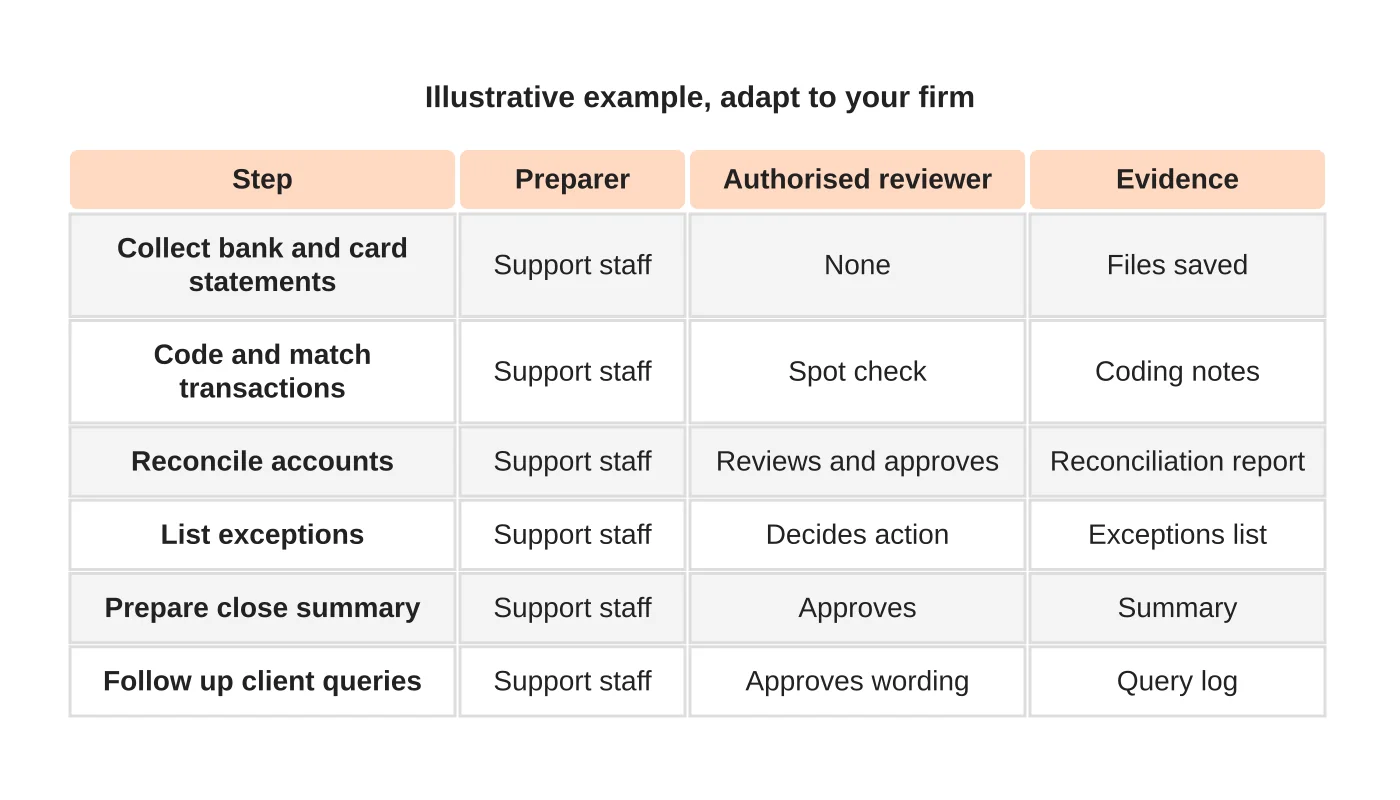
The preparer codes transactions according to the firm’s rules and reconciles accounts. They do not decide how to treat unusual items. They flag them: unrecognised payments, large or round-sum movements, possible duplicates, items that do not match a document. Each exception is listed with the evidence and a question for the reviewer.
Step 3: reviewer checkpoints
Insert checkpoints where an authorised reviewer looks at the work:
- After reconciliation, to review the report and approve the accounts.
- After exceptions, to decide treatment and any client query.
- Before the close summary goes out.
Keep the preparer and reviewer roles separate. Record who approved and when.
Step 4: close checklist and follow-up
On close, the preparer completes a checklist: reconciliations done, exceptions resolved or carried forward with notes, queries logged and files saved in the right place. The reviewer signs off. Open items are carried to the next month with an owner. Statutory lodgements such as BAS depend on dates set by the tax authority and are the firm’s responsibility.
Step 5: learn from the month
After close, note the reasons for exceptions and rework. Update the instructions. Over a few months, patterns appear, such as one client whose records always arrive late. Quality measures are covered in quality checks for offshore accounting support. Access rules are in secure access to client records.
Adapting the workflow
Firms with different systems, clients or services will change the steps. Keep the principle: a preparer does the groundwork, flags what is unusual and an authorised reviewer decides.
Frequently asked questions
What should the bookkeeping assistant flag instead of deciding?
Unusual items: unrecognised payments, large or round-sum movements, possible duplicates and items that do not match a document. Each exception is listed with the evidence and a question for the reviewer, who decides the treatment.
Where should reviewer checkpoints sit?
After reconciliation to review the report and approve the accounts, after exceptions to decide treatment and any client query, and before the close summary goes out. Keep the preparer and reviewer roles separate and record who approved and when.
What goes on the close checklist?
Reconciliations done, exceptions resolved or carried forward with notes, queries logged and files saved in the right place. The reviewer signs off, and any open items are carried to the next month with a named owner.
Sources
Talk through the role
Share the support tasks, systems, working hours and reviewer responsibilities your firm needs covered. Learn about our outsourced staffing service or get in touch.


