

Quick answer
To follow up roofing quotes, give every enquiry a clear status from new enquiry to decided, assign each quote one named owner and a next follow-up date, and send short, courteous follow-ups. Technical questions about materials, structure, timing or safety go to a qualified roofer, not the office.
- Track stages: new enquiry, inspection booked, inspected, quote sent and decided, with dates, contact details, job type and source.
- Follow up once after a few days and again after another week, then close the quote and record the reason.
- Spend ten minutes weekly checking quotes older than a week with no outcome, and ensure each has an owner.
Roofing sales often fail between the inspection and the decision. The quote is sent, nobody follows up and the customer chooses someone who did. A simple pipeline ensures every quote has an owner and a date. This guide sets it out. Technical judgement always stays with qualified roofers, and administrative staff must not answer technical questions. Staffing details for any remote support need confirmation.
1. Record inspection and quote status
Give each enquiry a clear status and keep it up to date:
- New enquiry
- Inspection booked
- Inspected
- Quote sent
- Decided: accepted, declined or no reply
- Scheduled or closed
Record the dates, the customer’s contact details, the property area, the type of job and the source of the enquiry. A spreadsheet is enough to start with, and a simple customer system can follow.
2. Assign customer follow-up
Each quote has one named owner and a next follow-up date. A reasonable pattern is:
- confirm that the quote was received,
- follow up once after a few days to ask whether the customer has questions,
- send a final polite check after another week,
- close the quote and record the reason if the customer declines or does not reply.
Follow-up is courteous, short and free of pressure. Contact only people who agreed to be contacted, and stop when the customer asks.
3. Route technical questions
Customers often ask questions about materials, structure, timing or safety. These go to a qualified roofer, not to the office. The administrator records the question and says, “I will pass this to our roofer, who will reply.” Agree in advance which topics are always escalated.
4. Track decisions and handover
When a quote is accepted, hand over the scope, agreed price, access details and any customer requests to the crew lead and confirm the schedule with the customer. When a quote is declined or lost, record the reason if the customer shares it. Over time, those reasons show whether price, timing, trust or something else is the issue.
After the job, record completion, any follow-up work and a review request if appropriate.
5. Review the pipeline weekly
Spend ten minutes each week looking at quotes older than a week with no recorded outcome. Check that every open quote has a next action and an owner. Monthly, review how many inspections led to quotes, how many quotes were accepted and how long each stage took. Use the numbers to improve the process, not to pressure customers.
Roofing quote pipeline
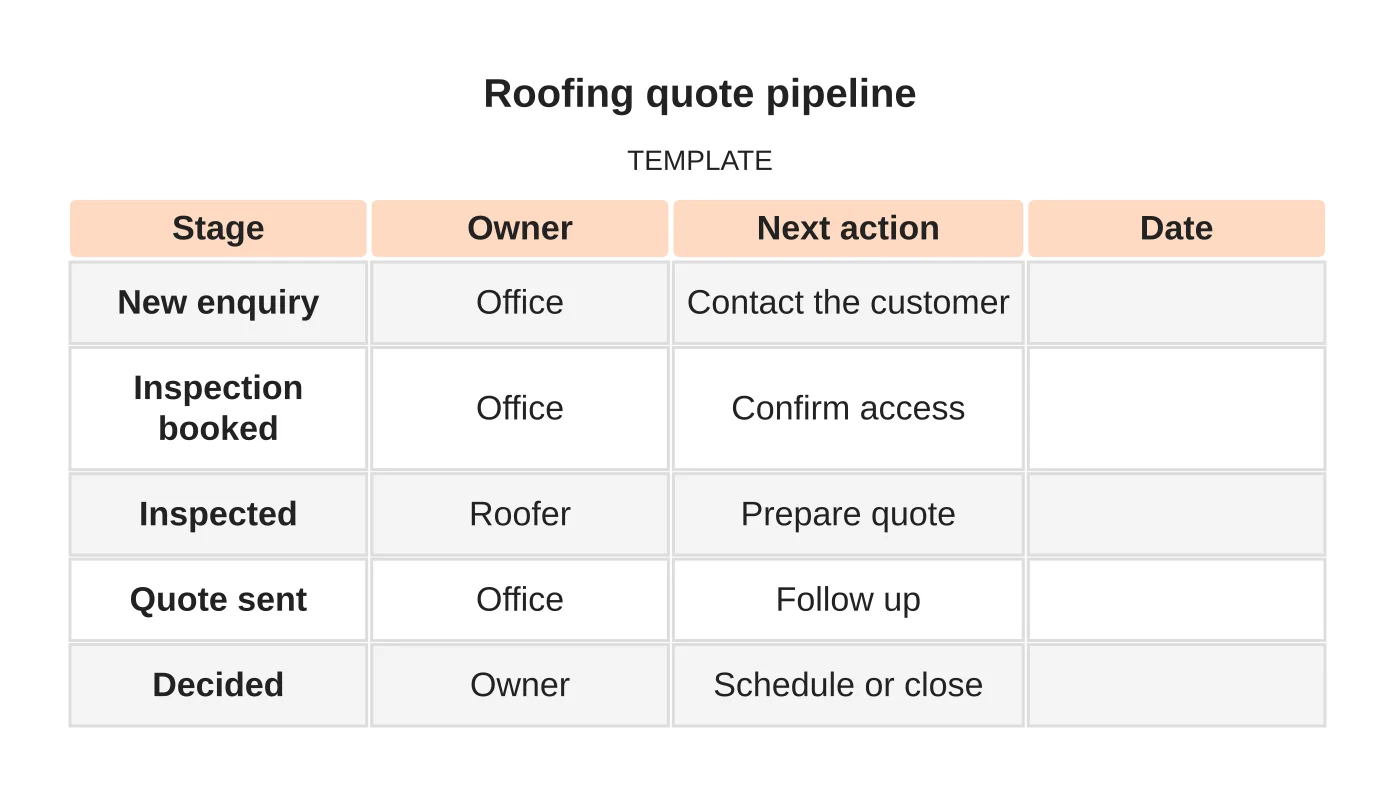
| Stage | Owner | Next action | Date |
|---|---|---|---|
| New enquiry | Office | Contact the customer | |
| Inspection booked | Office | Confirm access | |
| Inspected | Roofer | Prepare quote | |
| Quote sent | Office | Follow up | |
| Decided | Owner | Schedule or close |
Related reading: Roofing Case Studies with Photos, Scope, Materials and Verified Outcomes.
Common mistakes
- Sending quotes with no follow-up date.
- Office staff answering technical questions.
- Following up too often or after a refusal.
- Not recording why quotes are lost.
- Letting old quotes sit with no status.
Questions roofers ask
Do I need software? A shared spreadsheet is a good start. Move to a simple customer system when volume grows, and make sure you can export your data.
Who should follow up? Someone who is clearly responsible, whether that is you, an office person or a remote administrator. Technical questions always come back to a roofer.
How many follow-ups are reasonable? Two or three polite messages are usually enough. Stop if the customer declines.
See the roofing website checklist and the service-page content matrix.
Next step
Share your recurring tasks, required hours and approval boundaries so Web Design Davao can discuss a suitable staffing role. Read about our outsourced staffing service or contact us.
Frequently asked questions
How many follow-ups are reasonable after a roofing quote?
Two or three polite messages are usually enough. Contact only people who agreed to be contacted, keep messages short and free of pressure, and stop if the customer declines or asks you to.
Who should follow up roofing quotes?
Someone clearly responsible, whether that is you, an office person or a remote administrator. Technical questions always come back to a roofer, and the administrator records the question and passes it on.
Do I need software to track quotes?
A shared spreadsheet is a good start. Move to a simple customer system when volume grows, and make sure you can export your data. Each quote still needs one named owner and a next follow-up date.
Sources and notes
Last updated 21 November 2026. This guide is general information based on Web Design Davao’s web design and digital marketing practice. It cites no statistics and makes no promise about rankings, enquiries or contracts. Web Design Davao is not licensed or certified in this industry, so check technical, safety, legal and regulatory matters with a suitably qualified professional. Examples are templates or illustrations, not client results.


