
Quick answer
Roofers should plan a separate page for each customer intent, such as repair, replacement, maintenance and commercial roofing, because the needs and urgency differ. Explain what you do and where, link each page to matching project evidence, cross-link without duplicate copy and measure whether the enquiries match what each page offers.
- Say what you do not do as well as what you do, so unsuitable enquiries do not waste time.
- Use safe photography only, and never encourage customers to climb on roofs to take photographs.
- Match evidence to the page: replacement projects on the replacement page, repairs on the repair page.
Roofing customers search for repair, replacement or leak help, and these are different needs with different urgency. Planning a page for each intent, with real evidence, avoids duplicate text and helps customers find the right next step. This guide gives a content matrix and the thinking behind it. It makes no ranking promise.
1. Separate buyer intents
Start by listing the situations that bring customers to you.
- A problem now: a leak or storm damage, which needs a fast, calm route to an inspection.
- A planned project: replacing or renovating a roof, which needs more information and comparison.
- Prevention: inspections and maintenance, which need a reason to book.
- Property managers and commercial owners: who care about budgets, access and records.
Give each intent its own page or section. A page that tries to serve all of them ends up generic.
Related reading: How Fitness Centres and Gyms in Davao Can Build Memberships Through SEO and SocialProof.
2. Explain actual services and coverage
For each page, state what you do and where. Say what you do not do, so customers with unsuitable jobs do not waste time. Describe the process in simple steps: enquiry, inspection, written scope and quote, work, and aftercare. Keep technical detail accurate and reviewed.
State your coverage once and clearly. Create area-specific pages only where you have distinct local content.
3. Use project evidence
Link each service page to approved examples that match it. A replacement page should show replacement projects, a repair page should show repairs. Keep the evidence in one place, such as a project story, and link to it rather than copying the text.
Use safe photography only. Never encourage customers to climb on roofs to take photographs, and avoid images of unsafe work practices.
4. Link relevant pages without duplicate copy
Cross-link related pages with a short explanation of why the next page helps, such as “If you are planning a full replacement, see how we scope and quote it”. Avoid pasting the same paragraphs into every page. Each page should answer its own question and then point onward.
See the roofing website checklist for the wider structure and a roofing project story template for building the evidence.
5. Measure relevance
Check which pages receive enquiries and whether the enquiries match what the page offers. If a repair page attracts requests for work you do not do, tighten the wording. If a replacement page receives no enquiries, check that it answers the buyer’s questions and links to the inspection request.
Roofing service-page content matrix
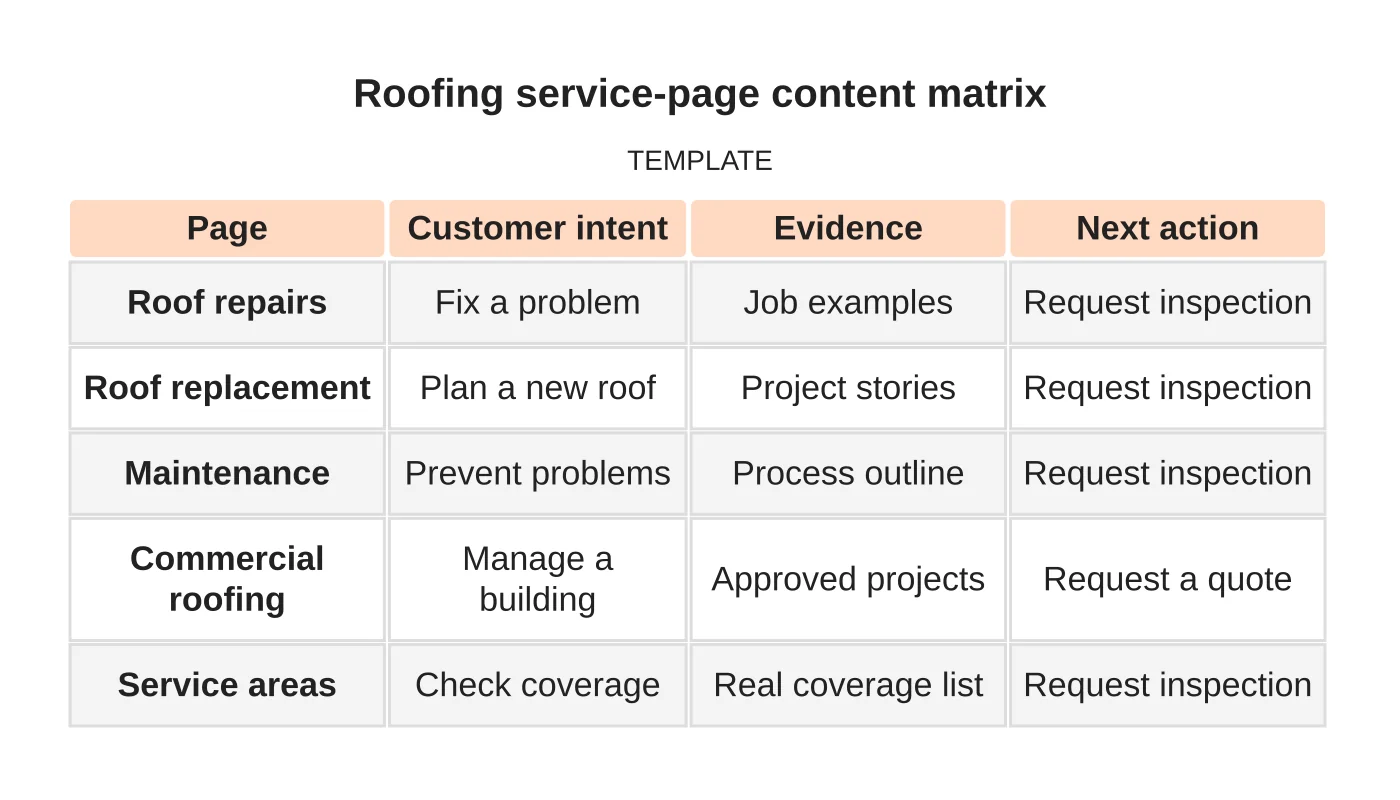
| Page | Customer intent | Evidence | Next action |
|---|---|---|---|
| Roof repairs | Fix a problem | Job examples | Request inspection |
| Roof replacement | Plan a new roof | Project stories | Request inspection |
| Maintenance | Prevent problems | Process outline | Request inspection |
| Commercial roofing | Manage a building | Approved projects | Request a quote |
| Service areas | Check coverage | Real coverage list | Request inspection |
Common mistakes
- One page for all services.
- Copying the same text across area pages.
- Evidence that does not match the service on the page.
- Encouraging customers to inspect roofs themselves.
- No next step.
Questions roofers ask
How many pages do I need? Enough to cover each distinct customer need you can address truthfully. For many contractors that is four to six pages, plus project stories.
Should I show prices? Explain how you quote and what affects cost. Publish figures only if you can keep them current.
What about storm damage? If you offer it, describe your process honestly. Do not advertise emergency response you cannot provide.
Can I reuse text from suppliers? Do not copy supplier or competitor text. Write in your own words and have technical content reviewed.
Next step
Discuss your target customers, service area and lead-generation priorities with Web Design Davao. Read about our digital marketing service or contact us.
Frequently asked questions
How many pages does a roofing website need?
Enough to cover each distinct customer need you can address truthfully. For many contractors that is four to six pages, plus project stories. Do not use one page for all services, and create area pages only where you have distinct local content.
Should a roofer show prices on the website?
Explain how you quote and what affects cost. Publish figures only if you can keep them current. A page can describe the process in simple steps: enquiry, inspection, written scope and quote, work and aftercare.
How should a roofer handle storm damage on the website?
If you offer it, describe your process honestly. Do not advertise emergency response you cannot provide. Give a fast, calm route to an inspection request, and never encourage customers to inspect roofs themselves or climb up to take photographs.
Sources and notes
Last updated 21 November 2026. This guide is general information based on Web Design Davao’s web design and digital marketing practice. It cites no statistics and makes no promise about rankings, enquiries or contracts. Web Design Davao is not licensed or certified in this industry, so check technical, safety, legal and regulatory matters with a suitably qualified professional. Examples are templates or illustrations, not client results.