
Quick answer
A manufacturing website should let a buyer confirm you can make the part, at the quantity and quality they need, before sending a drawing. Write separate sections for engineers, procurement and owners, list processes, materials and typical order sizes, show only current quality documents you hold, and give a request-for-quote route with a secure way to send drawings.
- State what you do not make, and give tolerances, capacities and lead times only as your technical team confirms.
- Show certificates only if current and in your company’s name, with issuing body, scope and validity where appropriate.
- Never publish customer drawings or names, and record each enquiry by type, industry and whether it was quotable.
A buyer evaluating a manufacturer wants to confirm that you can make the part, at the quantity and quality they need, before sending a drawing. They may be an engineer checking processes and tolerances, a procurement officer checking capacity and documents, or an owner looking for a local supplier. A manufacturing website should make that evaluation easy without exposing confidential detail. This guide covers the structure, the evidence and the request-for-quote path. It makes no promise about rankings or orders.
Web Design Davao is a web design and digital marketing business and not a certification body. Process, tolerance, capacity and quality statements must come from, and be reviewed by, your own technical people, and certifications may be stated only where you hold them.
1. Identify procurement and technical readers
Industrial buying involves several readers who each look for different things.
- Engineers and technical buyers check processes, materials, tolerances, equipment and whether you have made similar parts.
- Procurement officers check capacity, lead-time approach, documents, payment and delivery terms and supplier reliability.
- Owners and managers check whether you are a credible, stable supplier and who they would deal with.
Write separate sections for each. Let the home page route a visitor to capabilities, quality, facilities and the request-for-quote form in one click.
2. Explain processes, capacity and scope
List the processes you run, the materials you work with and the typical order sizes you handle. State what you do not make. A statement such as “We machine, fabricate and finish metal components to customer drawings in small and medium batches” tells a buyer more than “high-quality solutions”.
Be careful with numbers. Tolerances, capacities and lead times should be stated only as your technical team confirms, with context. If they vary, say they are confirmed at quote.
3. Present approved quality evidence
Show certificates and quality documents only if current and held in your company’s name. Put the issuing body, scope and validity where appropriate. Do not imply approval by a customer, a standard or a body without evidence. If a certification is being renewed, avoid wording that implies it is current when it is not.
Describe your quality process in practical terms: inspection steps, records kept and how problems are handled, but only as true.
4. Create useful RFQ paths
Provide a request-for-quote route that captures what an estimator needs, and explain what happens next. See manufacturing RFQ forms for design. Offer a secure way to send drawings and a route for confidential projects.
5. Support search and keep documents current
Plan search content around the processes and applications buyers look for; see B2B SEO for manufacturers. Keep datasheets, capability statements and certificates current; see keeping technical documents current.
6. Measure qualified enquiries
Record each enquiry by type, industry, part type and whether it contained enough detail to quote. Track how many became quotes and orders. Review monthly.
Manufacturing capability sitemap
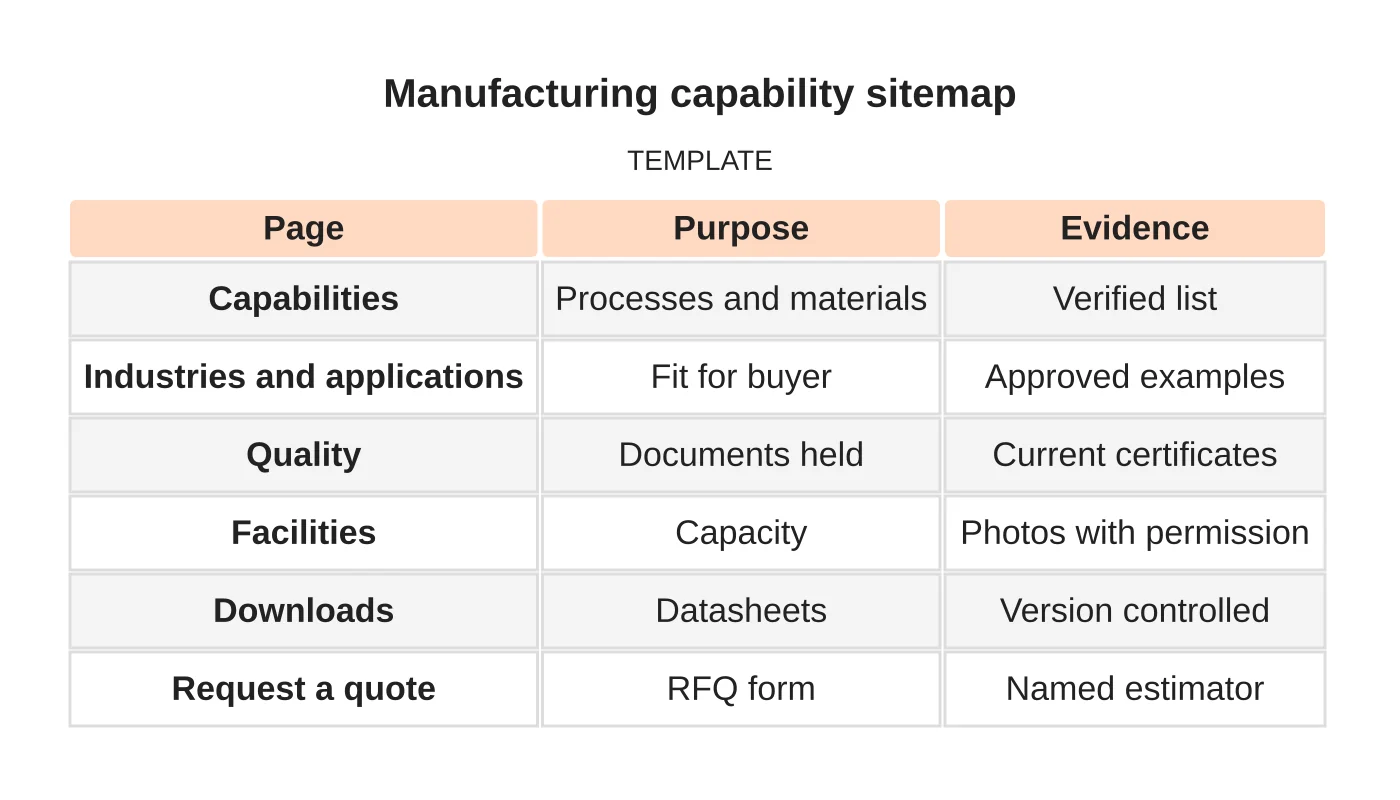
| Page | Purpose | Evidence |
|---|---|---|
| Capabilities | Processes and materials | Verified list |
| Industries and applications | Fit for buyer | Approved examples |
| Quality | Documents held | Current certificates |
| Facilities | Capacity | Photos with permission |
| Downloads | Datasheets | Version controlled |
| Request a quote | RFQ form | Named estimator |
Common mistakes
- Vague claims such as “total solutions”.
- Certification claims without current documents.
- Publishing customer drawings or names.
- A generic contact form instead of an RFQ route.
- Out-of-date downloads.
Questions manufacturers ask
Should I list my equipment? If it helps buyers judge capability and is accurate. Do not imply capacities you cannot deliver.
Can I show customer parts? Only with permission and without confidential details.
Does a website bring orders? It helps buyers evaluate and request quotes. Orders depend on price, quality, capacity and relationships.
Related: export business websites address overseas buyers.
Next step
Request a website review or discuss the pages and enquiry workflow your business needs. Read about our web design service or contact us.
Frequently asked questions
Should a manufacturer list its equipment on its website?
If it helps buyers judge capability and is accurate. Do not imply capacities you cannot deliver. Tolerances, capacities and lead times should be stated only as your technical team confirms, and if they vary, say they are confirmed at quote.
Can a manufacturer show customer parts online?
Only with permission and without confidential details. Avoid publishing customer drawings or names, and offer a route for confidential projects and a secure way to send drawings instead. Use approved examples only.
Does a manufacturing website bring orders?
It helps buyers evaluate you and request quotes. Orders depend on price, quality, capacity and relationships. Use a request-for-quote route rather than a generic contact form, and track which enquiries become quotes and orders each month.
Sources and notes
Last updated 21 November 2026. This guide is general information based on Web Design Davao’s web design and digital marketing practice. It cites no statistics and makes no promise about rankings, enquiries or contracts. Web Design Davao is not licensed or certified in this industry, so check technical, safety, legal and regulatory matters with a suitably qualified professional. Examples are templates or illustrations, not client results.


