

Quick answer
Manufacturers can plan B2B search content around how industrial buyers search: by process, material and application. Keep capability pages for made-to-order work separate from product pages for standard items, show technical evidence only with written permission and team confirmation, keep business details consistent, and judge success by qualified enquiries that contain enough detail to quote.
- Confirm buyer search terms with sales and engineering staff and recent customers instead of assuming them.
- Obtain written permission before showing customer work, and remove drawings, part numbers, names and tolerances that could identify them.
- Improve the RFQ form if many enquiries lack a part, quantity, material or date.
Industrial buyers search by process, material and application, and often use technical terms. Content should answer those searches with real specifics and without disclosing confidential data. This guide covers how a manufacturer can plan B2B search content, separate capability and product pages and measure qualified enquiries. It makes no ranking claim, and search platforms change their guidance, so check current official guidance before making technical changes.
1. Map process and application intent
List the processes you run and the applications you serve. Then write down the terms a buyer would use for each, confirmed with your sales and engineering staff and recent customers. A buyer may search by process (“CNC machining small batch”), by material, by application (“components for food processing equipment”) or by a specific part type. Do not assume; ask.
2. Separate capability and product pages
- Capability pages describe what you can make to order: process, materials, sizes, finishes and how the order process works.
- Product pages describe standard items: specification, options, ordering and documents.
Keep them separate. Buyers looking for a supplier to make a custom part should not have to read product catalogue text, and buyers looking for a standard item should not have to find it inside a capability page.
3. Use technical evidence without exposing confidential data
Technical evidence, such as examples of parts, process descriptions and inspection approaches, builds credibility. Customers’ drawings, part numbers, names and tolerances may be confidential. Obtain written permission before showing any customer work, and remove details that could identify the customer or the design.
State technical claims only as your technical team confirms.
Related reading: Keeping Manufacturing Websites and Technical Documents Current.
4. Support pages with accurate business details
Keep company name, address, phone and service information consistent across the website, your Google listing and directories. If you ship nationally or internationally, say so accurately, and consider the needs of overseas buyers separately; see international SEO for export businesses.
5. Evaluate qualified enquiries
A qualified enquiry contains enough information to quote: a part or drawing, a quantity, a material and a date. Track how many enquiries meet that standard, the sources and the outcomes. If many enquiries lack detail, improve the RFQ form; see RFQ forms. If you attract enquiries for work you do not do, clarify the capability pages. See the manufacturing website guide.
Process-application content matrix
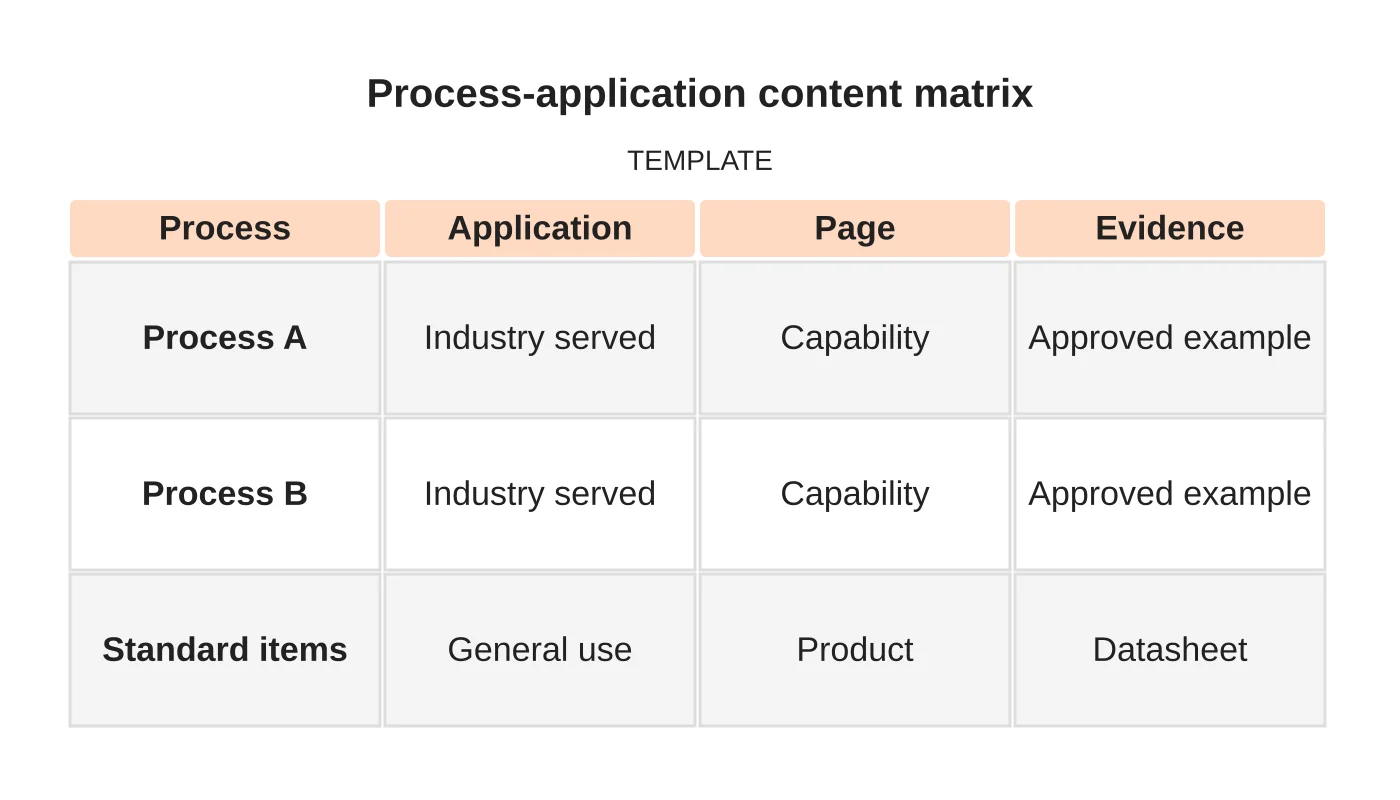
| Process | Application | Page | Evidence |
|---|---|---|---|
| Process A | Industry served | Capability | Approved example |
| Process B | Industry served | Capability | Approved example |
| Standard items | General use | Product | Datasheet |
Common mistakes
- Pages for processes you do not run.
- Technical claims with no review.
- Publishing customer details.
- Copying supplier text.
- Counting all enquiries as qualified.
Questions manufacturers ask
Which terms should I target? Those your buyers use, confirmed through conversations and Search Console data, not assumed volumes.
Do I need case studies? They help, with permission. See the evidence guidance in the manufacturing website guide.
Next step
Discuss your target customers, service area and lead-generation priorities with Web Design Davao. Read about our digital marketing service or contact us.
Frequently asked questions
What search terms should a manufacturer target?
Target the terms your buyers use, confirmed through conversations and Search Console data rather than assumed volumes. List the processes you run and the applications you serve, then write down the terms a buyer would use for each, such as process, material or part type.
Why separate capability pages from product pages?
Capability pages describe what you make to order, including process, materials, sizes and finishes. Product pages describe standard items with specification, options and documents. Buyers wanting a custom part should not wade through catalogue text, and buyers wanting a standard item should not have to find it inside a capability page.
What counts as a qualified enquiry for a manufacturer?
A qualified enquiry contains enough information to quote: a part or drawing, a quantity, a material and a date. Track how many enquiries meet that standard, their sources and outcomes. If many lack detail, improve the RFQ form; if you attract unwanted work, clarify the capability pages.
Sources and notes
Last updated 21 November 2026. This guide is general information based on Web Design Davao’s web design and digital marketing practice. It cites no statistics and makes no promise about rankings, enquiries or contracts. Web Design Davao is not licensed or certified in this industry, so check technical, safety, legal and regulatory matters with a suitably qualified professional. Examples are templates or illustrations, not client results.