

Quick answer
A good commercial cabling case study shows how you handled a real project: what the client needed, the site constraints, how work was coordinated, what was tested and what was handed over. Publish only with a real project, a baseline and written client approval, and report only outcomes your records support.
- Describe constraints such as an occupied building, limited access hours, a fixed opening date or other trades on site.
- Describe testing and handover factually, such as test results, labelling schedules and as-built information.
- Avoid cabinet photographs that reveal equipment, labels or layouts, and phrases such as future-proof or zero downtime.
A case study is the most persuasive page a cabling contractor can publish, and also the easiest to get wrong. A good one shows how you handle a real project: what the client needed, what constrained the work, how you coordinated, what you tested and what you handed over. A weak one is a gallery of photographs with a few adjectives.
This guide covers how to collect and write a commercial cabling case study. It does not supply results. A case study can only be published when a real project, a baseline and written client permission exist. Web Design Davao does not supply client examples or invent outcomes.
1. Describe site constraints and requirements
Begin with the client’s problem in plain words. Describe the type of premises, what needed cabling and why, and the main constraints. Constraints are what separate competent contractors from the rest: an occupied building, limited access hours, a fixed opening date, existing cabling that had to remain in service, or other trades working at the same time.
Write this section from the client’s point of view. For example: “A professional services office was relocating to a new floor and needed its cabling ready before staff moved in.” Avoid names, addresses and layouts unless the client has approved their use.
2. Show agreed work and coordination
Explain what was agreed and how the work was organised. Buyers want to know that you manage access, staff and other trades. Useful details include:
- who the contacts were on the client side and how updates were shared,
- how work was scheduled around the client’s operations,
- how you coordinated with electricians, builders or fit-out teams,
- how changes to scope were handled.
Keep to what happened. If a change occurred and was resolved well, say so briefly. Honest detail is more convincing than a flawless story.
Related reading: Service Pages for Structured Cabling, Fibre Installation and Network Cabinet Work.
3. Include approved testing and documentation evidence
Describe what was tested and what records were handed over, such as test results, labelling schedules, cable records and as-built information. Where the client permits, include a sanitised sample, with identifying details and layouts removed.
Be specific about the process without making claims you cannot back. “Each installed point was tested and the results recorded in a report provided to the client” is a factual description if it is true. “Guaranteed to meet all standards” is a claim that needs evidence and review.
4. State outcomes without unsupported claims
Report only outcomes that the client or your records support. Examples of defensible statements are the number of points installed and tested, completion within the agreed programme (if true), and the documents handed over. Avoid “future-proof”, “zero downtime” and “best in class”.
If you have no figure to report, describe the handover instead. A calm description of a well-run project is better than a number you cannot support. Before publishing, confirm the client’s written approval.
5. Interviewing the project team
The best case studies come from short interviews, not from memory. Ask the project lead and, if possible, the client contact:
- What did the client need and by when?
- What was the hardest part of the site?
- How did you handle access and other trades?
- What did you test and what did you hand over?
- Would the client be willing to approve this summary?
Record the answers, check facts against project documents and send the draft to the client for approval before it goes online.
Commercial cabling project interview and case-study template
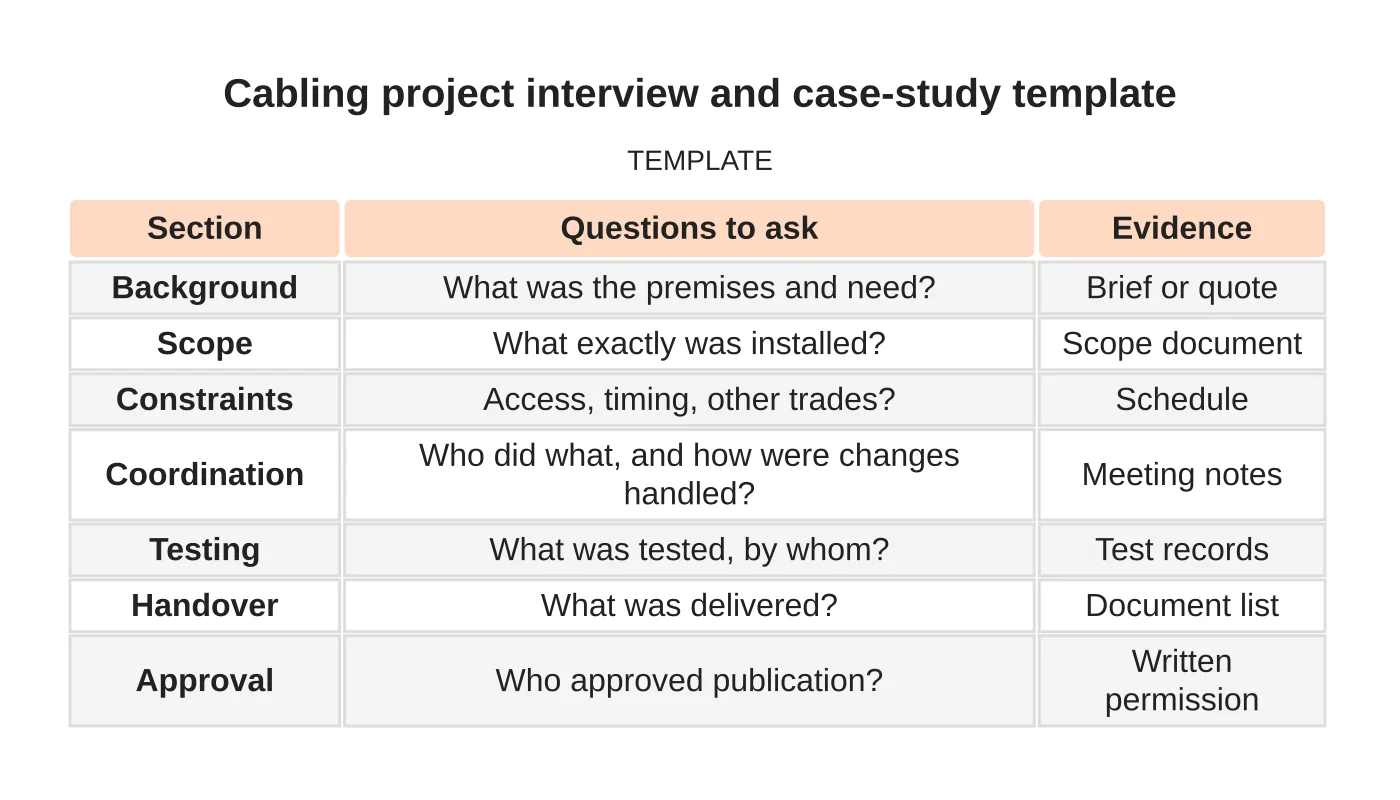
| Section | Questions to ask | Evidence |
|---|---|---|
| Background | What was the premises and need? | Brief or quote |
| Scope | What exactly was installed? | Scope document |
| Constraints | Access, timing, other trades? | Schedule |
| Coordination | Who did what, and how were changes handled? | Meeting notes |
| Testing | What was tested, by whom? | Test records |
| Handover | What was delivered? | Document list |
| Approval | Who approved publication? | Written permission |
Common mistakes
- Publishing without written client approval.
- Showing cabinet photographs that reveal equipment, labels or layouts.
- Claiming results that are not documented.
- Writing from the contractor’s point of view only.
- Treating one case study as a template and changing only the names.
Where to use the finished case study
Link it from your main cabling page, from the relevant service pages and from your survey request form, so a buyer reading it can take the next step. Keep it up to date: if a project detail changes or the client withdraws permission, remove or amend the page promptly.
Next step
Request a website review or discuss the pages and enquiry workflow your business needs. Read about our web design service or contact us.
Frequently asked questions
What should a cabling case study include?
The client’s problem and constraints, what was agreed, how access and other trades were coordinated, what was tested and what documents were handed over. Write it from the client’s point of view and keep to what happened, including a brief note of any scope change that was resolved well.
Do I need client permission to publish a case study?
Yes. Confirm the client’s written approval before it goes online, and avoid names, addresses and layouts unless the client has approved them. If permission is withdrawn or a project detail changes, remove or amend the page promptly.
What outcomes can a cabling contractor claim?
Only outcomes the client or your records support, such as the number of points installed and tested, completion within the agreed programme if true, and documents handed over. Avoid vague claims like ‘future-proof’ and ‘zero downtime’.
Sources and notes
Last updated 21 November 2026. This guide is general information based on Web Design Davao’s web design and digital marketing practice. It cites no statistics and makes no promise about rankings, enquiries or contracts. Web Design Davao is not licensed or certified in this industry, so check technical, safety, legal and regulatory matters with a suitably qualified professional. Examples are templates or illustrations, not client results.


