

Quick answer
Give structured cabling, fibre installation and cabinet work separate service pages only when each matches a distinct buyer need and you can show real scope and evidence. Each page should say what the buyer must provide, what is outside your scope, what you deliver at handover and one clear next step, such as requesting a site survey.
- Only create a page for a service you do regularly, can evidence and buyers would ask about separately.
- Show credentials only if you hold them now and can show a document, placed close to the claim.
- Link service pages to relevant project examples and back, using descriptive link text rather than ‘click here’.
A single “Services” page that lists everything in one paragraph rarely helps a buyer decide. A facilities manager looking for structured cabling for a new office wants a different answer from an IT manager asking about fibre between two buildings. Separate service pages work when each page matches a distinct need and you can describe your actual scope and evidence. This guide shows how to decide which pages you need, what each should contain and how to link them.
1. Separate genuine service capabilities
Start with an honest inventory. For each service, ask three questions: do we do this regularly, can we show evidence of it, and would a buyer search for it or ask about it separately? If the answer to all three is yes, it probably deserves its own page.
Typical candidates for a commercial cabling contractor are:
- structured cabling for offices and commercial premises,
- fibre installation within and between buildings,
- network cabinet and patching work,
- testing, labelling and documentation,
- relocation or extension of existing cabling.
If you only occasionally do a service, mention it on a related page rather than creating a thin page with little to say. Thin pages that repeat each other add nothing for buyers and make the whole site look less credible.
2. Explain buyer inputs and project boundaries
Each service page should tell the buyer what you need to know before you can quote, and what is outside your scope.
- What you need from the buyer: the type and size of the premises, the number of points or the distances involved, site access and working hours, whether the building is occupied, and the timeframe.
- What the buyer should expect from you: a site survey, a written scope, the testing carried out and the documents delivered at handover.
- What is outside your scope: for example, electrical supply, building works or active network equipment, if that is true of your business.
Clear boundaries reduce unsuitable enquiries and avoid arguments later. Buyers also appreciate it, because it shows you have thought through where responsibility changes hands between trades.
3. Present approved credentials and evidence
Show credentials, memberships and manufacturer training only if you hold them now and can show a document. Put the evidence close to the claim it supports. If a claim is about testing, show what is tested and how results are recorded. Do not claim that work meets a standard unless it was tested and documented against that standard.
Evidence can also be non-technical. A description of how you coordinate with other trades, how you protect occupied premises and how you handle sign-off is valuable to facilities managers and main contractors.
4. Write each page around the buyer’s problem
A useful structure for each service page is:
- The buyer’s situation: “You are fitting out a new office and need a cabling layout that suits your teams.”
- What the service covers: a short, plain description.
- How the process works: survey, scope, installation, testing, handover.
- What you will receive: documents and records.
- Evidence: one or two approved project examples.
- Next step: a clear “Request a site survey” action.
Keep paragraphs short and avoid jargon the buyer would not use. Where a technical term is necessary, explain it once.
5. Link service and project pages
Link each service page to the relevant project examples and back, so a buyer can move from “what do you do” to “can you do mine”. Link all service pages to the main strategy in the cabling website and SEO guide, and send the survey action to the form described in data cabling quote forms. If you use case studies as evidence, build them using the method in commercial data cabling case studies.
Use descriptive link text that tells the reader where the link leads, such as “see how we document a cabling handover”, not “click here”.
Cabling service-page intent matrix
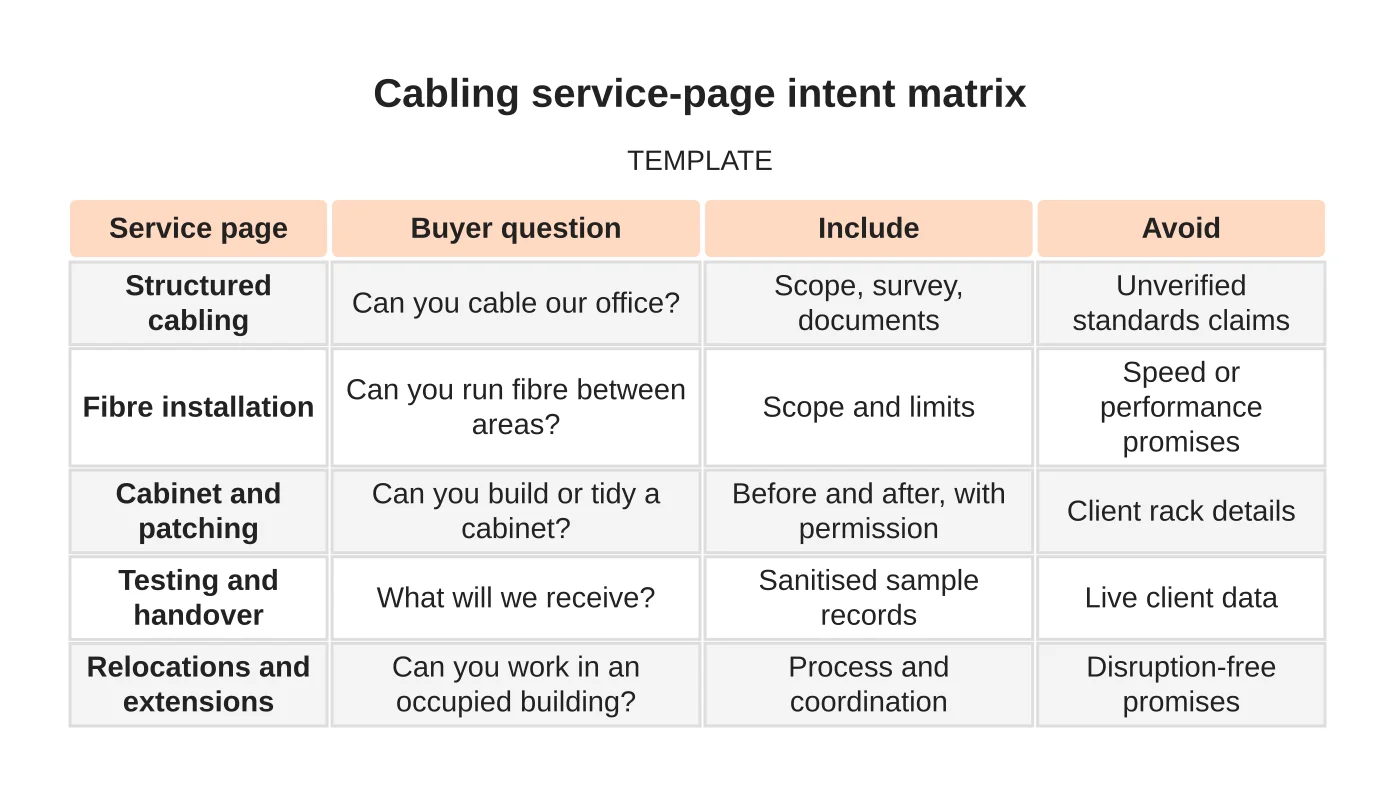
| Service page | Buyer question | Include | Avoid |
|---|---|---|---|
| Structured cabling | Can you cable our office? | Scope, survey, documents | Unverified standards claims |
| Fibre installation | Can you run fibre between areas? | Scope and limits | Speed or performance promises |
| Cabinet and patching | Can you build or tidy a cabinet? | Before and after, with permission | Client rack details |
| Testing and handover | What will we receive? | Sanitised sample records | Live client data |
| Relocations and extensions | Can you work in an occupied building? | Process and coordination | Disruption-free promises |
Common mistakes
- A single page covering every service in one block of text.
- Duplicate paragraphs across several pages with a few words changed.
- Claims about performance or standards without testing evidence.
- No statement of what the buyer must provide.
- No clear next action.
Questions contractors ask
How many service pages are too many? There is no fixed number. Each page should be justified by a distinct buyer need and real content. If you cannot write at least a few useful paragraphs and show some evidence, combine it with a related page.
Should I name equipment brands? Only if you are authorised to use the brand, and only if brand names help your buyer. Never imply an endorsement you do not have.
What if I do not have project examples yet? Be honest. Describe your process and the documents you deliver, and add examples as clients approve them.
Can I publish prices? Cabling depends on the site, so most contractors explain how they quote instead of listing prices. State the quoting approach so the buyer knows what to expect.
Next step
Discuss your target customers, service area and lead-generation priorities with Web Design Davao. Read about our digital marketing service or contact us.
Frequently asked questions
How many service pages are too many?
There is no fixed number. Each page should be justified by a distinct buyer need and real content. If you cannot write a few useful paragraphs and show some evidence, combine it with a related page instead of publishing a thin one.
What if I have no project examples yet?
Be honest. Describe your process and the documents you deliver, and add examples as clients approve them. Never publish a client’s live data or real rack details; sanitised sample records are the safer choice.
Can I publish cabling prices?
Cabling depends on the site, so most contractors explain how they quote instead of listing prices. State your quoting approach so the buyer knows what to expect, and tell them what you need, such as premises size, number of points or distances and site access.
Sources and notes
Last updated 21 November 2026. This guide is general information based on Web Design Davao’s web design and digital marketing practice. It cites no statistics and makes no promise about rankings, enquiries or contracts. Web Design Davao is not licensed or certified in this industry, so check technical, safety, legal and regulatory matters with a suitably qualified professional. Examples are templates or illustrations, not client results.
Related guides: Office Relocation Cabling Pages: Helping Buyers Plan Around Moving Day | Data Cabling Websites for Multi-Site Rollouts: Explaining Coordination and Handover


