

Quick answer
A data cabling contractor’s website should answer commercial buyers early: what you install, where, how work is tested and documented, and who is accountable. Identify facilities, IT and project buyers, list real scope and limits, show approved project and handover evidence, make requesting a site survey the main action, and measure survey requests and accepted quotes.
- Make Request a site survey the main action on every service page, routed to a named person.
- Remove client names, addresses, layouts and equipment photographs from project evidence unless you have written permission.
- Create a page only for services you genuinely offer, and avoid duplicating the same text across many pages.
Commercial buyers do not choose a cabling contractor from a slogan. A facilities manager fitting out an office, an IT manager relocating a server room or a main contractor completing a building wants to know what you install, where you have done it, how the work is tested and documented, and who will be accountable. A good website for a data cabling contractor answers those questions early and sends serious project enquiries to the right person.
This guide sets out the structure of a commercial cabling website and the search content that supports it. It does not promise rankings, enquiries or contracts. Web Design Davao is a web design and digital marketing business, not a cabling contractor, so every technical statement below must come from your own qualified people.
1. Identify facilities and IT buyers
Most commercial cabling decisions involve more than one person. Understanding who reads your site shapes what it should say.
- IT managers and network administrators care about the cabling type, cabinet and patching quality, labelling, testing and the documentation they receive at handover. They are the people who live with the installation afterwards.
- Facilities and property managers care about site access, disruption to occupants, scheduling, safety and who coordinates with other trades.
- Main contractors and project managers care about capacity, programme, coordination with electrical and fit-out teams, and your track record on similar projects.
- Procurement and finance staff care about documents, insurance, terms and a clear scope they can compare against other quotes.
Plan a page or section for each group’s first question, and make sure the home page lets each of them find it in one click. A single page trying to speak to everyone usually speaks to no one.
2. Present cabling scope and real experience
Buyers compare contractors on scope. A vague line such as “complete IT solutions” gives them nothing to compare. List what you actually do, in plain terms, for example:
- structured cabling for offices and commercial premises,
- fibre installation between rooms, floors or buildings,
- network cabinet and patching work,
- testing, labelling and documentation,
- relocations, extensions and tidy-ups of existing cabling.
Then state what you do not do. If you do not supply or configure active network equipment, say so. If you work only in certain cities or building types, say so. Stating limits reduces unsuitable enquiries and builds credibility, because buyers know that contractors who claim to do everything rarely do everything well.
Describe experience only as far as you can support it. “Over a decade of experience” is a claim you need evidence for. A short, accurate list of project types you have completed is stronger than a long list of adjectives.
3. Show project and handover evidence
For cabling, much of the proof is in what is handed over: test results, labelling schemes, cable records and as-built drawings. A buyer who has been left with an undocumented installation understands the value of this immediately.
Where a client approves, show a project summary covering the scope, the site constraints and the documents delivered at handover. Include a sanitised sample of a test report or label schedule if the client permits. Remove client names, addresses, building layouts, cabinet photographs showing equipment details and anything that could weaken a client’s security unless you have written permission. Network layouts are sensitive, and a contractor who treats them carefully signals the right attitude.
Do not use language that implies certification you cannot show, such as “fully compliant with all standards” or “future-proof”. Describe what was tested and how, and let the buyer draw conclusions. A fuller method for documenting projects is in commercial data cabling case studies.
4. Build a commercial enquiry path
Cabling quotes depend on the site, so the natural next step is a survey, not a price list. Make “Request a site survey” the main action on every service page. Ask for the information a surveyor needs, route the request to a named person and tell the buyer what happens next and roughly when.
Avoid a generic “Contact us” form that arrives in a shared inbox with no owner. For a commercial buyer, a slow or unclear reply is a signal about how the project will be run. The design of the form itself, including what to ask and how to handle uploaded plans, is covered in data cabling quote forms.
5. Plan the search content around real capabilities
Search content for a contractor should reflect what buyers type when they are looking for a supplier, and what you can truthfully deliver. In practice that means:
- a page for each genuine service, written around the buyer’s problem, as described in service pages for structured cabling, fibre and cabinet work;
- project pages that give each service real evidence;
- accurate business details on your Google profile and other listings;
- clear location information about where you work.
Avoid creating pages for services you do not offer to catch searches, and avoid duplicating the same text across many pages. Check the terms that your own customers use by asking recent clients how they described the job when they first contacted you.
6. Measure qualified project enquiries
Counting every enquiry is not enough. A request for a single data point at a home is not the same as a request to survey a three-floor office. Record, for each enquiry, the project type, the buyer type, the source and whether it led to a survey and a quote. After a few months you will see which pages and channels bring the projects you want. Review the numbers against survey requests and accepted quotes, not page views.
Cabling contractor capability sitemap
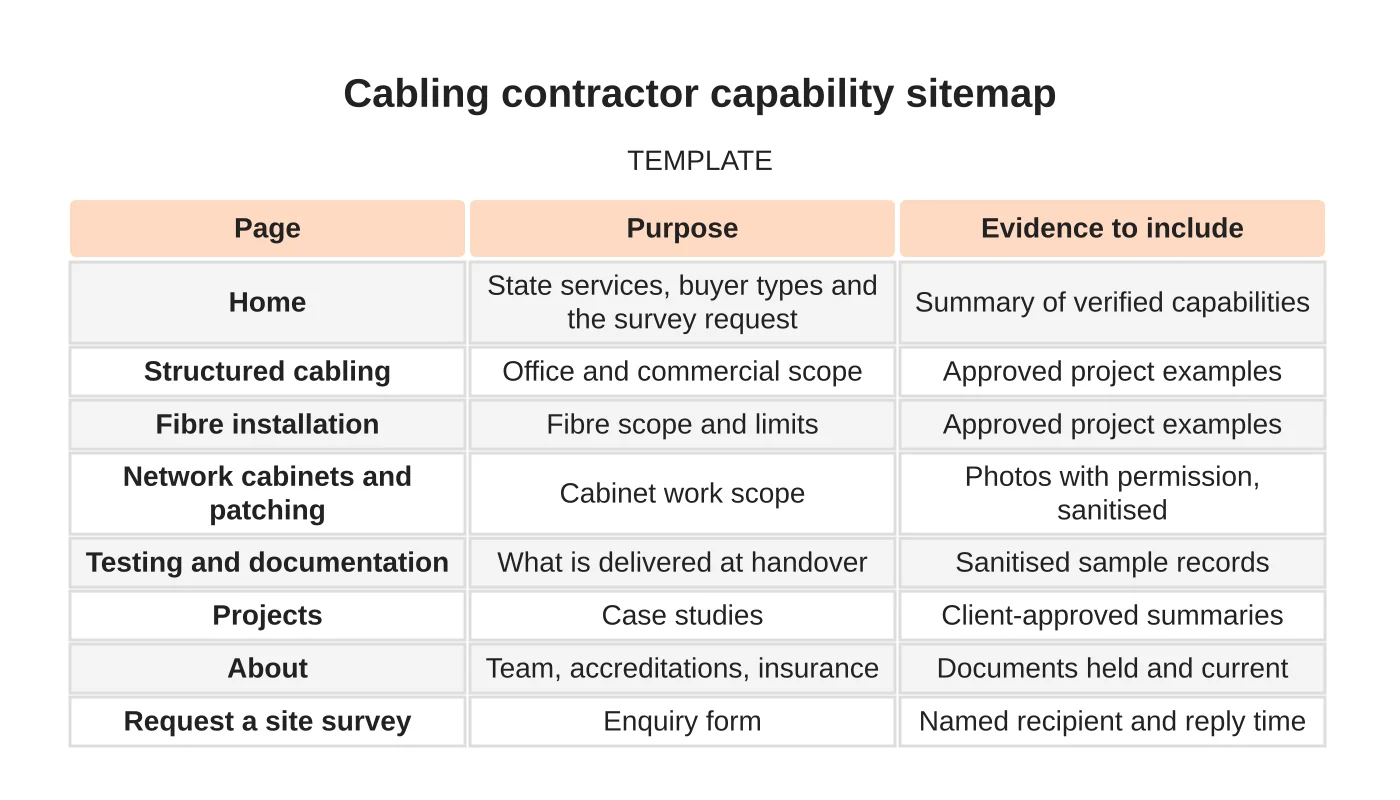
| Page | Purpose | Evidence to include |
|---|---|---|
| Home | State services, buyer types and the survey request | Summary of verified capabilities |
| Structured cabling | Office and commercial scope | Approved project examples |
| Fibre installation | Fibre scope and limits | Approved project examples |
| Network cabinets and patching | Cabinet work scope | Photos with permission, sanitised |
| Testing and documentation | What is delivered at handover | Sanitised sample records |
| Projects | Case studies | Client-approved summaries |
| About | Team, accreditations, insurance | Documents held and current |
| Request a site survey | Enquiry form | Named recipient and reply time |
Common mistakes to avoid
- Listing every possible service without evidence for any of them.
- Publishing project photographs that reveal client equipment or layouts.
- Using standards and certification language you cannot back with documents.
- Sending all enquiries to a general inbox without an owner.
- Measuring page views instead of survey requests.
Questions contractors ask
Do I need a separate page for every town? Only if you have something genuinely different to say about working there. If your service is the same across an area, one clear coverage statement is better than many near-identical pages.
Can I show client logos? Only with written permission. Without it, describe the client type, such as “a professional services office”, without naming them.
How much technical detail should the site contain? Enough for an IT manager to judge fit, such as cable types supported and what is tested, but not so much that you expose client sites or make claims you cannot support.
Will a website bring commercial contracts? It supports discovery and helps buyers evaluate you. It does not guarantee contracts. Relationships, referrals and past work still matter, and the website should make them easier to find and check.
Adjacent contractors face similar questions; see building a website for commercial electrical contractors for a related approach.
Next step
Request a website review or discuss the pages and enquiry workflow your business needs. Read about our web design service or contact us.
Frequently asked questions
Who reads a commercial cabling website?
Several people: IT managers care about cable type, labelling, testing and documentation, facilities managers about access and disruption, main contractors about programme and coordination, and procurement staff about documents, insurance and a clear scope. Plan a page or section for each group’s first question.
What project evidence should a cabling contractor show?
Where a client approves, show a summary of scope, site constraints and the documents delivered at handover, such as test results, labelling schemes and as-built drawings. Remove client names, addresses and layouts, and avoid claims of compliance you cannot back with documents.
Why use a site survey as the main call to action?
Cabling quotes depend on the site, so the natural next step is a survey, not a price list. Ask for the information a surveyor needs, route the request to a named person and tell the buyer what happens next and roughly when.
Sources and notes
Last updated 21 November 2026. This guide is general information based on Web Design Davao’s web design and digital marketing practice. It cites no statistics and makes no promise about rankings, enquiries or contracts. Web Design Davao is not licensed or certified in this industry, so check technical, safety, legal and regulatory matters with a suitably qualified professional. Examples are templates or illustrations, not client results.
Related guide: How to Present Cabling Test Reports on Your Website Without Exposing Client Networks