

Quick answer
A residential electrician’s website should answer three questions fast: do you do this job, do you work in my area, and can I trust you in my home. Describe services in homeowners’ words, state real qualifications and hours, name areas actually served, and keep urgent contact separate from planned quote requests.
- Show only licences, registrations and memberships you currently hold, and keep documents ready on request.
- Use real project photographs with permission and genuine customer reviews, and never write testimonials yourself or offer rewards for reviews.
- Do not publish DIY electrical advice; safety wording should be reviewed by a qualified person.
A homeowner hiring an electrician usually wants answers to three questions fast: do you do this job, do you work in my area, and can I trust you in my home. A website cannot make anyone a licensed electrician. What it can do is present what your business genuinely is, make it easy to ask for a visit and keep urgent contact separate from planned quotes.
This guide covers the structure and content of a website for a residential electrical contractor, and how marketing fits around it. It does not promise rankings or bookings. Web Design Davao does not provide electrical services or electrical advice, so every technical or safety statement on your site must come from your qualified people.
1. Define household service scope
Describe your services in the words homeowners use, then add the technical term in brackets where it helps. For example, “extra power points (outlets)”, “switchboard upgrades”, “lighting installation”, “fault finding” and “safety inspections”, but only the services you really offer.
For each service, write a short explanation covering:
- when a homeowner might need it,
- what happens at a visit,
- how you quote, including whether an inspection is required first,
- what you do not do.
Do not give instructions for carrying out electrical work, and avoid anything that encourages homeowners to attempt repairs themselves. A simple line such as “Electrical faults should be checked by a qualified electrician” is both honest and protective. Safety wording should be reviewed by a qualified person.
2. Show genuine qualifications and availability
Trust is the main concern for people letting a tradesperson into their home. State licences, registrations and memberships you currently hold, and keep documents ready to show on request. Do not display badges or logos you are not entitled to use. Do not imply that you are available around the clock or for emergencies unless you really are and your team is staffed for it.
State your actual working hours, the days you answer the phone, and how you handle requests outside those hours. For example: “We answer calls from 8 am to 5 pm on weekdays. Outside those hours, leave a message and we will reply the next working day.” Honest availability protects your reputation.
3. Present location and customer evidence
Tell visitors where you work. For a Davao-based business, name the areas you actually serve and how far you travel. Do not list areas you never visit to catch searches.
Evidence builds trust more than adjectives:
- Real project photographs, taken with the customer’s permission, with addresses and personal details removed.
- Reviews written by real customers on your Google profile or other platforms. Never write testimonials yourself or offer rewards for reviews.
- A short about page introducing the people who will visit, with their roles and, if appropriate, their qualifications.
For more on location content, see local SEO for electricians.
4. Separate quotes and urgent contact
A homeowner planning a renovation and a homeowner with a tripped circuit have different needs. Give each a clear path.
- Planned work: a quote request form asking for the job type, the area, photos of the location and preferred timing. State when the customer will receive a reply.
- Urgent contact: a visible phone number, your honest hours and a short, reviewed safety note. Do not advertise a rapid response you cannot deliver.
Make sure the right person reads each. Requests that suggest risk, such as burning smells, sparks or water near electrics, should be handled by a qualified electrician promptly. See electrical service pages for page design and administrative support for electricians for the routing workflow.
5. Plan simple marketing around the website
Once the website is clear, marketing has something to send people to.
- Keep your Google business profile accurate and linked to the quote page.
- Ask satisfied customers for a genuine review after a job.
- Share real finished work with permission on social media.
- Track where enquiries come from by asking “How did you hear about us?” on the form.
Measure enquiries and booked jobs, not visits. Compare the jobs you want with the enquiries you receive, and adjust pages that attract the wrong ones.
Residential electrician website map
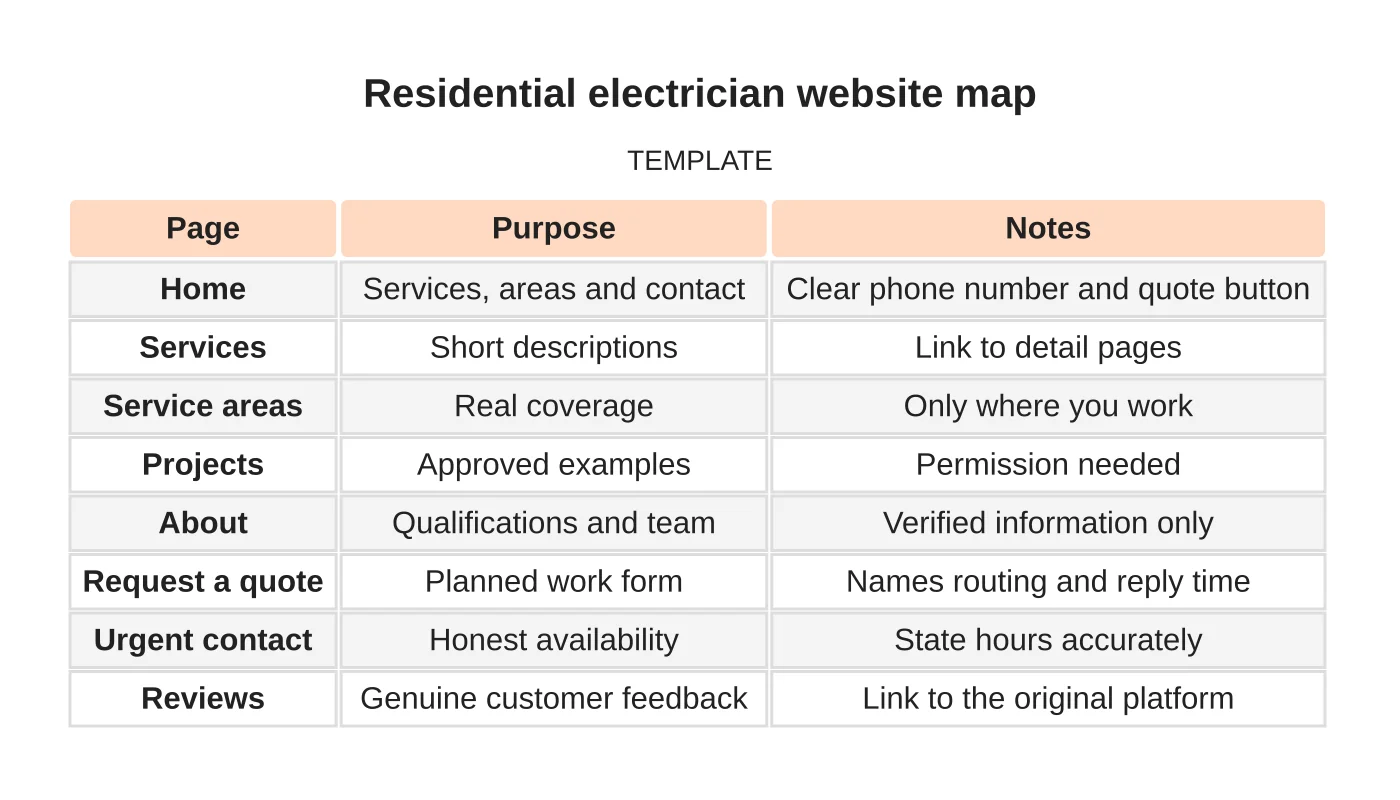
| Page | Purpose | Notes |
|---|---|---|
| Home | Services, areas and contact | Clear phone number and quote button |
| Services | Short descriptions | Link to detail pages |
| Service areas | Real coverage | Only where you work |
| Projects | Approved examples | Permission needed |
| About | Qualifications and team | Verified information only |
| Request a quote | Planned work form | Names routing and reply time |
| Urgent contact | Honest availability | State hours accurately |
| Reviews | Genuine customer feedback | Link to the original platform |
Common mistakes
- Claiming emergency or round-the-clock service that does not exist.
- Showing licence marks or logos without entitlement.
- Publishing DIY electrical advice.
- Using one form for planned quotes and urgent faults.
- Writing identical pages for every suburb.
Questions electricians ask
Do I need a website, or is a social page enough? A page can start the conversation, but a website gives you a stable place for services, areas, qualifications and quote requests that you control.
Should I publish prices? Electrical jobs vary with the property, so most electricians explain how they quote instead of listing prices. State the approach so customers know what to expect.
Can I use stock photographs? Original photographs of your team and work are more credible. If you must use stock images, do not present them as your own work.
Will a better website mean more jobs? It can make it easier for the right customers to find you and ask for a visit. It cannot guarantee jobs, and results depend on your area, season and reputation.
For a related approach with larger buyers, see commercial electrical websites later in the series.
Next step
Request a website review or discuss the pages and enquiry workflow your business needs. Read about our web design service or contact us.
Frequently asked questions
Should I publish prices?
Electrical jobs vary with the property, so most electricians explain how they quote instead of listing prices. Say whether an inspection is required first, and state the approach so customers know what to expect.
Do I need a website or is a social page enough?
A page can start the conversation, but a website gives you a stable place for services, areas, qualifications and quote requests that you control. It can make it easier for the right customers to find you, but results depend on your area, season and reputation.
Can I use stock photographs?
Original photographs of your team and work are more credible. If you must use stock images, do not present them as your own work. Get customer permission for project photos and remove addresses and personal details.
Sources and notes
Last updated 21 November 2026. This guide is general information based on Web Design Davao’s web design and digital marketing practice. It cites no statistics and makes no promise about rankings, enquiries or contracts. Web Design Davao is not licensed or certified in this industry, so check technical, safety, legal and regulatory matters with a suitably qualified professional. Examples are templates or illustrations, not client results.