
Quick answer
An MSP should delegate defined ticket types, not a general role. Tickets suit delegation when they are repetitive, have a documented procedure, a clear definition of done and limited impact if handled wrongly. Record permitted actions, approvals, escalation owner and evidence per ticket type, and roll out in phases while senior engineers keep architecture and major incidents.
- Group three months of PSA tickets by type and note volume, handling time, systems touched and risk.
- Name each permitted action precisely, such as resetting a password after the identity check in procedure X, not ‘handle accounts’.
- Move to the next phase on evidence such as review results and reopened tickets, not the calendar.
An MSP does not hire an offshore technician to “do IT support”. It hands over defined work with defined limits. The most useful question is not whether offshore support works, but which tickets, at what permission level and under whose approval.
This guide gives a task matrix and a phased approach for MSP owners and service desk managers. The matrix is illustrative. Your own tools, contracts and client agreements decide the real limits. For the overall picture, see how Australian MSPs can scale with outsourced tech support.
Start with ticket categories, not job titles
Pull three months of tickets from your PSA and group them by type: access and identity, onboarding and offboarding, endpoint faults, software and licences, network and server, security. For each group, note volume, typical handling time, the systems touched and the damage a mistake could do. Delegation should follow risk and repeatability, not only volume.
A ticket suits delegation when it is repetitive, has a documented procedure, has a clear definition of done and has limited blast radius if handled wrongly. A ticket that needs judgement about a client’s environment, or touches production servers, usually does not suit the first phase.
Related reading: How to Measure Offshore Service Desk Performance Beyond Ticket Counts.
The delegation matrix
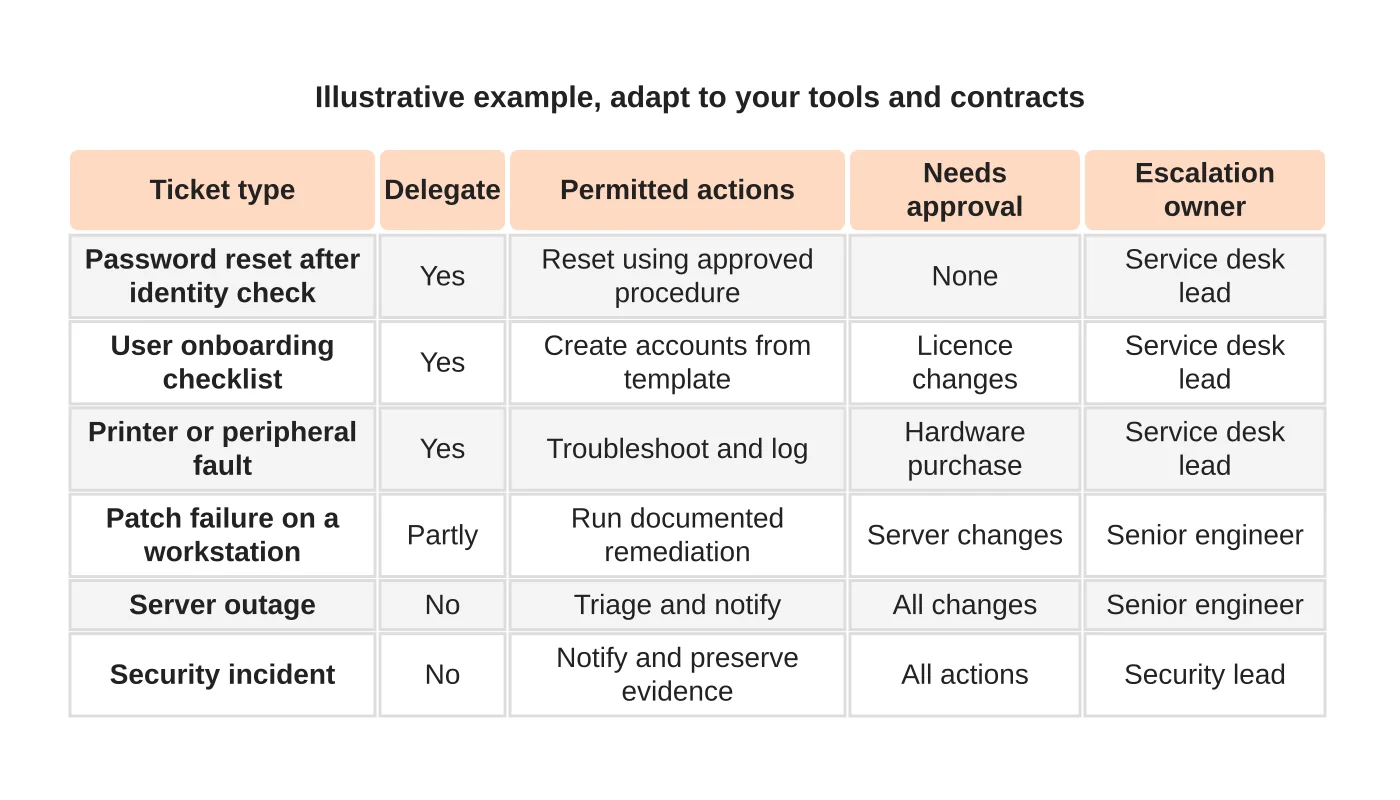
For every ticket type, record five things: whether to delegate, which actions are permitted, what needs approval first, who owns escalation and what evidence the technician records. “Permitted actions” should name the action, such as “reset a password after the identity check in procedure X”, not a general permission to “handle accounts”.
Keep the matrix in your documentation tool so that it is the same document your technicians use daily. Version it and date changes.
Permission and approval limits
Permissions are separate from tasks. A technician may be allowed to resolve a ticket type but not to hold administrator rights across every client. Decide, per role:
- Which client tenants and systems the technician can reach.
- Which actions need a second approval, such as deleting accounts or changing mail flow.
- Which actions are never delegated, such as changing backup retention or disabling security tooling.
Apply least privilege and review it on a schedule. See combining office access controls with client system permissions for how physical and system controls fit together.
Work senior engineers keep
Most MSPs keep these with senior staff:
- Architecture decisions and client environment changes.
- Major incidents and anything that could be a security breach.
- Client-facing judgement calls, such as scope disputes and contract questions.
- Approvals for spending and for changes outside change windows.
Keeping them senior does not mean the offshore technician is shut out. They can triage, gather information and write a good handover note. See offshore help desk escalation.
Related reading: Dedicated Offshore Technicians vs an Outsourced Help Desk Service.
Delegate in phases
A phased rollout limits risk and shows evidence at each step.
- Observe: the technician shadows tickets and reads documentation.
- Supervised: they handle a small set of low-risk ticket types with review of every ticket.
- Sampled: review drops to a sample as quality is shown.
- Expanded: add ticket types and permissions one at a time, with sign-off by the escalation owner.
Move to the next phase on evidence, such as review results and reopened tickets, not the calendar. See onboarding an offshore technician into your PSA and RMM and assessing a technician before hiring.
Record what you decided
After each phase, update the matrix and note why. If a ticket type is moved back to senior staff, record the reason. This becomes the basis for your client-facing explanation of how work is handled.
What this guide does not decide
Roles, hours, tool skills and responsibilities depend on the agreed scope.
Frequently asked questions
Which tickets suit offshore delegation first?
Tickets that are repetitive, follow a documented procedure, have a clear definition of done and limited impact if handled wrongly. Tickets needing judgement about a client’s environment, or touching production servers, usually do not suit the first phase.
What should senior engineers keep?
Most MSPs keep architecture decisions and client environment changes, major incidents and anything that could be a security breach, client-facing judgement calls and approvals for spending or changes outside change windows. The offshore technician can still triage, gather information and write a good handover note.
How should delegation be phased?
Observe first, then handle low-risk ticket types under supervision with every ticket reviewed, then move to sampled review, then expand ticket types and permissions one at a time with sign-off. Advance on evidence, such as review results and reopened tickets, not the calendar.
Sources
- Essential Eight, Australian Cyber Security Centre
- Creating helpful, reliable, people-first content, Google Search Central
Talk through the role
Send us your ticket categories, tool stack, required hours and escalation structure so we can discuss the role. Learn about our outsourced staffing service or get in touch.


