

Quick answer
Measure pickleball marketing by tracking enquiries, completed bookings, attendance and repeat customers, not likes or page views. Define each term in one place, tag enquiry quality, ask customers how they heard about you, and review monthly. Be honest about attribution gaps, and use trends over several months rather than one-week swings.
- Tag each enquiry as booking intent, information only or not relevant, and separate enquiries from completed bookings and attendance.
- Add a ‘How did you hear about us?’ question to forms where tracking is limited, instead of guessing.
- Track repeat rate within a set window such as 60 days, and utilisation as hours booked divided by hours available.
Marketing is only useful if you can tell whether it brought customers. For a pickleball venue, that means going beyond likes and page views to enquiries, completed bookings, attendance and repeat use. This guide sets out a simple framework. It is not an analytics tutorial; for tool-level guidance see turning website analytics into marketing results.
1. Define meaningful conversions and enquiry quality
Decide what counts. A “conversion” should be something that matters to the business, for example:
- a completed booking,
- a trial session booked,
- a coaching enquiry from a suitable person,
- a membership sign-up.
Separate enquiry quality from enquiry volume. A message asking if a venue exists is not the same as a message asking to book Saturday morning. Tag each enquiry as booking intent, information only, or not relevant.
2. Connect traffic sources to booking outcomes where supported
Ask how each booking started: Google listing, website, social post, referral or walk-in. You can do this by:
- adding a “How did you hear about us?” question to booking or enquiry forms,
- using separate links for different campaigns, if your booking tool and website support it,
- checking the source information in your analytics or booking software.
What your tools can report depends on their configuration and current features. Where tracking is limited, a simple question to the customer is better than guessing.
3. Separate enquiries, completed bookings and attendance
These are different numbers:
- Enquiries: people who asked.
- Completed bookings: people who confirmed and, where relevant, paid.
- Attendance: people who actually played.
A drop between them tells you where to look. Many enquiries but few bookings may mean unclear prices or slow replies. Many bookings but low attendance may mean reminders or cancellation rules need work. See following up pickleball enquiries.
4. Track repeat bookings and utilisation
- Repeat rate: of customers who played once in a period, how many booked again within a set window, such as 60 days.
- Utilisation: hours booked divided by hours available, by court and time. This shows whether off-peak efforts work. See filling off-peak court hours.
- Revenue per booked hour, if you track prices. Keep it simple and consistent.
5. Understand attribution gaps and data quality
No single measure is complete.
- People see a post, search your name later and book through Google. The listing gets the credit, though the post helped.
- Walk-ins and word of mouth are hard to track.
- Duplicate or missing records distort the numbers.
- Privacy settings and consent choices limit what tools can record.
Be honest about these gaps in reports. Use trends over several months, not one-week swings. Keep personal data to what you need and protect it. This is general information, not legal advice. Check your situation with a qualified adviser.
6. Use results to adjust campaigns
Each month, ask:
- Which channel produced the most completed bookings, not just the most enquiries?
- Which offers brought customers who returned?
- Where did enquiries drop off?
- What will we stop, change or try next?
Record the decision and the date. The 90-day plan in how to market a pickleball court business uses this review.
Example dashboard and metric definitions
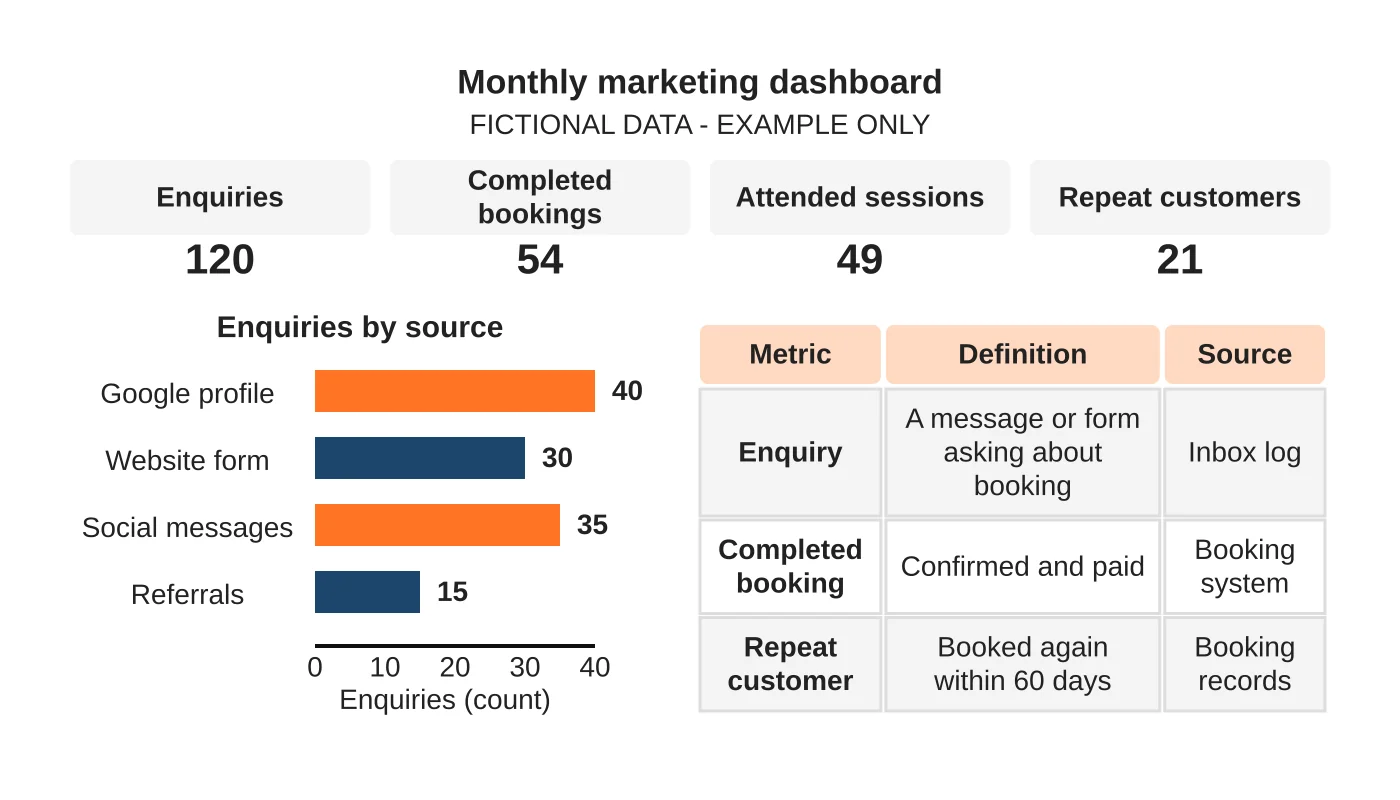
The dashboard above uses fictional data to show the layout. It does not describe any venue or typical result.
| Metric | Definition | Source |
|---|---|---|
| Enquiry | A message or form asking about booking | Inbox or enquiry log |
| Completed booking | Confirmed and, where required, paid | Booking records |
| Attended session | Booking where the customer played | Check-in or court log |
| Repeat customer | Booked again within the chosen window | Booking records |
| Utilisation | Hours booked divided by hours available | Booking records |
Keep definitions in one place so that everyone reports the same way. Local discovery results are covered in getting your courts found on Google Search and Maps. For retailers, see selling pickleball equipment online.
Next step
Discuss a reporting setup that connects marketing activity with business outcomes, or see our digital marketing service.
Frequently asked questions
What should a pickleball venue count as a conversion?
Something that matters to the business, such as a completed booking, a trial session booked, a suitable coaching enquiry or a membership sign-up. Separate enquiry quality from volume, since a message asking if a venue exists is not the same as one asking to book.
How can I tell which channel brought a booking?
Ask how each booking started, using a ‘How did you hear about us?’ question, separate campaign links where your booking tool and website support them, or the source information in your analytics or booking software. What tools report depends on their configuration.
What does a gap between enquiries, bookings and attendance mean?
It shows where to look. Many enquiries but few bookings may mean unclear prices or slow replies. Many bookings but low attendance may mean reminders or cancellation rules need work. Record the decision and date each month.
Sources and notes
This framework is based on our own practice. All dashboard numbers are fictional and no benchmark is claimed.