
Quick answer
Fill off-peak pickleball hours by finding the genuinely quiet times from your booking records, matching each to a group that can use it, such as coaches, shift workers or workplace teams, and offering a trial that leads to a recurring booking. Check margins and capacity first, and count completed bookings and repeat visits, not enquiries.
- Use at least four weeks of your own booking records to mark each court and hour as booked or empty.
- Keep the offer simple: one clear offer for one group is easier to promote and measure than five.
- Confirm the price covers lighting, staff and wear, and that extra bookings will not crowd peak times.
An empty court is a cost you cannot recover: the hour passes and the revenue is gone. But a blanket discount is a poor fix. It lowers your price for people who would have paid in full, and it can attract customers who never return. A better approach is to find the genuinely quiet times, match each to a group that can use them and measure what happens.
This guide gives a repeatable method. The numbers in the worksheet are illustrative only.
1. Identify genuinely underused times
Use your own booking records for at least four weeks if you have them. List each court and hour and mark it booked or empty. Then ask:
- Is it quiet every week, or only during holidays and bad weather?
- Is it quiet because of customer behaviour, or because the court is not available, advertised or easy to book at that time?
- Is a “quiet” session free of a cost you would otherwise pay, such as lighting or staff?
Focus on slots that are empty most weeks. Do not discount sessions that fill without help.
2. Match offers to coaches, groups and flexible players
Each quiet session suits different people.
- Weekday mornings and early afternoons: coaches running lessons, retirees, shift workers, people who work from home.
- Late evenings: shift workers, groups who finish work late.
- Weekend off-peak: families, beginners, friends’ groups.
- Workplace and community groups: teams who can book a regular session at a set time.
Ask a few regular customers what would make them come at a different time. A short message to existing players is a cheap way to learn.
3. Design trial sessions and recurring bookings
- A trial is a way to start, not a permanent price. State what it includes, that it is for first-time visitors or a limited period, and what the normal price is.
- A recurring booking (the same slot each week) gives you predictable use. Offer it after a good trial, and be clear about what happens when someone cannot attend.
- Keep the offer simple. One clear offer for one group is easier to promote and measure than five.
4. Promote through partners, email and ads
- Partners: coaches, workplaces, schools, fitness businesses and event organisers. Give them a short, concrete offer for their members.
- Email or messages: to people who have already played or enquired and agreed to hear from you. See following up pickleball enquiries and respect communication preferences.
- Social posts: share the time, the offer and a simple way to book. See a social media content plan for clubs and operators.
- Paid ads: if you use them, target a small local radius and a single offer, with a link to the exact booking page. Test a modest budget and check results before scaling.
5. Check margins, capacity and repeat behaviour
Before you promote, answer these:
- Does the offer cover your real cost per hour, such as electricity, staff and wear?
- If it works, can you handle the extra bookings without crowding peak times?
- After the trial, did people book again at the normal price?
Count completed bookings, not enquiries. Then count how many came back. For measurement methods see measuring pickleball marketing results.
Off-peak campaign worksheet
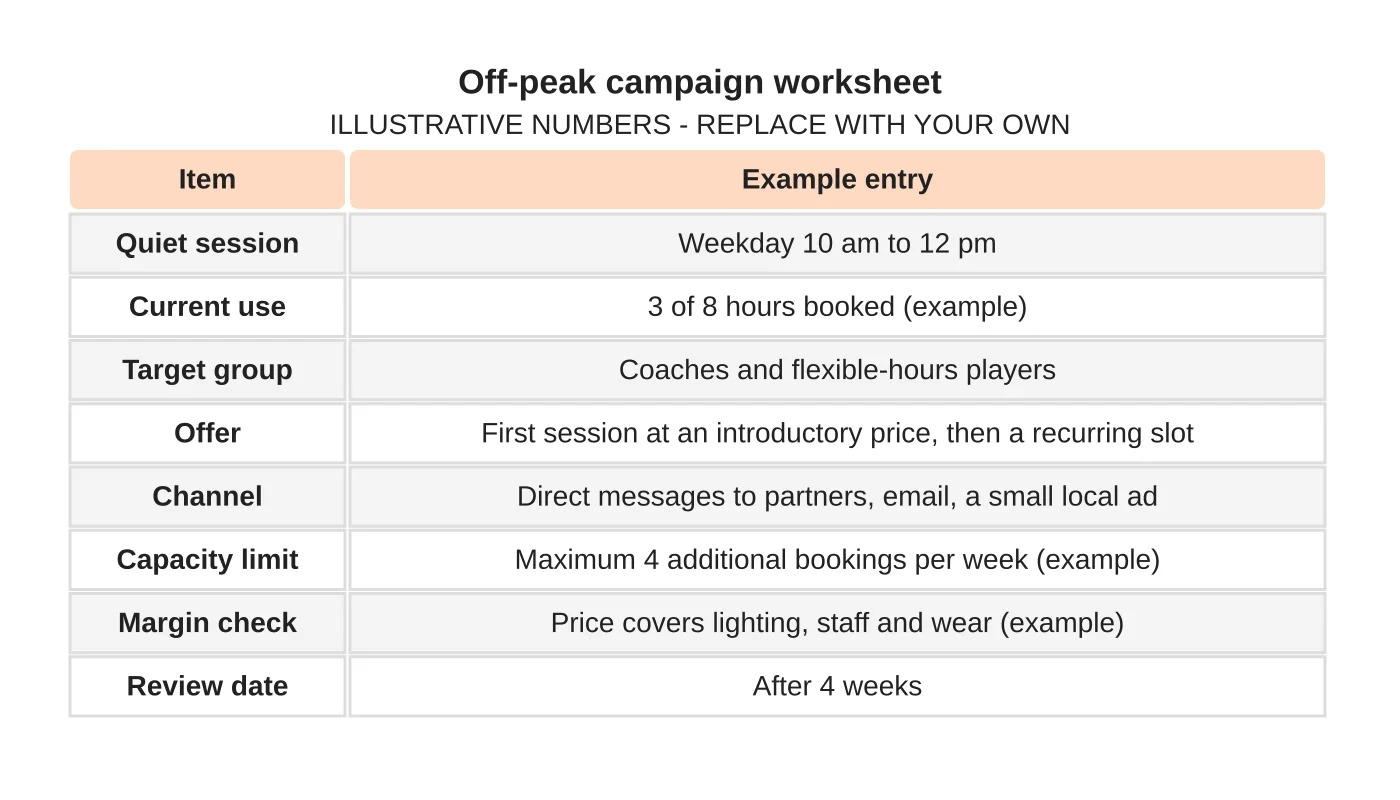
| Item | Example entry (illustrative) |
|---|---|
| Quiet session | Weekday 10 am to 12 pm |
| Current use | 3 of 8 hours booked (example) |
| Target group | Coaches and flexible-hours players |
| Offer | First session at an introductory price, then a recurring slot |
| Channel | Direct messages to partners, email, a small local ad |
| Capacity limit | No more than a set number of extra bookings per week |
| Margin check | Price covers lighting, staff and wear |
| Review date | After four weeks |
The entries above are examples only. Replace them with your own figures. No figures here predict what your venue will earn.
Common mistakes
- Discounting all sessions.
- Promoting a time you cannot staff.
- Offering a trial with no path to a regular booking.
- Not telling regular customers about changes to peak pricing.
The full plan is in how to market a pickleball court business.
Next step
Discuss a campaign for your quieter court sessions, or read about our digital marketing service.
Frequently asked questions
Why not just discount every quiet session?
A blanket discount lowers your price for people who would have paid in full, and it can attract customers who never return. Sessions that fill without help should not be discounted. Match a clear offer to a specific group for each genuinely quiet time instead.
Who can use weekday daytime courts?
Weekday mornings and early afternoons suit coaches running lessons, retirees, shift workers and people who work from home. Late evenings suit shift workers and groups who finish work late, while weekend off-peak suits families, beginners and friends’ groups. Ask a few regular customers what would change their booking time.
How do I know an off-peak campaign worked?
Count completed bookings, not enquiries, and then count how many people came back at the normal price. Check the offer covers your real cost per hour and that you can handle extra bookings without crowding peak times. Review after a set period such as four weeks.
Sources and notes
This method is drawn from our own planning practice and uses no external statistics. All numbers in the worksheet are illustrative.


