

Quick answer
A pickleball court business grows when four things work together: people can see what you offer, they can find you locally, booking is easy, and they have reasons to return. Define player groups and bookable offers, fix location, prices and booking steps, then measure completed bookings and repeat visits, not likes.
- Write each offer as something bookable, with what it includes, how long it lasts, the price and cancellation terms.
- Fix location, prices and booking steps on your website and Google profile before promoting or running ads.
- Track enquiries, completed bookings, attendance and repeat visits separately, then review the first 90 days and decide what to keep.
A pickleball court business in the Philippines grows when four things work together: people can see what you offer, they can find you locally, booking is easy, and you give them reasons to return. This guide sets out a practical plan for owners and operators, with links to detailed guides on each part.
Local activity is real. The Davao City Government announced a pickleball tournament for the 2026 Duaw Davao Festival, and Arena Athletics in Davao published a national tournament for August 2026. Both have now passed, and neither is proof of search demand or guaranteed returns. Treat them as signs of local interest, then check your own enquiries and bookings.
1. Define player groups and bookable offers
Marketing fails when “everyone who plays” is the audience. List your genuine groups and what each wants to book:
- Casual and new players: a trial session, equipment hire, a simple price.
- Regular players: recurring slots, open play, membership.
- Groups and workplaces: private bookings for a set time.
- Learners: coaching or clinics. See how coaches turn website visitors into lesson bookings.
Write each offer as something a customer can book: what it includes, how long it lasts, the price and the cancellation terms. If you cannot write it plainly, customers will not understand it either.
Read next: Maintaining a Pickleball Website: Checking Bookings, Payments and Customer Notifications.
2. Make location, prices and booking steps easy to find
Most lost bookings come from missing basics: no address, unclear prices, or a booking step that only works by waiting for a reply. Your website should answer the questions in our pickleball court website checklist. If you currently take bookings by Messenger, choosing between online bookings and Messenger helps you decide what to change and what to keep.
Read next: Hosting a Pickleball Booking Website: Preparing for Registration and Booking Surges.
3. Combine local search, social content and partnerships
These three work best together, not as separate projects.
- Local search. People searching for places to play nearby should find an accurate listing with correct hours, photos and a working link. See getting your courts found on Google Search and Maps.
- Social content. Short posts that answer real questions (where, how much, what to bring, which times are free) are more useful than generic sports posts. See a social media content plan for clubs and operators.
- Partnerships. Coaches, workplaces, schools, fitness businesses and event organisers can bring groups. Approach them with a specific offer, not a general request.
4. Fill quieter sessions without permanent discounts
Permanent discounts train customers to wait for them. Find the genuinely quiet times, match each to a group that can use it, and test one offer at a time. The method is in how to fill off-peak court hours with targeted marketing.
5. Measure completed bookings and repeat visits
Likes and page views do not pay for courts. Track enquiries, completed bookings, attendance and repeat visits separately. A simple framework is in measuring pickleball marketing results. Follow-up matters as much as acquisition; see following up pickleball enquiries.
Read next: Pickleball Membership Websites: Managing Plans, Renewals and Member Enquiries.
A one-page 90-day plan
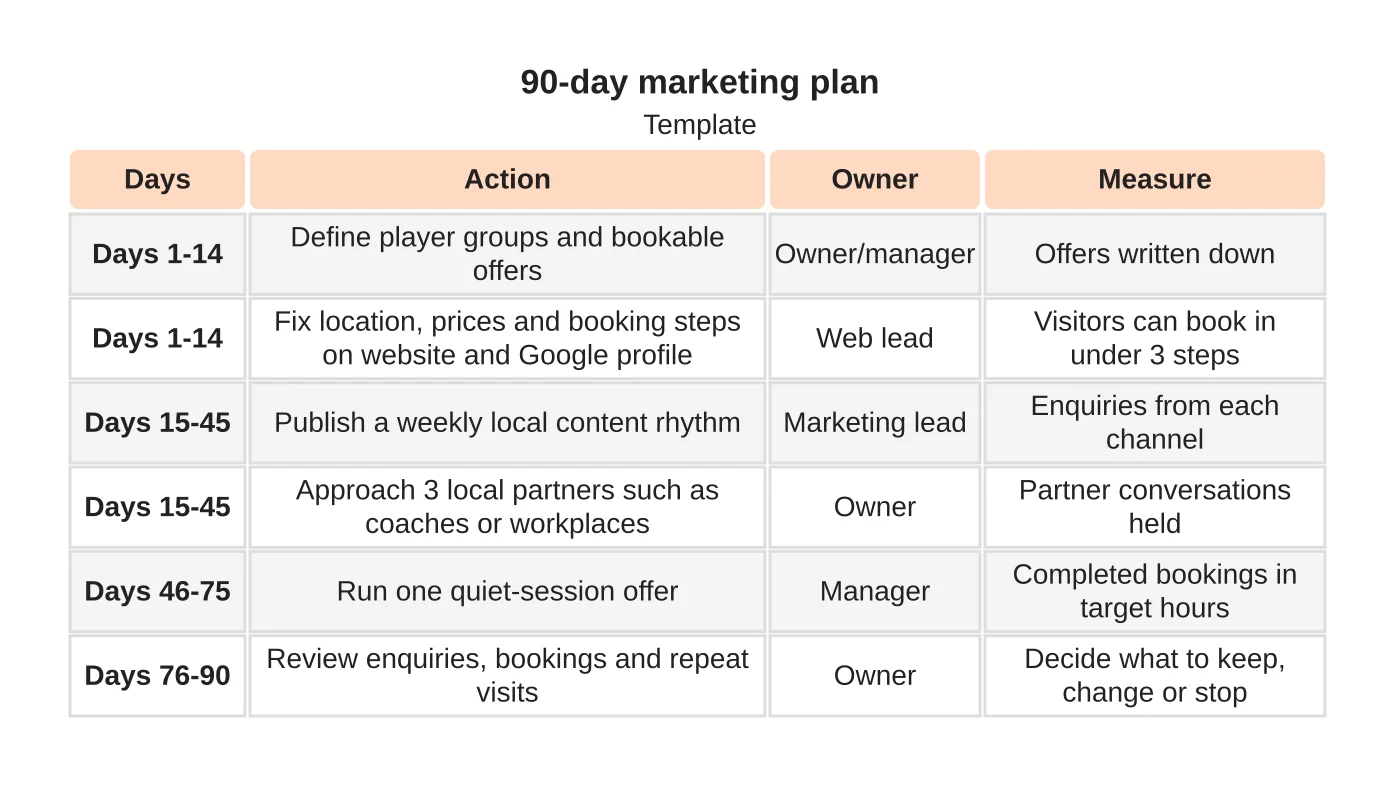
| Days | Action | Owner | Measure |
|---|---|---|---|
| 1 to 14 | Define player groups and bookable offers | Owner or manager | Offers written down |
| 1 to 14 | Fix location, prices and booking steps on the website and Google profile | Web lead | A visitor can book in a few clear steps |
| 15 to 45 | Publish a steady weekly local content rhythm | Marketing lead | Enquiries by channel |
| 15 to 45 | Speak to three local partners | Owner | Conversations held |
| 46 to 75 | Run one quiet-session offer | Manager | Completed bookings in target hours |
| 76 to 90 | Review enquiries, bookings and repeat visits | Owner | Keep, change or stop each action |
Keep it to one page, give every line a named person, and review it on a fixed date. Do not expect a particular number of bookings; use the first 90 days to learn what your customers respond to.
How the supporting guides fit together
Think of the plan as four connected jobs. Use this to decide where to start:
| If your main problem is | Start with |
|---|---|
| People cannot find the venue | local search and Google Maps |
| Visitors leave without booking | the website checklist and the booking system decision |
| Courts are empty at certain times | off-peak marketing |
| Posts get likes but no bookings | the social content plan |
| You cannot tell what works | measurement |
| You run coaching, tournaments or a shop | coach pages, tournament registration or online equipment sales |
Questions owners ask
Do I need a website, or is a Facebook page enough? A page can work to start, but a website gives you one place for prices, rules, booking and policies, which you control. Many venues use both.
How much should I spend? There is no standard figure. Start with the free and low-cost fixes (accurate listing, clear prices, a working booking step) and spend more only on what your own results support.
How soon will I see bookings? It depends on your starting point, season and local competition. We do not promise a time frame or a number. Review the first 90 days and decide from your own records.
Should I run ads? Only after your booking steps work. Ads send people to your page; they cannot fix a confusing one.
What about player enquiries versus business enquiries? Separate them. Someone asking to play is a customer for the venue. A venue owner asking about a website or marketing is a business enquiry for us. Keep the two lists apart so you can tell what is working.
Read next: How a Virtual Assistant Can Support a Pickleball Club’s Daily Administration.
Common mistakes to avoid
- Promoting before the booking steps work.
- Treating likes as bookings.
- Offering discounts at times when courts are already full.
- Not recording where enquiries came from.
- Sharing photos of players without permission.
Where to get help
If you would like help turning this plan into a website, a local search profile and a content routine, our digital marketing service covers the planning and delivery. Tell us about your courts, target customers and booking goals so we can discuss a marketing plan.
Frequently asked questions
Do I need a website, or is a Facebook page enough?
A page can work to start, but a website gives you one place for prices, rules, booking and policies, which you control. Many venues use both, so you can keep the page you have and add a website for the details customers need.
How much should I spend on marketing a pickleball venue?
There is no standard figure. Start with the free and low-cost fixes, such as an accurate listing, clear prices and a working booking step, and spend more only on what your own results support.
How soon will I see bookings?
It depends on your starting point, season and local competition, so no time frame or number is promised. Review the first 90 days of enquiries, bookings and repeat visits, and decide from your own records what to keep, change or stop.
Sources and notes
- Davao City Government, Duaw Davao first pickleball tournament announcement (posted June 2026): https://davaocity.gov.ph/sports/duaw-davao-first-pickleball-tournament-unveiled/
- Arena Athletics, tournament page (August 2026 event): https://arenadavao.com/tournaments-new
Both events are historical.


