

Quick answer
Before hiring a virtual assistant, check that your work is ready to hand over. Write down recurring tasks, document the three most time-consuming processes, set priorities, set up shared access safely and name who approves work. Overwhelm is often a process problem, so a virtual assistant cannot fix it alone.
- Plan on about three to five hours a week in the first month for onboarding and feedback.
- Hand over repeatable, clearly defined, low-risk tasks first; keep strategy, pricing, sensitive client conversations and control of key accounts.
- Use days 1 to 30 to learn, 31 to 60 to own complete tasks and 61 to 90 to improve.
Overwhelm feels like a headcount problem, so the instinct is to hire. Often the real cause is a process problem: work that lives in your head, priorities that change daily, and tasks nobody has written down. A virtual assistant (VA) cannot fix that, and in some cases makes it louder.
This guide helps you decide whether you are ready, what to tidy up first, what to hand over and how to plan the first 90 days.
Why a VA is not always the right first move
The newsletter issue Why Hiring a VA Is the Wrong First Move in 2026 makes the case that hiring a VA can be the wrong first step because the cause of overwhelm is usually a process, not a shortage of hands. If you cannot describe what you want done, how you want it done and what good looks like, an assistant has nothing to work from. You pay for confusion, and the person leaves frustrated.
That does not mean you should not hire. It means the first hour belongs to preparation. Done well, preparation also makes the hire cheaper, because less time is lost to guesswork.
Signs you are ready, and signs you are not
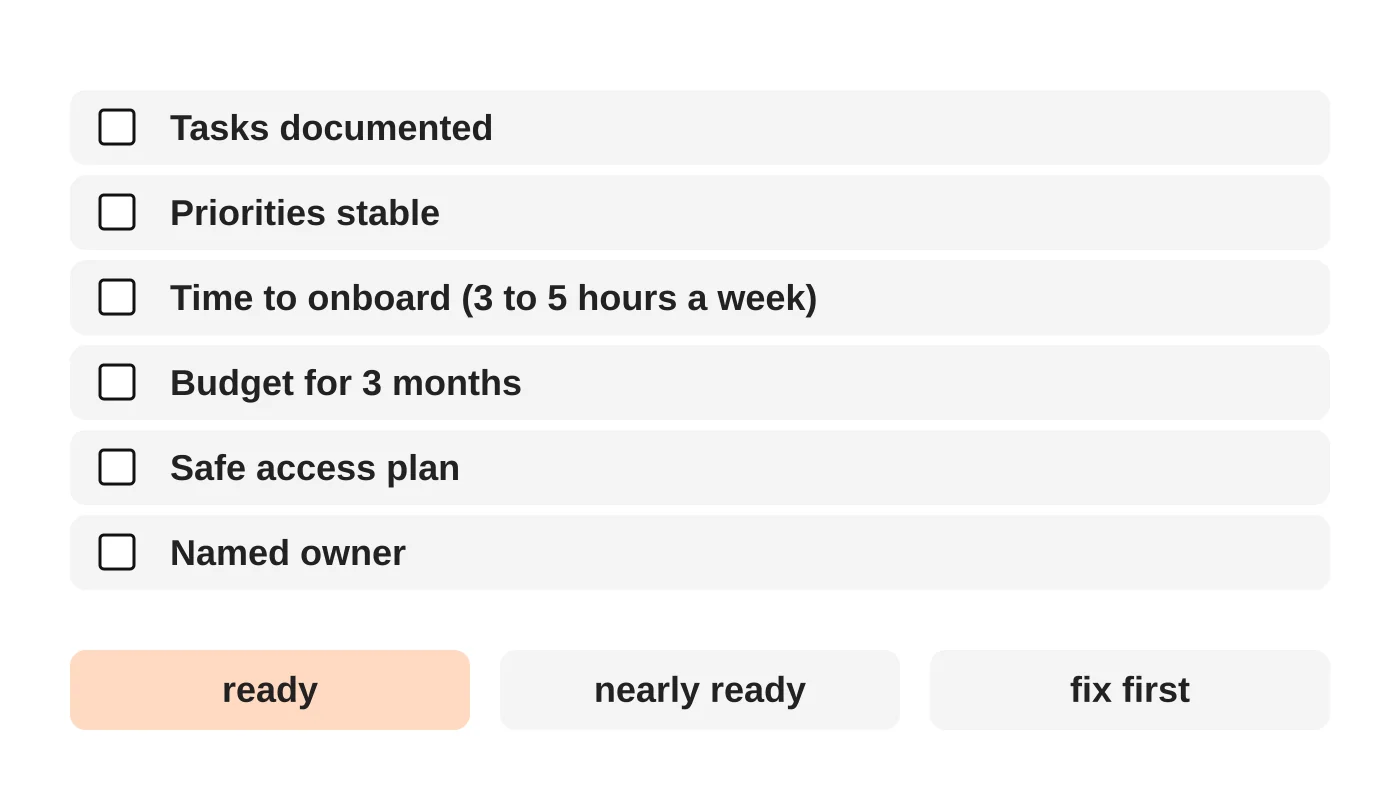
You are probably ready if
- You can list at least five recurring tasks you do every week.
- You can explain how to do at least some of them in a few written steps.
- Your priorities are stable enough that a task assigned today is still wanted next week.
- You can give about three to five hours a week in the first month to onboarding and feedback.
- You have a budget you can sustain for at least three months.
- You are willing to share access safely, using a password manager and individual logins.
You probably need to prepare first if
- Most of your work is “whatever is on fire today.”
- You cannot describe a task without doing it yourself.
- You expect the VA to work out what the business needs on their own.
- You have no time to onboard anyone.
- Everything is stored in your personal email and your head.
Fix these first
1. Write down your recurring tasks
For a week, keep a simple log of what you do, how long it takes and whether it needs your judgement. Circle everything that repeats.
2. Document the processes
Choose the three most time-consuming repeating tasks. For each, write the steps, where things live, who to ask and what a finished job looks like. Recording a short screen video is faster than writing and often clearer.
3. Set priorities
Decide the top three outcomes the help is for: more time with clients, faster replies, cleaner books. These will guide every choice that follows.
4. Set up the basics
- A shared password manager and individual accounts, with the access plan covered in our offboarding checklist.
- A shared folder structure and a place for task notes.
- A communication routine: one channel for quick questions, one for tasks.
5. Decide who owns what
Name yourself, or a manager, as the person who answers questions and approves work.
A good start matters, so use this 30-day virtual assistant onboarding plan.
Tasks that suit a VA
VAs do far more than basic admin. Good candidates are tasks that are repeatable, clearly defined and low risk to learn:
- Inbox and calendar management.
- Data entry, spreadsheet updates and reporting.
- Customer follow-ups and appointment confirmations.
- Social media scheduling and basic content formatting.
- Research and lead lists.
- Bookkeeping support, invoice chasing and document preparation.
- Website updates and routine CMS tasks.
The issues How Smart Founders Quietly Eliminate 80% of Admin Work and You Hired a VA to Do Admin. You Missed the Real Opportunity. explore removing admin and using VAs beyond admin. For the AI-related skills to look for, see the 10 essential AI skills every modern virtual assistant needs and the executive virtual assistant as an AI-enabled co-pilot.
Keep these with you, at least at first
- Decisions that affect strategy, pricing or hiring.
- Sensitive conversations with key clients.
- Final approval of anything public.
- Control of key accounts such as your domain, banking and primary email.
Your first 90 days
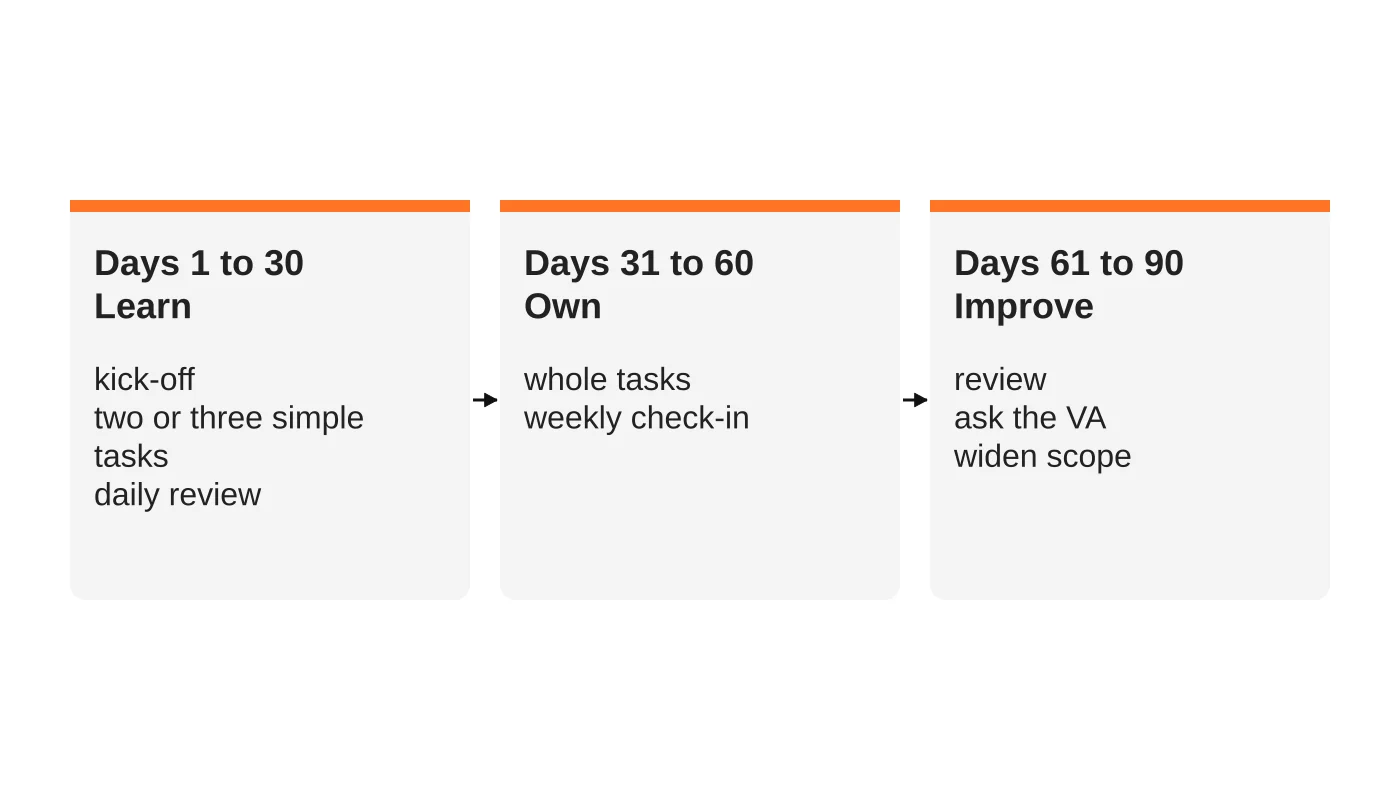
Days 1 to 30: learn
- Run a kick-off call and share your documented tasks.
- Start with two or three simple tasks, then add more.
- Review work daily at first, then twice a week.
- Collect questions in one place and update your documentation as you answer them.
Days 31 to 60: own
- Hand over complete tasks, not pieces of tasks.
- Move to a weekly check-in with a short written update.
- Agree what the VA can decide without asking.
Days 61 to 90: improve
- Look at what worked and what did not.
- Ask the VA what they would change. They see the processes up close.
- Decide whether to widen the scope, add hours or adjust the role.
Learning to delegate well is its own skill. Our guide to how to delegate to a virtual assistant has a briefing template you can copy. For budgeting, see how much a virtual assistant costs in the Philippines, and for why many Australian businesses choose Davao, read why Australian businesses outsource virtual assistants from Davao.
Before you hire, test candidates with a fair, paid virtual assistant work sample.
Related reading: What to Delegate to an Administrative Virtual Assistant in Your First Month.
Frequently asked questions
How many hours a week do I need to give a new VA?
Plan on about three to five in the first month for onboarding and feedback, falling as they take on more.
Should I hire a freelancer or use a managed team?
If you can supervise and your needs are simple, a freelancer can work. If you want continuity, backup cover and supervision, a managed team usually suits better.
What if I do not have processes written down?
Start with the three tasks you do most. Record yourself doing them once, then add short notes.
Can a VA handle my customer emails?
Often yes, with templates, guidelines and a review period. Start with low-risk categories.
How do I know it is working?
Check against the outcomes you set: hours returned to you, errors, response times and customer feedback.
From the Wired for Growth newsletter
This readiness guide builds on Why Hiring a VA Is the Wrong First Move in 2026 from Duarne Bernhagen’s LinkedIn newsletter, Wired for Growth. Related issues How Smart Founders Quietly Eliminate 80% of Admin Work and You Hired a VA to Do Admin. You Missed the Real Opportunity. look at removing admin work and using VAs for more than admin.
Scope your first VA role with us
Web Design Davao’s virtual staffing service helps you define the role, then provides a managed assistant. Book a consultation and we will help you scope the first 90 days.