

Quick answer
Google publishes no fixed timetable for SEO. Industry sources commonly quote three to six months before measurable results, and six to twelve months in competitive markets, but these are rules of thumb, not promises. Small fixes can show effects quickly, while bigger strategic changes can take a long time.
- Watch early signs before traffic arrives: indexing, Search Console impressions, rankings for chosen terms, profile actions and enquiries.
- Set a baseline in month one so later progress can be compared with where you started.
- Be careful if a provider promises first-page rankings in thirty days for a competitive term.
“How long will it take?” is the first question every business asks about SEO, and the honest answer is “it depends”. That is not helpful on its own. This guide gives you a realistic pattern, explains what changes the speed and shows how to judge progress before the big results arrive.
First Page or Fade Out: Why SEO Just Got More Ruthless argues that SEO has become more demanding. That makes realistic expectations more important, not less.
What Google says
Google does not publish a fixed timetable. Google’s John Mueller has said there is no set timeframe for how long it takes to see results with SEO. Different changes take different amounts of time: small fixes can show effects quickly, while bigger strategic changes can take a long time.
What the industry commonly says
Industry sources commonly quote three to six months before SEO shows measurable results, and six to twelve months for competitive markets. Treat these as rules of thumb from practitioners, not as guarantees. Search Engine Land notes that the timeline depends on the age and authority of the site, how quickly changes are implemented and how long search engines take to crawl and reassess pages.
If someone promises first-page rankings in thirty days for a competitive term, be careful.
A realistic timeline
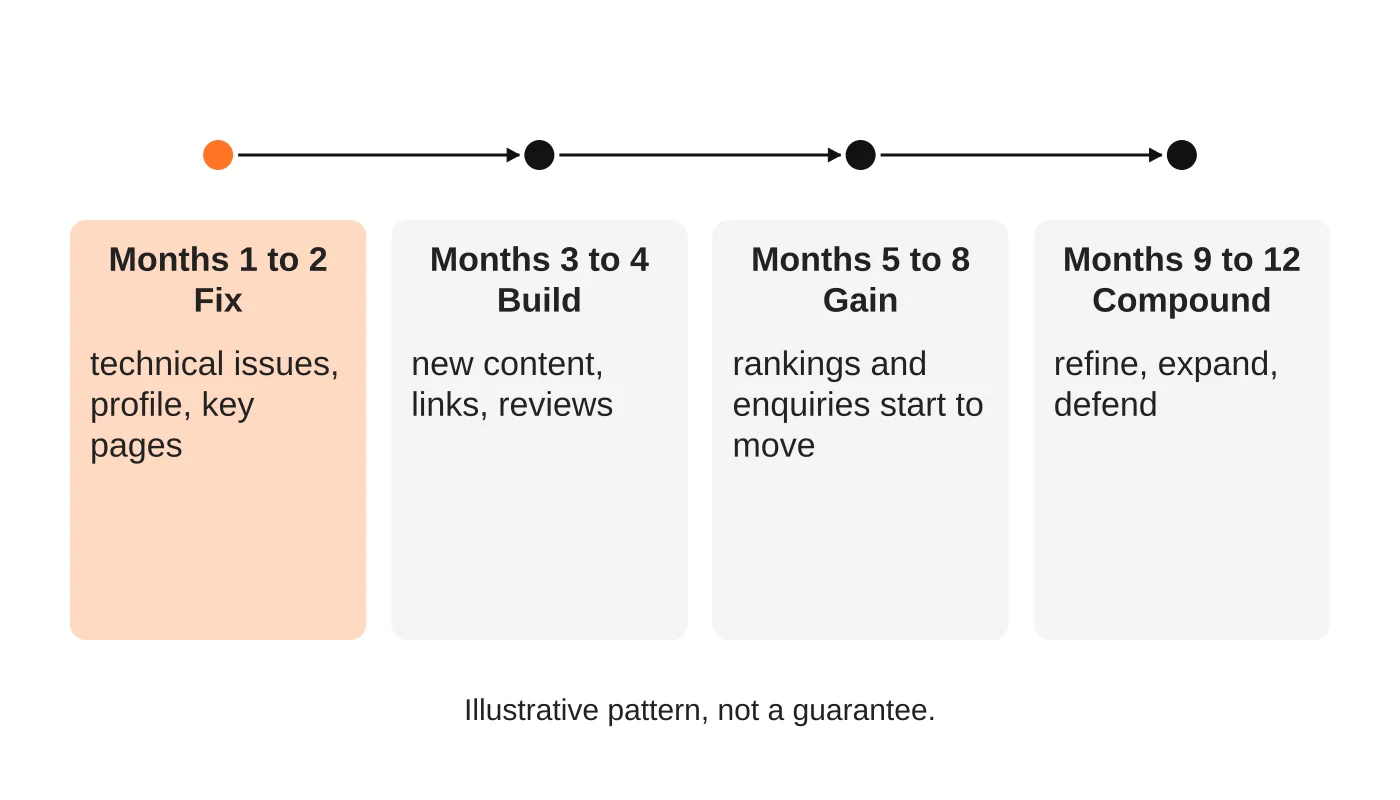
The pattern below is illustrative. Your pace will differ.
Months 1 to 2: fix
Repair the basics: technical errors, speed, mobile problems, your Google Business Profile and the pages that should be bringing enquiries. Google Business Profile optimisation often gives the earliest local movement. You may see small changes in impressions, but not much traffic yet.
Months 3 to 4: build
Publish and improve content that answers real questions, fix weak pages and start earning reviews and mentions. A content audit tells you where to put effort. Google needs time to crawl and assess the changes.
Months 5 to 8: gain
For many local businesses this is when rankings and enquiries start to move, particularly for service and area pages. Keep publishing and refining. Area pages often matter here.
Months 9 to 12: compound
Results build on earlier work. You expand into related topics, defend positions and improve conversion. Gains continue as long as you keep working, and slip if you stop.
What speeds it up or slows it down
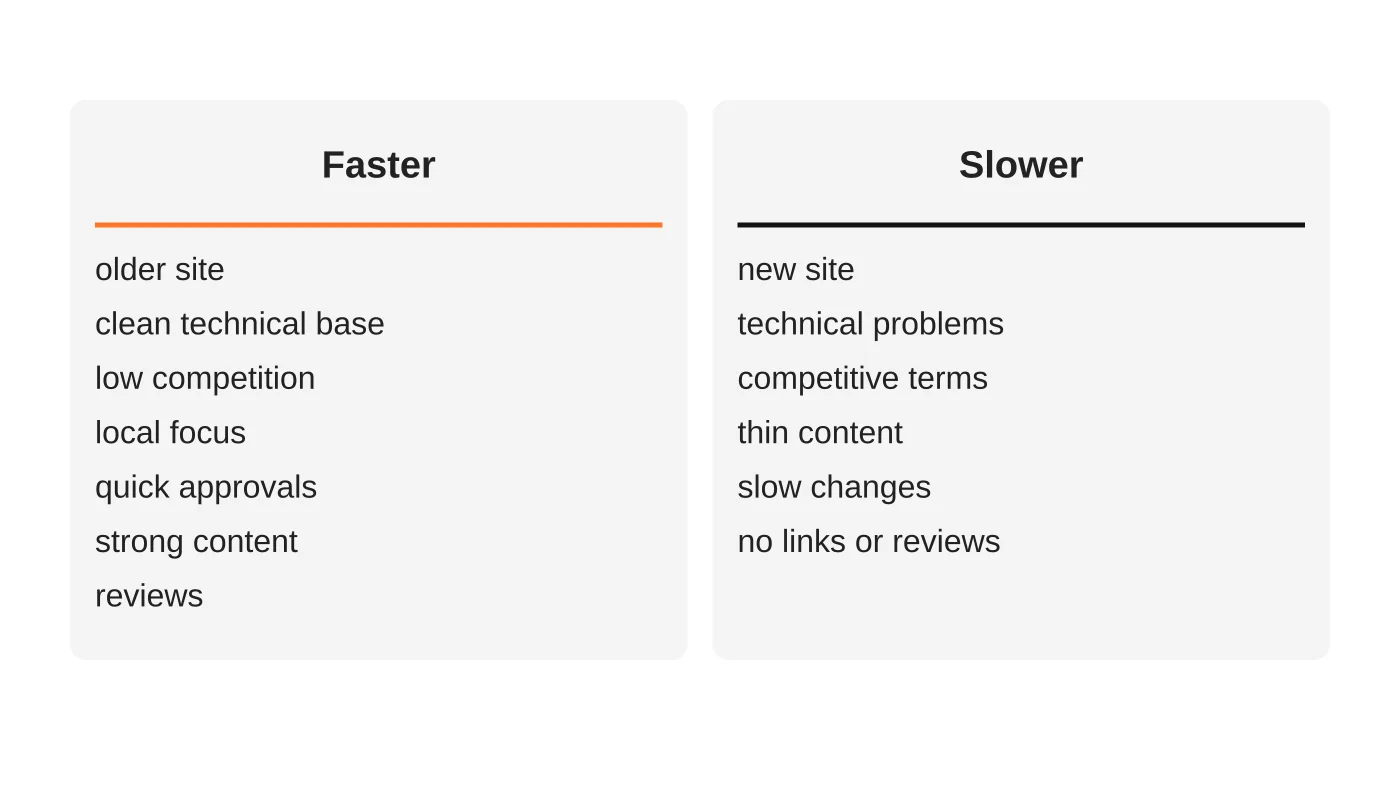
- Site age and history. Established sites with a clean history often move faster than brand-new domains.
- Competition. “Web design” is harder than “web design for dental clinics in Davao”.
- Technical health. Broken pages, slow speed and indexing problems hold everything back. See website speed.
- Content quality. Thin or duplicated pages do not get far.
- Speed of approvals. If changes wait weeks for sign-off, results wait too.
- Reviews and links. Real reviews and credible mentions help, particularly for local searches. See Google reviews and local SEO.
- Business focus. A clear location and service focus helps. A site that tries to cover everything is slower.
What to measure before traffic arrives
Do not wait six months to learn whether the work is on track. Watch leading signs:
- Indexing: are your key pages in Google’s index?
- Impressions in Search Console: are you appearing for more relevant searches?
- Rankings for chosen terms: is the position improving, even from page five?
- Profile actions: calls, directions and website clicks from your Google profile.
- Enquiries and where they came from.
Set a baseline in month one so you can compare. Turning website analytics into decisions shows how.
SEO and paid ads together
If you need enquiries sooner, paid search can fill the gap while SEO builds. Paid results stop when the budget stops, while SEO gains tend to last. See whether Google Ads benefit a small business.
When you review results, separate branded and non-branded search so awareness is not mistaken for new demand.
How to judge an SEO provider
- They explain what they will do in the first ninety days.
- They report on enquiries, not only rankings.
- They do not promise a specific position or a guaranteed timeline.
- They tell you what you must do, such as content, approvals and reviews.
- They avoid manipulative tactics. See white hat vs black hat SEO.
If you are choosing someone, hiring an SEO specialist in Davao lists what to look for.
Frequently asked questions
Can SEO work in a month?
Some small fixes can show quickly, such as a profile correction. Meaningful enquiry growth usually takes longer.
Why did my rankings drop after a change?
Changes can cause temporary movement while Google reassesses. See the redesign checklist if you changed your site.
Do I have to keep paying for SEO?
Search conditions keep changing, and competitors keep working. Most businesses maintain a lighter, steady effort after the build phase.
Is local SEO faster than national SEO?
Often, because there is less competition and strong local signals, but not always.
What should I do while I wait?
Keep your profile accurate, collect reviews, publish useful content and make it easy for visitors to enquire.
From the Wired for Growth newsletter
This guide builds on First Page or Fade Out: Why SEO Just Got More Ruthless from Duarne Bernhagen’s LinkedIn newsletter, Wired for Growth.
Sources
- Google on how long SEO takes, Search Engine Journal
- How long does SEO take to work? Search Engine Land
- The three to six month range is an industry rule of thumb, not a Google statement.
Plan your first ninety days
Web Design Davao’s SEO team sets a baseline, a ninety-day plan and clear measures. Ask for an SEO plan.


