
Quick answer
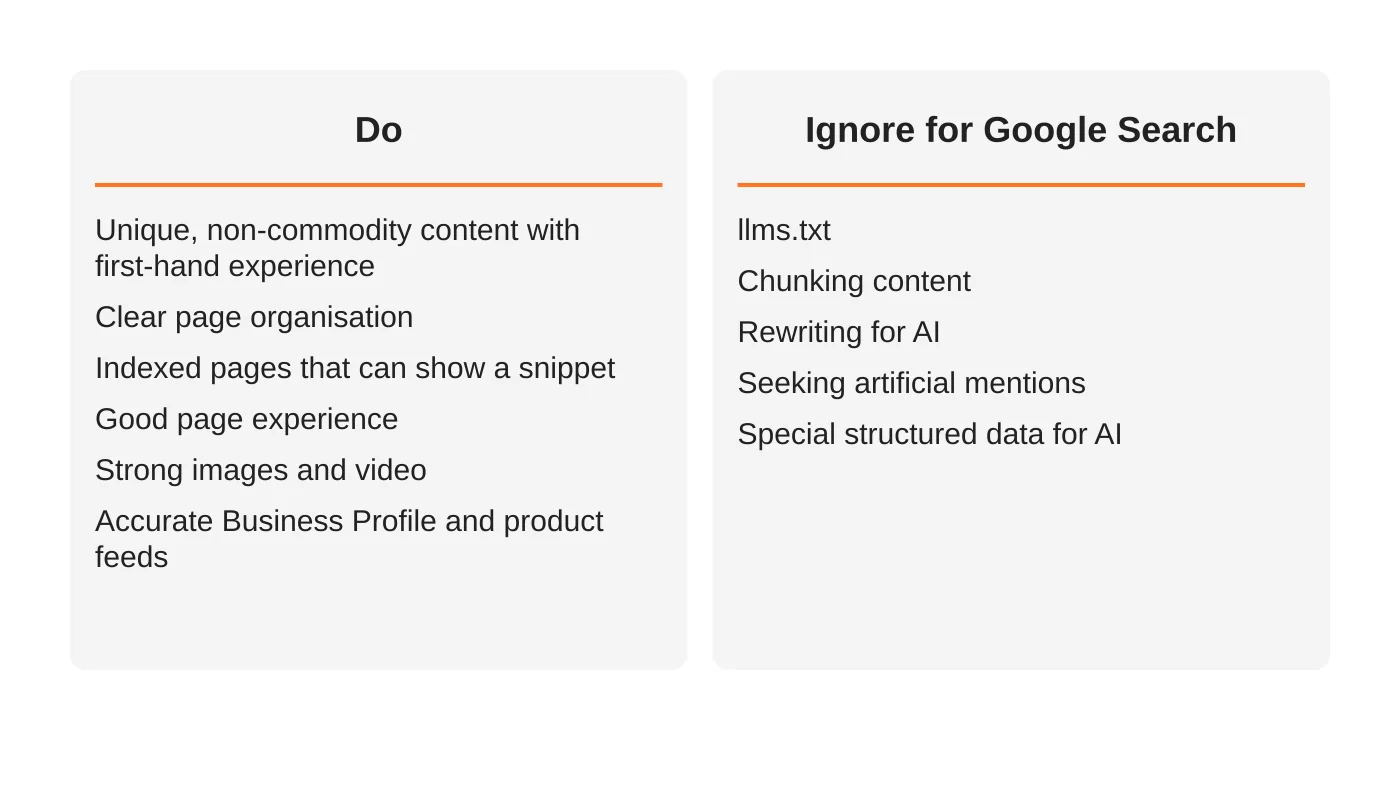
Google’s own guide to AI search says standard SEO still applies and no special markup or files are required. It asks for content with a unique viewpoint, correct technical basics and accurate local and product data. For Google Search it lists llms.txt, chunking, rewriting for AI, artificial mentions and overfocusing on structured data as unnecessary.
- Add first-hand experience, local detail, your own photos and numbers so each page says something only your business can.
- Check that key pages are indexed and showing snippets, and open the Generative AI performance report in Search Console.
- Keep business information identical across your site and profiles, and stop paying for tactics Google says to ignore.
Many people selling “GEO” will tell you AI search needs secret tactics. Google, the biggest AI search provider, has published its own guide for website owners. It is worth reading before you spend money.
This is a plain-English summary of what the guide says, what it tells you to ignore, and how to turn it into a to-do list. It covers Google Search features only. Other AI tools work differently, which later guides in this series cover.
The main message: SEO still applies
Google’s guide says generative AI features rely on its core ranking and quality systems, so standard SEO practice still applies. It also says terms like AEO and GEO describe SEO for the new search experience. In Google’s earlier guidance on AI features, it said there are no additional requirements to appear in AI Overviews or AI Mode. First Page or Fade Out: Why SEO Just Got More Ruthless made a similar point about SEO getting more demanding, not different.
Related reading: Google’s New Broad Core Algorithm And What You Need To Know.
What Google says to do
1. Create content that is not a commodity
The guide asks for a unique viewpoint, such as first-hand experience, rather than restating what is already available. Its test is whether visitors would find the content satisfying. It warns against mass-producing pages to manipulate AI responses.
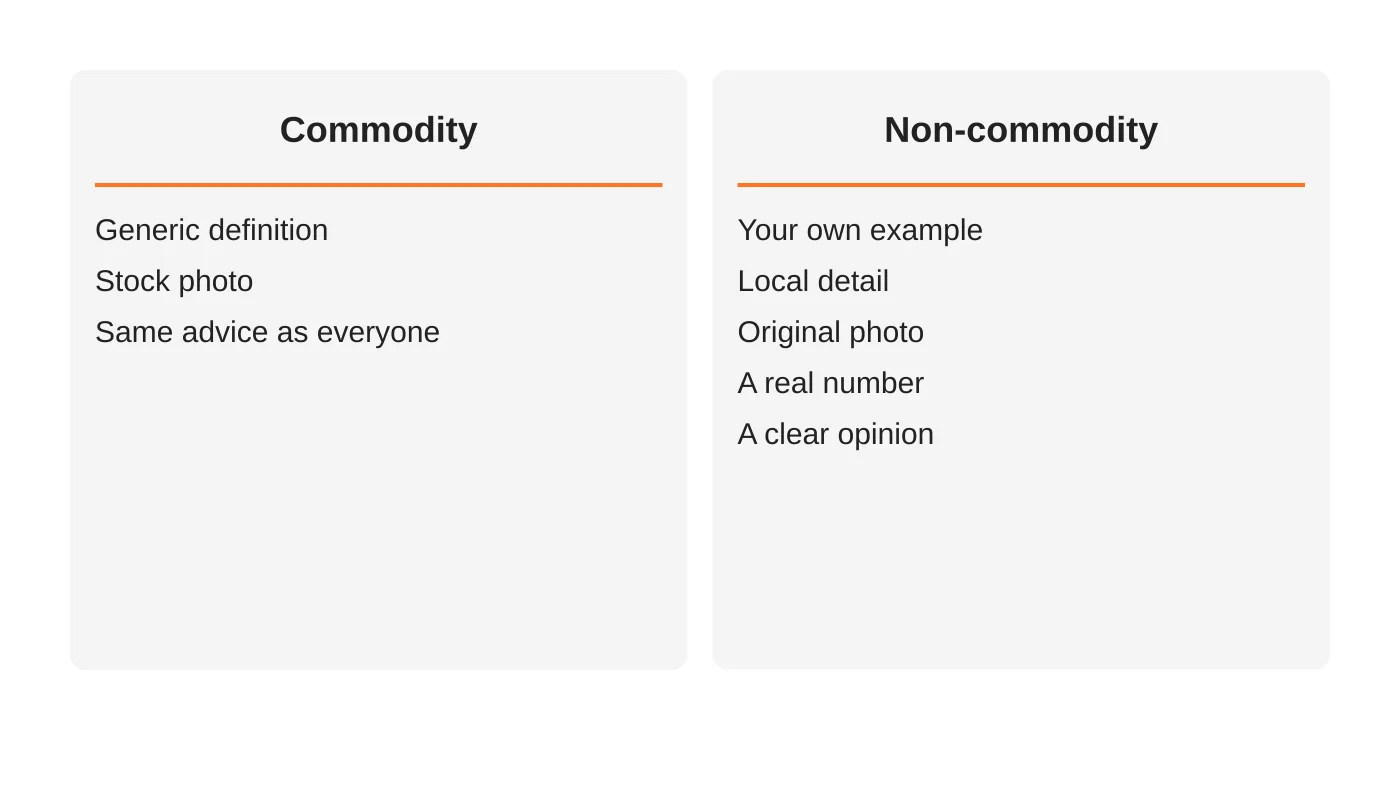
For a Davao business, that means local detail, real project examples, your own photos, your own numbers and a clear point of view. See writing content AI assistants want to cite.
2. Keep the technical basics right
Pages need to be indexed and eligible to appear in Search with a snippet. The guide keeps standard advice on crawlability, JavaScript, page experience and duplicate content. It also notes that indexing and serving are never guaranteed. See website speed and accessibility basics.
3. Organise pages clearly and use good images and video
Clear headings, scannable sections and high-quality media help people and machines understand a page.
4. Keep local and product data accurate
The guide points to Google Business Profiles and Merchant Center feeds as ways businesses and products can appear in AI responses. See the Google Business Profile guide and the product page checklist.
What Google says to ignore
For Google Search, the guide lists these as unnecessary:
- llms.txt and similar files. Google Search does not use them. See do you need an llms.txt file.
- Chunking. You do not need to split content into tiny pieces, and there is no ideal page length.
- Rewriting content for AI. Systems understand synonyms and intent, so you do not need to chase every variation.
- Artificial mentions. Fake or manufactured mentions do not help, and spam systems work against manipulation.
- Overfocusing on structured data. It is not required for generative AI search and no special markup is needed, though Google still recommends it for rich results. See schema markup for AI search.
What it says about measurement and tools
The guide points to the Generative AI performance report in Search Console. It also warns against third-party tools that promise ranking success or claim access to internal Google metrics. See GEO agency red flags.
Turn it into a checklist
- Are my key pages indexed and showing snippets?
- Does each page contain something only my business can say?
- Is my business information identical across my site and profiles?
- Are my images mine, and are they clear?
- Have I opened the Search Console AI report?
- Have I stopped paying for tactics Google says to ignore?
Frequently asked questions
Does this apply to ChatGPT and Perplexity?
The guide is about Google Search. Other tools use their own systems, so treat it as strong evidence for Google and a useful baseline elsewhere.
Is there anything I must add to my site?
No special file or markup is required for Google’s AI features.
Why do agencies still sell special tactics?
Some tactics may help on other platforms, and some are simply easy to sell. Ask for evidence.
Will Google change the guide?
Probably. Check it on the date you act.
From the Wired for Growth newsletter
This guide builds on First Page or Fade Out: Why SEO Just Got More Ruthless from Duarne Bernhagen’s LinkedIn newsletter, Wired for Growth.
Sources
- Optimizing your website for generative AI features on Google Search, Google Search Central
- AI features and your website, Google Search Central
Put the guide into practice
Web Design Davao’s SEO team can turn the checklist into a plan for your site. Talk to us.


