

Quick answer
Match staffing capacity to a measured workload, not budget or gut feeling. Track the tasks you want to delegate for two to four weeks, including review time, account for peaks and absence, then compare part-time, full-time and shared support against that pattern. Pilot with a written scope and review fit after a few weeks.
- Include time spent explaining and reviewing, not just doing, and separate steady work from occasional work.
- Part-time suits steady, smaller work; full-time suits a steady, full workload; shared suits variable tasks but needs written commitments.
- Check the written agreement for hours, availability, replacement, notice and data rather than relying on a verbal summary.
Owners often decide staffing capacity by budget or gut feeling and discover a few months later that they bought too much or too little. A simple workload measure leads to a better choice among part-time, full-time and shared support.
All figures here are hypothetical, and nothing in this guide implies any provider offers a particular model. Shared support availability must be confirmed in writing for any arrangement. For costs, see virtual assistant cost in the Philippines and for who manages the work, managed versus self-managed offshore teams.
Step 1: measure task demand
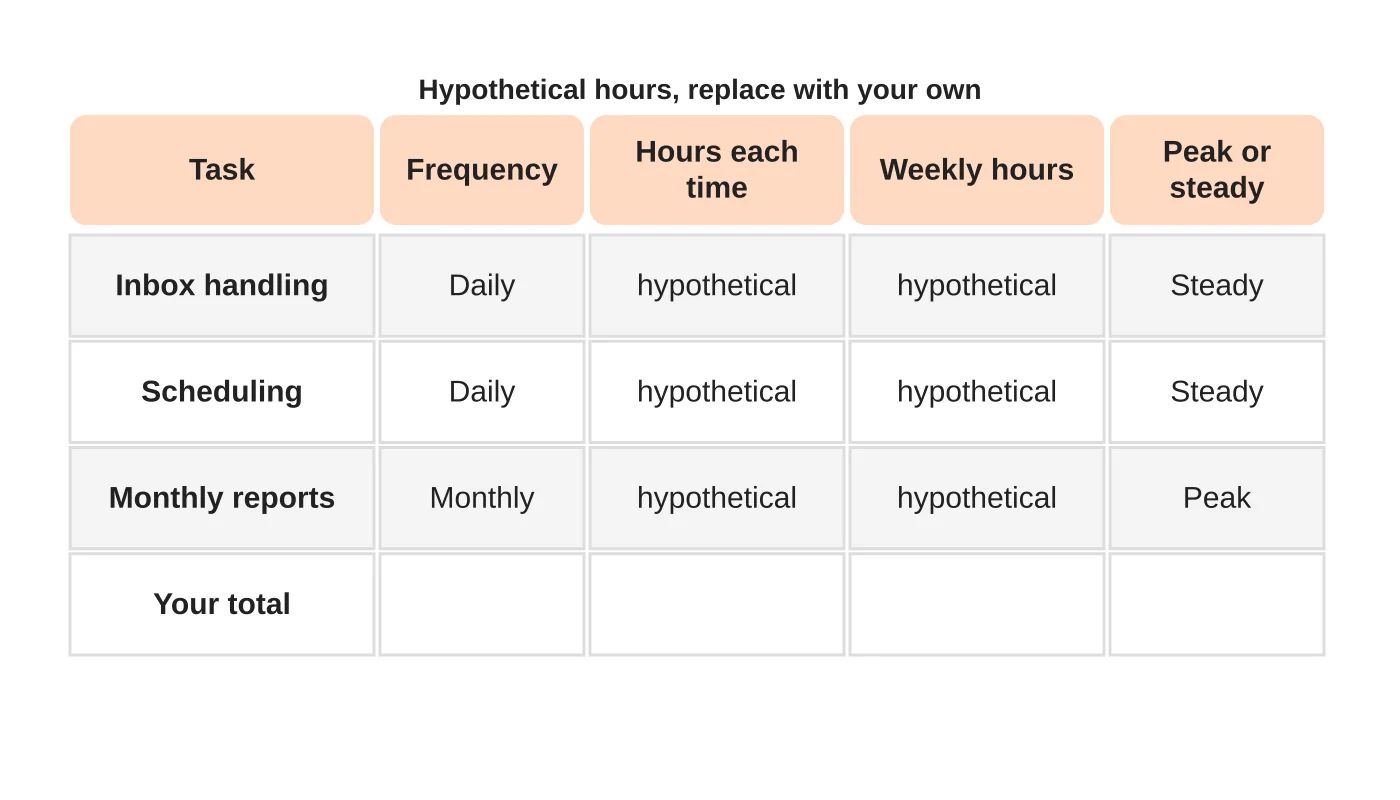
Track the work you want to delegate for two to four weeks: each task, how often and how long it takes. If you cannot track it, estimate and mark it as an estimate. Include the time spent explaining and reviewing, not just doing. Separate steady work from occasional work.
Related reading: How AI and Offshore Staffing Combine to Cut Costs Without Cutting Corners.
Step 2: account for peaks and cover
Workloads rise at month end, in seasons and around campaigns. Decide whether to staff for the average, the peak or something between, and what happens in a peak: overtime, delay or extra help. Also consider absence: leave, illness and resignation. See backup coverage. A model with no cover has a hidden cost.
Step 3: compare capacity models
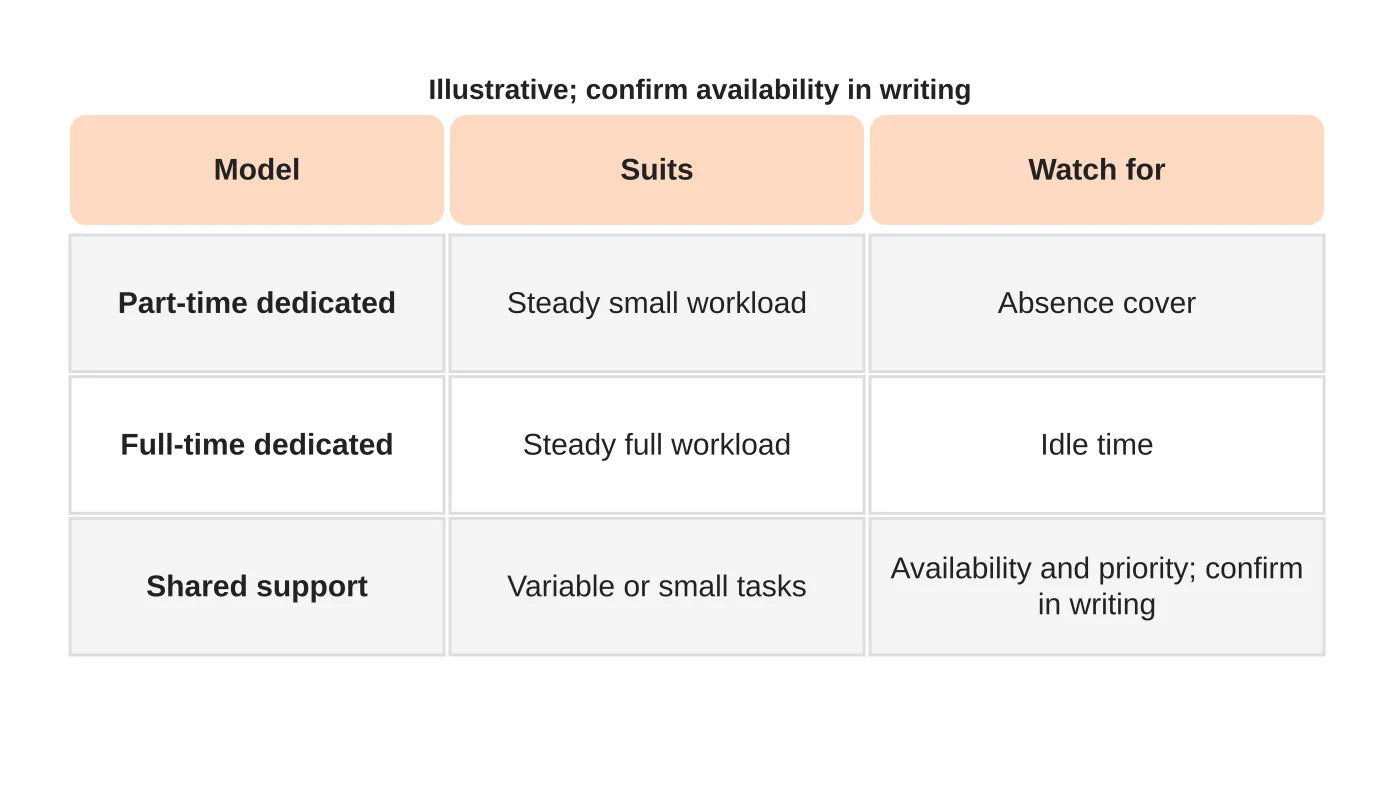
- Part-time dedicated: suits a steady, smaller workload. Check what happens during absence.
- Full-time dedicated: suits a steady, full workload and deeper context. Check that there is enough work.
- Shared support: suits variable or small tasks, but you need clarity on availability, priority and who knows your business. Confirm what is committed in writing.
None is best by default. Match the model to the pattern of work. For role choices, see project coordinator or executive assistant.
Related reading: Administrative Support for Plumbing Bookings and Customer Updates.
Step 4: pilot and review fit
Start with a limited pilot and a written scope: tasks, hours, hours of availability, how requests are made and how success is judged. Review after a few weeks. Were the hours enough? Was there idle time? What took longer than expected? Adjust the model or the scope. See a KPI scorecard.
Step 5: plan growth
As trust builds, you may shift tasks or add capacity. Document processes so scaling does not depend on memory. See writing SOPs.
Check the written scope
Before committing, check what the agreement says about hours, availability, replacement, notice and data. Do not rely on a verbal summary.
Frequently asked questions
How many hours do I need?
Measure your own tasks; do not copy another business’s number.
Is shared support cheaper?
It can be, depending on the arrangement. Compare the written scope, not only price.
Can I change later?
Often, with notice. Check the terms.
Should I pilot first?
Yes, if the arrangement allows it.
Sources
Match capacity to your work
Web Design Davao’s outsourced staffing team can discuss which capacity model could suit your workload. Get in touch.


