

Quick answer
Choose self-managed if you have time to brief and review regularly and want direct control of how tasks are done. Choose managed if you lack management time or need cover, replacement and someone accountable for results. A lower rate is not a lower cost, so compare your own time, rework and replacement.
- Avoid half-control: hold the responsibility without a system and you pay in rework and worry.
- Ask any provider who manages your person daily, what happens if they leave, and the contract terms and exit conditions.
- If unsure, start managed for a few months, document the work, then decide whether to move it in-house.
When you decide to work with a team in the Philippines, the first question is who manages them. You can hire people yourself and run them day to day, or you can use a provider that manages the team and is accountable for delivery. Both work. They suit different businesses.
Why Most Outsourcing Fails: Hidden Costs of Half-Control argues that most outsourcing fails because of hidden costs of half-control, and Your First Outsourced Hire Shouldn’t Be a Doer. It Should Be a Decoder. suggests the first outsourced hire should be a decoder, not a doer. This guide turns those ideas into a clear comparison.
What each model means
Self-managed
You recruit or contract the person, brief them, assign work, review it and handle day-to-day issues. You may use a platform or a recruiter to find them. You carry the management.
Managed
A provider employs or contracts the team and manages them: supervision, training, cover and replacement. You set the goals and review the output, while the provider is accountable for delivery. The details vary by provider, so ask for them in writing.
There is a hybrid too: a managed provider handles hiring, equipment and management, while you direct the work closely, as if they were part of your team.
How the models compare
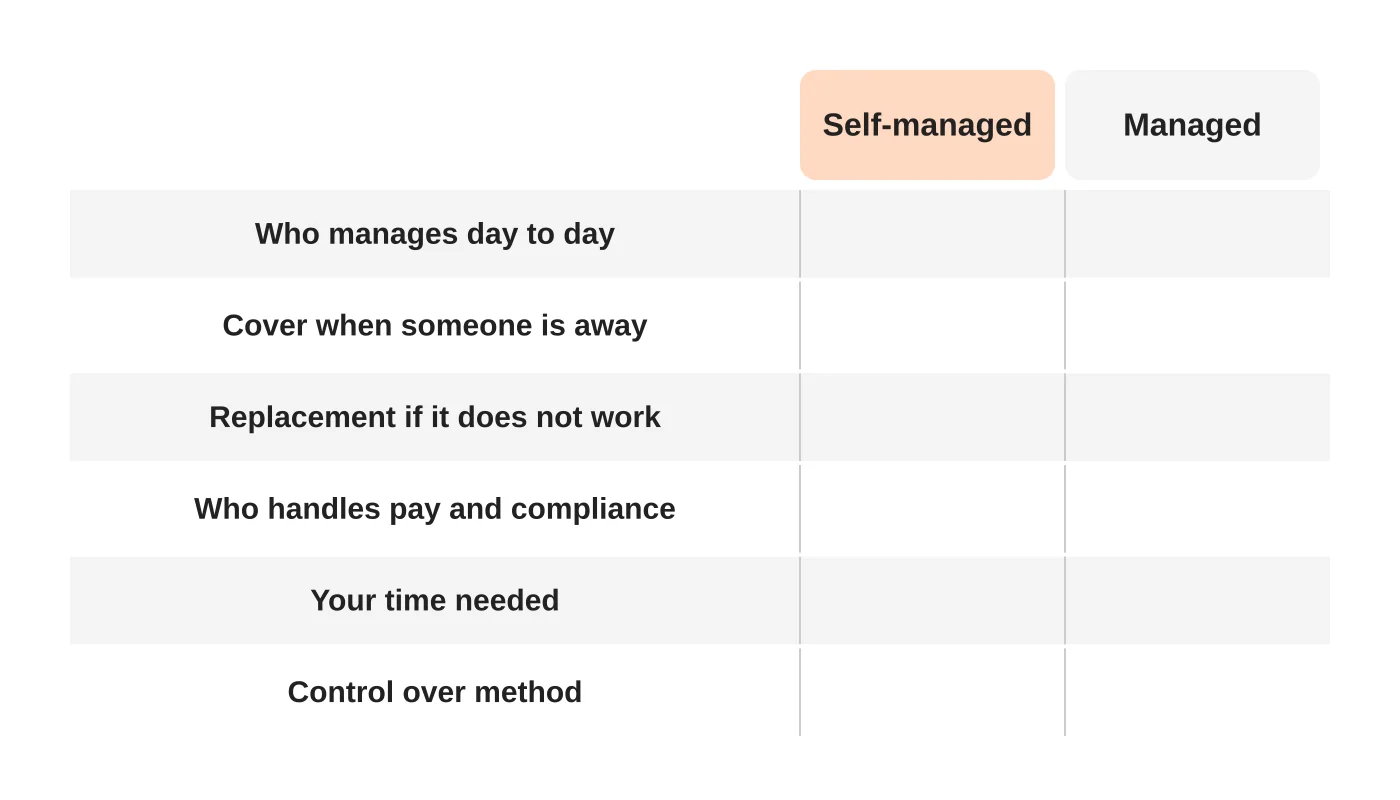
| Factor | Self-managed | Managed |
|---|---|---|
| Day-to-day management | You | Provider, with you setting goals |
| Cover when someone is away | You find it | Provider arranges |
| Replacement if it does not work | You restart the search | Provider handles |
| Pay, benefits and compliance | You or an employer-of-record arrangement | Provider |
| Your time needed | High at the start, then moderate | Lower |
| Control over method | High | Shared, agreed in the brief |
| Typical cost | Lower fee, higher hidden cost in your time | Higher fee, lower hidden cost |
Those last two lines are the heart of it. A lower rate is not the same as a lower cost. What a virtual assistant costs in the Philippines explains the full cost, and how to measure the ROI of a virtual assistant shows how to compare them.
Plan ahead for leave and illness with backup coverage for your virtual assistant.
Related reading: Outsourced Staffing Benefits | Philippines Offshore Solutions.
The “half-control” problem
The trap Why Most Outsourcing Fails: Hidden Costs of Half-Control warns about is being in the middle: you hold the responsibility but not the system. You hire someone without a clear process, then supervise irregularly, correct late and discover problems when a customer complains. You pay in rework and worry.
Full control of a self-managed assistant means briefing, reviewing and giving feedback every week. Full delegation to a managed provider means defining outcomes, checking results and trusting the provider’s process. Both work. The half-and-half version is where outsourcing fails.
Which model fits
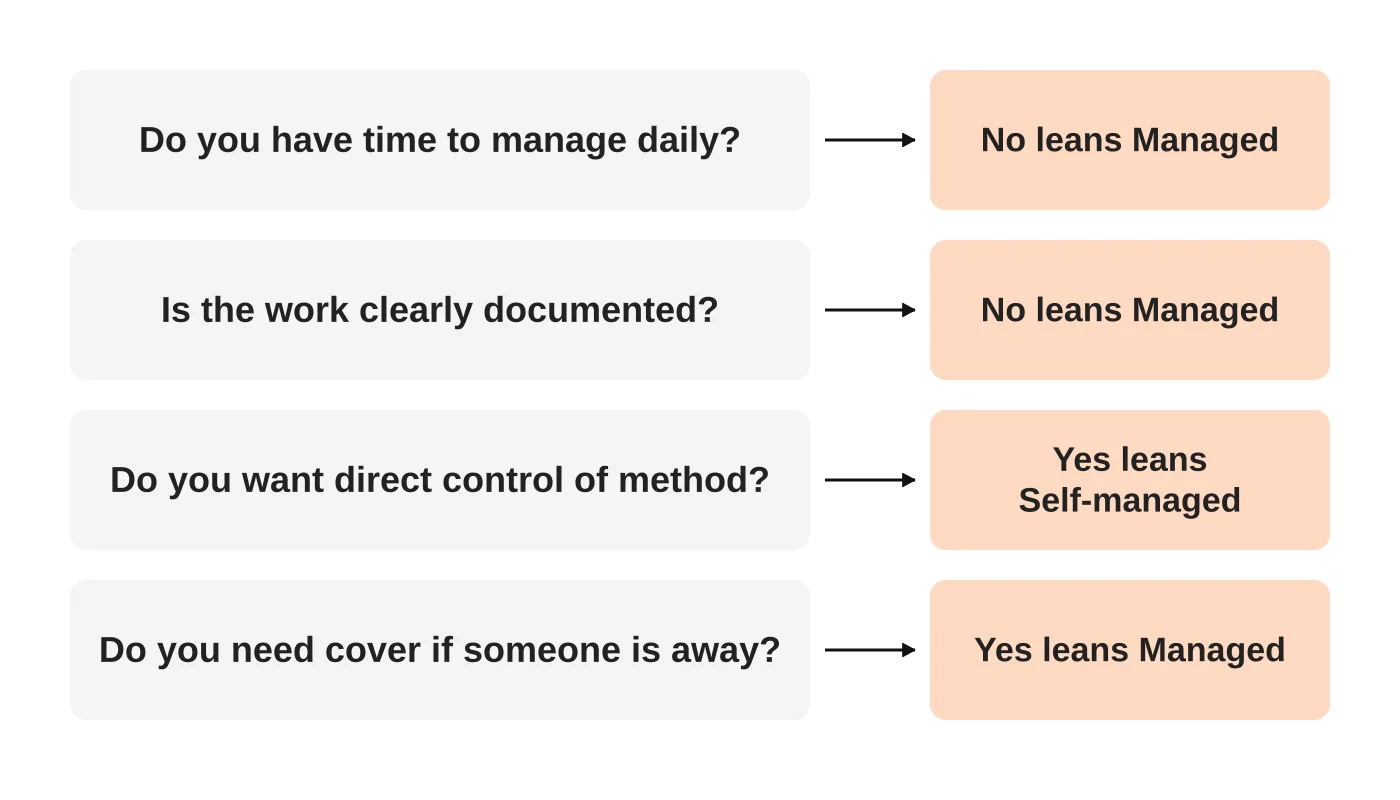
Choose self-managed when:
- You have time to brief and review regularly.
- The work is documented or you are willing to document it. See how to write SOPs.
- You want direct control of how tasks are done.
- You have a single role with steady work.
Choose managed when:
- You do not have management time, or you are the bottleneck. See the owner bottleneck audit.
- You need cover, replacement and consistency.
- You need several skills or may need to scale.
- You want someone accountable for results.
If you are unsure, start managed for a few months, document the work and decide later whether to move it in-house.
Questions to ask any provider
- Who manages my team member day to day, and how many people do they manage?
- What happens if the person is sick, leaves or is not a fit?
- How do you screen, train and monitor your staff?
- What security controls do you use, and how do I keep ownership of my accounts and data?
- Who is the employer, and how are pay, leave and compliance handled? This is general information, not legal advice. Check your situation with a qualified adviser.
- What are the contract terms, minimum commitment and exit conditions?
- Can I speak to a current client?
Protect yourself in either model
- Access: use least privilege and your own accounts. See the offboarding checklist.
- Privacy: if your team sees customer information, apply the Data Privacy Act checklist.
- AI tools: set rules in an AI use policy.
- Readiness: check yourself first with before you hire a virtual assistant, and brief well using how to delegate.
- Myths: see twelve outsourcing myths for common misunderstandings.
To size the role, compare part-time, full-time and shared support.
Where structure matters most
Offshore teams succeed when roles, processes and communication are clear. Why structure matters in offshore digital teams goes deeper, and hire, automate or outsource helps you decide whether this is the right answer to start with.
Frequently asked questions
Which is cheaper?
Self-managed usually has the lower fee. Managed often has the lower total cost once you count your time, rework and replacement.
Can I switch later?
Often yes, but check notice periods and any buy-out or non-solicit terms.
What about legal and tax issues?
They depend on the structure and where each party is located. Take advice before you sign. This guide does not cover them.
Who owns the work?
Your contract should say so. Make sure the work, files and accounts belong to you.
What if I only need a few hours a week?
A shared or managed arrangement often fits better than a single dedicated hire.
From the Wired for Growth newsletter
This guide builds on Why Most Outsourcing Fails: Hidden Costs of Half-Control and Your First Outsourced Hire Shouldn’t Be a Doer. It Should Be a Decoder. from Duarne Bernhagen’s LinkedIn newsletter, Wired for Growth.
Talk to us
Web Design Davao’s virtual staffing team can explain how a managed team would work for you. Book a conversation.


