

Quick answer
Start with the work, not the role. Ask five questions: does it need doing at all, is it rules-based and repeatable, can it be written down as steps, does it need your judgement, and is the volume steady enough for a full-time role. The answers point to removing, automating, outsourcing or hiring.
- Track a week of tasks first to see volume, repeatability and how much needs your judgement.
- Keep pricing, key clients, staff management and strategy with you or a senior hire; others prepare the ground.
- Check your management first: if priorities change daily or decisions wait for you, a new hire inherits the same problem.
A job is open, or someone is overwhelmed, and the instinct is to hire. Sometimes that is right. Often the work does not need a new employee: it needs removing, simplifying, automating or handing to someone who does it as part of a team.
Before You Hire That Next Role—Ask What AI Can Do First asks you to consider what AI can do before you hire, and Your Next Hire Won’t Fix Your Management Problem warns that a new hire will not fix a management problem. This guide turns both ideas into a five-question framework.
Start with the work, not the role
“We need an admin assistant” describes a person. “We need invoices sent, bookings confirmed and emails sorted” describes the work. Write the work down first, in tasks. Three things then become visible: how much there really is, how repeatable it is and how much of it needs your judgement.
Before the framework, do one exercise: track a week of your own and your team’s tasks. The owner bottleneck audit gives a simple method.
The five questions
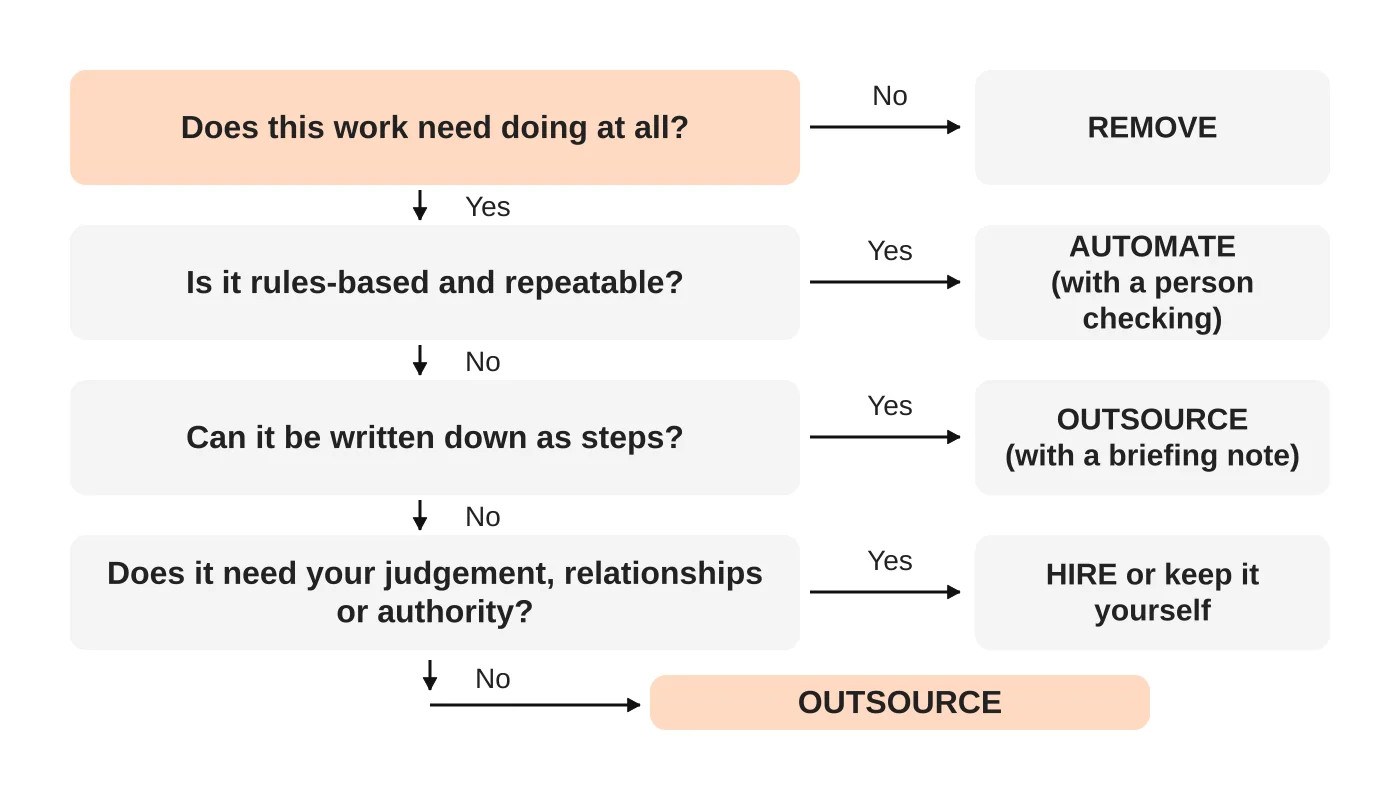
1. Does this work need doing at all?
Reports nobody reads, meetings with no decision and duplicate entry are common. Remove them first. It is the cheapest option and often the most overlooked.
2. Is it rules-based and repeatable?
If the same steps happen the same way each time, such as moving data between systems, sending reminders or formatting documents, automation or AI assistance may do most of it. Keep a person checking the results. How to choose AI tools for your business explains how to pick without wasting budget.
3. Can it be written down as steps?
If you can document how it is done, a trained person can do it, whether in-house or outsourced. Writing it down is the work. How to write SOPs a virtual assistant can follow shows how.
4. Does it need your judgement, relationships or authority?
Setting prices, handling a key client, managing staff and making strategy calls usually stay with you or a senior hire. A cheaper helper can prepare the ground, not make the decision.
5. Is the volume steady enough for a full-time role?
If the work fills most of a week, every week, a hire may fit. If it is uneven, a flexible arrangement or a managed service often costs less than idle time.
Related reading: The Smart Way to Outsource Web Development Without Sacrificing Quality.
How the four options compare
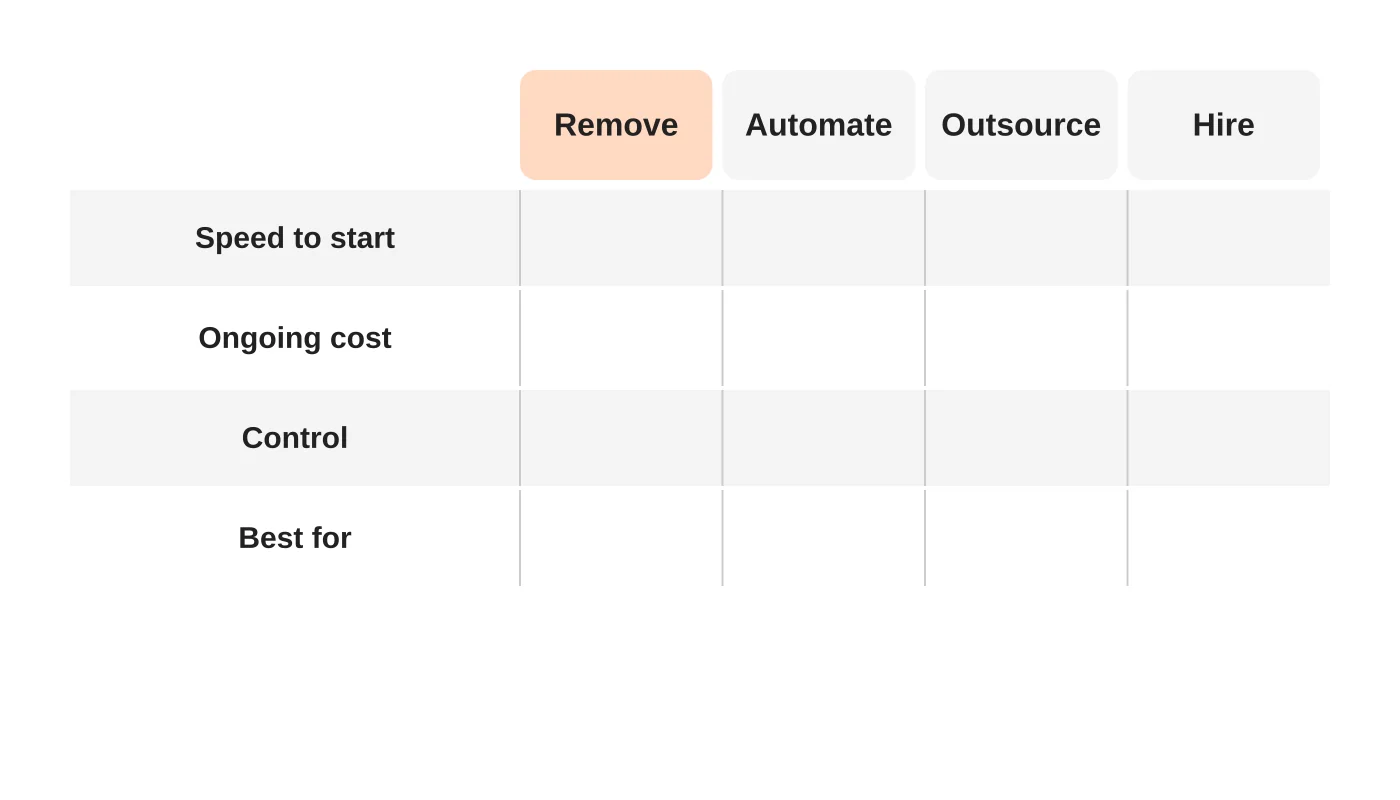
| Option | Best for | Watch out for |
|---|---|---|
| Remove | Work with no real purpose | Removing something others rely on |
| Automate | Repeatable, rules-based tasks | Setup effort; errors that scale quickly |
| Outsource | Documented tasks with steady volume | Unclear briefs; weak handover |
| Hire | Judgement, culture, customer-facing or leadership work | Long commitment; management time |
You can combine them. A common pattern is to remove what you can, automate the repeatable parts, outsource the documented tasks and hire for the judgement-heavy ones.
Related reading: Following Up Roofing Quotes: Inspection Notes, Customer Questions and Next Steps.
The management check
Your Next Hire Won’t Fix Your Management Problem makes a point worth testing: if projects are late because priorities change daily, roles are unclear or decisions wait for you, a new hire will inherit the same problem. Ask yourself:
- Do I know what “done” looks like for each task?
- Do I have a place where work and priorities are written down?
- Do I make decisions quickly, or do people wait?
- Have I got a routine for checking work?
If the answers are no, fix them first. Before you hire a virtual assistant and how to delegate to a virtual assistant cover readiness and handover.
Outsourcing options
If the answer points to outsourcing, choose the model deliberately. Managed or self-managed offshore teams compares them, and what a virtual assistant costs in the Philippines explains the real cost, not just the rate. For the longer view of working with Philippine teams, see why structure matters in offshore digital teams.
A worked example
A Davao accounting practice is busy at month end. The work: chasing documents from clients, entering invoices, reconciling accounts, preparing reports and advising clients.
- Remove: a weekly status report nobody reads.
- Automate: document reminders and bank feed imports.
- Outsource: invoice entry and reconciliation, using written steps, with the senior accountant reviewing.
- Hire or keep: client advice and sign-off.
The result is one fewer hire than planned, and the senior person spends more time on advice. This example is illustrative, and your numbers will differ.
Frequently asked questions
Isn’t hiring always more reliable?
Not always. A poorly managed hire is less reliable than a well-briefed outsourced team or a stable automation.
What if I cannot document the work?
Then you probably cannot hand it over yet. Documenting it is the first job, and it helps whichever option you pick.
Will AI replace the role?
AI often takes parts of a role. Decide which parts, and who checks them. See the one-page AI use policy.
How do I decide between a hire and a team?
Look at volume, skill range and cover. One person cannot cover several skills or absences, while a team can.
When should I revisit this?
Whenever workload changes, and at least once a year.
From the Wired for Growth newsletter
This guide builds on Before You Hire That Next Role—Ask What AI Can Do First and Your Next Hire Won’t Fix Your Management Problem from Duarne Bernhagen’s LinkedIn newsletter, Wired for Growth.
Talk it through
Web Design Davao’s virtual staffing team can help you map the work and choose the right mix. Book a conversation.


